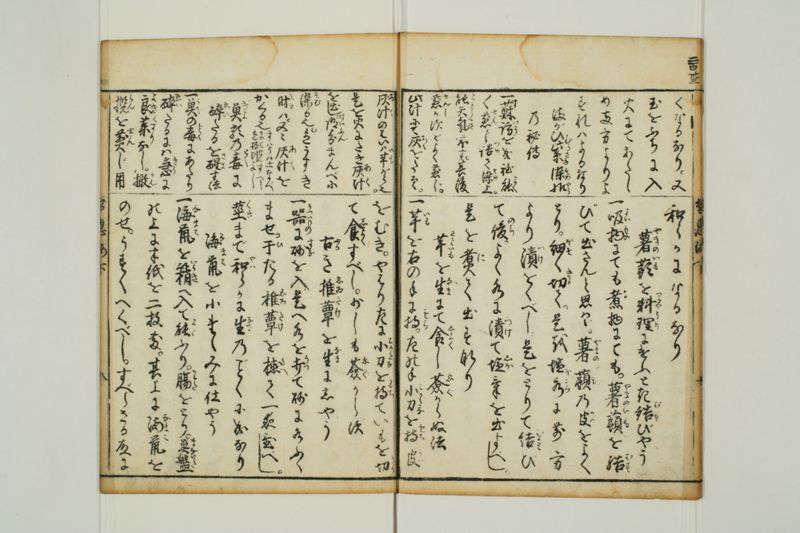
翻刻
【右丁】
【欄外上部】二百卅三
【上段】
くなるなり。又
玉をふちに入
火にてあたゝ
め両方よりよ
すれはよるなり
まがひ紫(むらさき)染(そめ)様(やう)
の秘伝
一 蘇訪(すはう)を成程 能(よく)
〳〵煎(せん)じ詰(つめ)て染(そめ)上。
能(よき)天気(てんき)にほす。其後
煎(せんし)かすをよく煎じ。
此汁にて灰(あく)をたるゝ。
【左丁・上段】
灰汁(あく)のはいは芋(いも)がら也。
是を火にたき灰汁(あく)
を出し。随分(すいふん)まんべに
染(そむ)る也。色うすき
時(とき)は。又々 灰汁(あく)を
かくる也《割書:すはうは土なべ|にてせんすへし|色格別よし》
魚(きよ)類の毒(とく)に
酔(ゑい)たるを醒(さま)す法
一 魚(うを)の毒(どく)にあたり
酔(ゑい)たるには急(きう)に
良薬(よきくすり)なし。撒(かん)
攬(らん)を煎(せん)じ用
【右丁・下段】
和らかになるなり
薯蕷(やまのいも)を料理(りやうり)に遣ふとき結(むす)びやう
一 吸物(すいもの)にても煮(に)物にても。薯蕷(やまのいも)を結(むす)
びて出さんと思はゞ。薯蕷(やまのいも)の皮(かは)をよく
とり。細(ほそ)く切(きり)て。是を塩水(▢ほみつ)に前方
より漬(つけ)をくべし。是をとりて結(むす)び
て後(のち)。よく水に漬(つけ)て塩(しほ)気を出すべし。
是を煮(に)て出すなり
芋(さといも)を生(なま)にて食(しよく)し蘞(ゑぐ)からぬ法
一 芋(いも)を右の手に持(もち)。左の手 小刀(こかたな)を持(もち)皮(かは)
【左丁・下段】
をむき。やはり左に小刀(こかたな)を持(もち)ていも切(きり)
て食(しよく)すべし。少しも蘞(ゑぐ)からず
古(ふる)き椎蕈(しゐたけ)を生(なま)にしやう
一 器(うつはもの)に砂(すな)を入。是へ水を打(うつ)て砂に水ふく
ませ。干(ひ)たる椎蕈(しゐたけ)を植(うへ)て一夜置べし。
茎(くき)まで和(やは)らかに生(なま)のごとくに成なり
海鼠(なまこ)を小たゝみに仕やう
一 海鼠(なまこ)を箱(いかき)へ入て能(よく)ふり。膓(わた)をとり。魚盤(まないた)
の上に半紙を二枚敷。其上に海鼠(なまこ)を
のせ。うすくへくべし。すべらさる故に
現代語訳
【右丁・上段】
(前ページからの続き)
(レンズが)新しくなるのである。また、玉(レンズ)を縁(ふち)に入れ、火で温め、両方から寄せれば(押し込めば)、収まるのである。
まがい紫染めの秘伝
一 蘇芳(すおう)をよくよく煎じ詰めて染め上げ、良い天気に干す。その後、煎じかす(残りかす)をよく煎じ、この汁で灰汁(あく)をたらす。
【左丁・上段】
灰汁の灰は芋がら(里芋の茎)である。これを火で焚いて灰汁を出し、十分にまんべんなく(布に)染みこませるのである。色が薄いときは、さらに灰汁をかけるのである。(割書:蘇芳は土鍋にて煎ずべし。色が格別によい。)
魚類の毒に酔ったのを醒ます法
一 魚の毒に当たって気分が悪くなったときは、すぐに効く良薬はない。(しかし)橄欖(かんらん)を煎じて用い……
【右丁・下段】
(前ページからの続き)
(鮑が)柔らかくなるのである。
山芋を料理に使うときの結び方
一 吸い物にても煮物にても、山芋を結んで出そうと思うならば、山芋の皮をよく剥き、細く切って、これを塩水にあらかじめ漬けておくべし。これを取り出して結んだ後、よく水に漬けて塩気を抜くべし。これを煮て出すのである。
里芋を生のまま食べてもえぐくない方法
一 芋を右の手に持ち、左の手に小刀を持って皮を剥き、そのまま左の手に小刀を持ったまま芋を切って食べるべし。少しもえぐくない。
【左丁・下段】
古い椎茸を生(なま)のようにする方法
一 器(うつわ)に砂を入れ、これに水を打って砂に水を含ませ、干した椎茸を(砂の中に)植えて一晩置くべし。茎まで柔らかく、生のようになるのである。
海鼠(なまこ)を小たたみに仕上げる方法
一 海鼠を笊(ざる)に入れてよく振り、腸(わた)を取り、まな板の上に半紙を二枚敷き、その上に海鼠をのせ、薄くへぐべし。(半紙を敷くことで)滑らないため……
英語訳
【Right Page, Upper Section】
(Continued from previous page)
...[the lens] will be restored to like-new condition. Furthermore, to set the lens back into its frame, insert the lens into the frame, warm it over a flame, and press from both sides — it will fit back into place.
Secret Method for Dyeing an Imitation Purple (Magaimurасaki)
- Simmer sappanwood (suō) thoroughly until well reduced, dye the cloth with it, and dry it in good weather. Afterward, boil the remaining dregs of the sappanwood again, and with this liquid drip lye (aku) onto [the cloth].
【Left Page, Upper Section】
The ash used for the lye should be made from taro stems (imogara). Burn these over a fire to produce lye, and saturate [the cloth] thoroughly and evenly. If the color is too light, apply the lye again. (Marginal note: Sappanwood should be simmered in an earthenware pot. The color will come out remarkably well.)
Method for Curing Fish Poisoning
- When one has been poisoned by fish and feels ill, there is no immediately effective remedy to hand. However, simmer Chinese olive (kanran) and use [the decoction]...
【Right Page, Lower Section】
(Continued from previous page)
...[the abalone] will become tender.
Method for Tying Mountain Yam for Use in Cooking
- Whether for clear soup (suimono) or simmered dishes, if you wish to tie mountain yam (yamaimo) into knots before serving, peel the yam well, cut it into thin strips, and soak these in salt water in advance. After removing them and tying them into knots, soak them well in fresh water to remove the saltiness. Then cook and serve.
Method for Eating Taro Raw Without the Astringent Sting
- Hold the taro in your right hand, hold a small knife in your left hand, and peel the skin. Then, still holding the knife in your left hand, cut the taro and eat it. There will be no astringent sting whatsoever.
【Left Page, Lower Section】
Method for Reconstituting Dried Shiitake Mushrooms to a Fresh State
- Place sand in a vessel, add water to the sand to moisten it thoroughly, plant the dried shiitake mushrooms into the wet sand, and leave them overnight. Even the stems will become soft, as if fresh.
Method for Cutting Sea Cucumber (Namako) into Small Flat Pieces
- Place the sea cucumber in a strainer (ikaki/zaru) and shake it well, remove the innards, lay two sheets of hanshi paper on a cutting board, place the sea cucumber on top, and then slice it thinly. Because it will not slip [on the paper]...