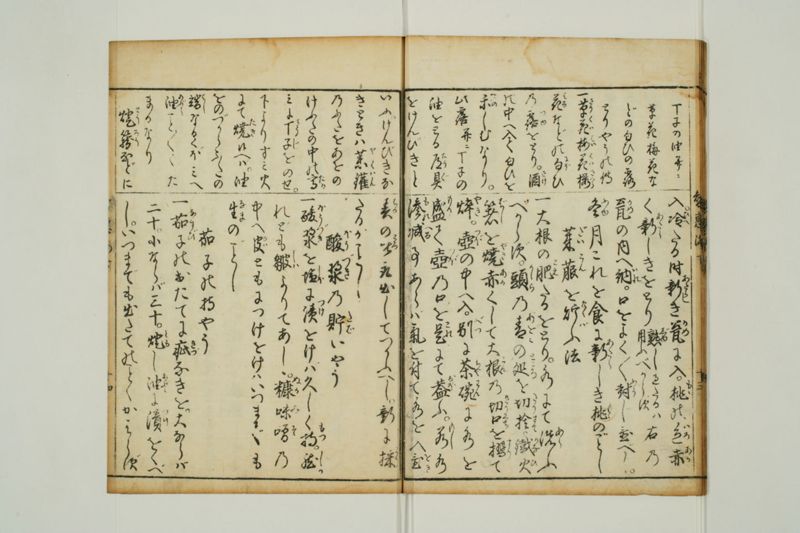
翻刻
【右丁・上段】
丁子の油《割書:幷に|》
草花梅花な
どの匂ひの露
とりやうの伝
一 草花(さうくは)梅花(はいくは)桜(さくら)
花(はな)などの匂(にほ)ひ
の露(つゆ)をとり。酒(さけ)
の中へ入て匂ひを
楽(たの)しむなり。
此露《割書:幷に|》丁子の
油をとる道具(たうぐ)
をけんびきと
【左丁・上段】
いふ。けんびきな
きときは薬鑵(やくはん)
のふたをあをの
けふたの中の高(たか)
みに丁子(てうじ)をのせ。
下よりすみ火
にて焼(たき)候へば。油
をのづからふたの
端(はし)なるくぼみへ
油(あぶら)こと〳〵〳〵た
まるなり
灯籠(とうろう)などに
【右丁・下段】
入。冷(ひへ)たる時 新(あたらし)き瓮(かめ)に入。桃(もゝ)の色(いろ)赤(あか)
く新(あたら)しきをとり《割書:熟(じゆ)し過たるは|用ふべからす》右の
■(かめ)の内へ納(いれ)。口をよく〳〵封(ふう)じ置べし。
冬(ふゆ)月これを食に新(あたら)しき桃(もゝ)のごとし
萊菔(だいこん)を貯(たくば)ふ法
一大根の肥(こえ)たるをとり。水にて洗(あら)ふ
べからず。頭(かしら)の青(あをみ)の処(ところ)を切捨(きりすて)。鉄火(かなひ)
箸(ばし)を焼(やき)赤(あか)くして大 根(こん)の切口(きりくち)を摺(すり)て
焼(やき)。壺(つぼ)の中へ入。別(べつ)に茶碗(ちやわん)に水を
盛(もり)て壺(つぼ)の口を是(これ)にて蓋(おほ)ふ。若(もし)水
滲(もれ)減(へる)事あらば気を付て水を入 置(をき)
【左丁・下段】
春(はる)の比(ころ)取出してつかふべし。新に採(とり)
たるがことし
酸漿(ほうづき)の貯(たば)いやう
一 酸漿(ほうづき)を塩(しほ)に漬(つけ)をけは久しく持(もつ)。然(しか)
れども皺(しは)よりてあしゝ。糠味噌(ぬかみそ)の
中へ皮(かは)ともにつけをけはいつまでも
生(なま)のごとし
茄子の持やう
一 茄子(なすび)の出たてに疵(きづ)なきを。大ならば
二十。小ならば三十。灯(とも)し油(あぶら)に漬(つけ)をくべ
し。いつまでも出たてのことくかはらず
現代語訳
【右丁・上段】
丁子(ちょうじ)の油、並びに
草花・梅花など
の匂いの露(つゆ)を
取る方法の伝授
一 草花・梅の花・桜の花などの匂いの露を取り、酒の中へ入れて匂いを楽しむのである。この露、並びに丁子の油を取るための道具を「けんびき」と
【左丁・上段】
いう。けんびきがない時は、薬缶(やかん)の蓋を裏返し、蓋の中の高くなった部分に丁子を乗せ、下から炭火で炙れば、油は自然と蓋の端のくぼみへと、少しずつ溜まるものである。
灯籠(とうろう)などに〔続く〕
【右丁・下段】
〔前頁より続き:桃を冬まで持たせる法〕
……入れ、冷めたら新しい瓶(かめ)に入れる。桃の色が赤く新鮮なものを選んで(熟しすぎたものは用いてはならない)、右の瓶の中へ収め、口をよくよく封じておくべし。冬にこれを食べると、新鮮な桃のようである。
大根を貯蔵する法
一 太くよく育った大根を取り、水で洗ってはならない。頭部の青みのある箇所を切り捨て、焼き火箸(かなひばし)を赤くなるまで焼いて大根の切り口に押し当てて焼き、壺の中へ入れる。別に茶碗に水を盛り、壺の口をこれで蓋をする。もし水が滲んで減ることがあれば、気をつけて水を継ぎ足しておき、
【左丁・下段】
春の頃に取り出して使うべし。新しく採ったもののようである。
酸漿(ほおずき)の貯蔵の仕方
一 酸漿(ほおずき)を塩に漬けておけば長く持つ。しかしながら皺(しわ)がよって見た目がよくない。糠味噌(ぬかみそ)の中に皮ごと漬けておけば、いつまでも生のようである。
茄子の保存の仕方
一 茄子(なすび)が出始めの傷のないものを、大きければ二十個、小さければ三十個、燈明油(とうみょうあぶら)に漬けておくべし。いつまでも出始めの頃のように変わらない。
英語訳
【Right Page, Upper Section】
Method for Extracting Clove Oil and the Fragrant Dew of Flowering Plants such as Plum Blossoms
- Take the fragrant dew from flowering plants, plum blossoms, cherry blossoms, and the like, add it into sake, and enjoy the fragrance. The implement used to collect this dew, as well as clove oil, is called a *kenbiki*.
【Left Page, Upper Section】
When a *kenbiki* is not available, turn the lid of a kettle (yakan) upside down, place cloves on the raised centre of the lid, and heat from below with charcoal fire — the oil will naturally collect, drop by drop, into the hollow at the rim of the lid.
[For use in] lanterns (tōrō), etc. [continued below]
【Right Page, Lower Section】
[Continued from previous page: Method for Keeping Peaches Until Winter]
…place into it, and once cooled, put into a new jar. Select peaches that are red and fresh (overripe ones must not be used), and place them inside the said jar; seal the mouth thoroughly and leave it. When eaten in winter, they will taste like fresh peaches.
Method for Storing Daikon Radish
- Take a well-grown, plump daikon radish and do not wash it with water. Cut off and discard the green top portion. Heat iron tongs (kana-hibashi) until red-hot, press them against the cut surface of the daikon to sear it, and then place it inside a crock. Separately, fill a tea bowl with water and use it to cover the mouth of the crock as a lid. If the water seeps away and decreases, take care to replenish it,
【Left Page, Lower Section】
and take it out for use in spring. It will be just as if freshly harvested.
Method for Storing Physalis (Ground Cherries)
- If physalis (hōzuki) are pickled in salt, they will keep for a long time. However, they will wrinkle and look unappealing. If they are pickled whole — skin and all — in nukamiso (rice-bran miso paste), they will remain as if fresh indefinitely.
Method for Preserving Eggplant
- Take eggplants (nasubi) that have just come into season and are without blemish — twenty if they are large, thirty if small — and immerse them in lamp oil (tōmyō abura). They will remain unchanged, just as they were at the beginning of the season, for as long as needed.