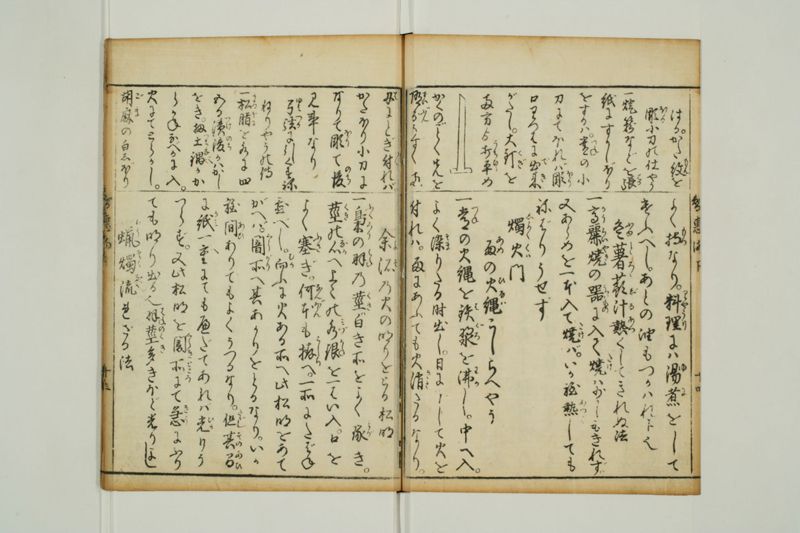
翻刻
【右丁・上段】
はる。かた紋(もん)を
彫(ほる)小刀の仕やう
一 灯籠などを張(はる)
紙にすかしぼり
をするは。常(つね)の小
刀にてほれば彫(ほり)
口りつはに出来(でき)
がたし。大 釘(くぎ)を
両方ゟ 打平(うちひら)め
【図あり】
かくのごとく先を
随分(ずいぶん)うすく両
【左丁・上段】
刃(は)にとぎ付(つく)れば。
かたほり小刀に
なりて彫(ほり)て後(のち)
見事なり
弓(ゆみ)弦(つる)に引くすね
ねりやうの伝
一 松脂(まつやに)を水に四
五日 漬(つけ)後(のち)かはかし
をき。扨 土鍋(つちなべ)かか
らかねなべかに入。
火にてとらかし。
胡麻(ごま)の白しぼり
【右丁・下段】
よく持(もつ)なり。料理(りやうり)には湯煮(ゆに)をして
遣ふべし。あとの油もつかはれ候也
冬(ふゆ)薯蕷汁(とろゝじる)熱(あつ)くしてきれぬ法
一 高麗焼(かうらいやき)の器(うつはもの)に入て焼(たけ)は少しもきれず。
又あらめを一本入て焼(たけ)ば。いか程 熱(あつく)しても
ねばりうせず
燭火(しよくくは)門
雨(あめ)の火縄(ひなは)こしらへやう
一 常(つね)の火縄を鉄漿(はぐろ)を沸(わか)し。中へ入。
よく染(そま)りたる時出し。日にほして火を
付れは。雨にあふても火 消(きえ)さるなり。
【左丁・下段】
余所(よそ)の火の明りをとる松明
一 梟(ふくろう)の羽(はね)の茎(くき)。白き所をよく琢(みが)き。
茎(くき)の心(なか)へ上々の水銀(みづかね)を一はい入。口を
よく塞(ふさ)ぎ。何本(なんぼん)も拵(こしら)へ。一所にたばね
置べし。向(むか)ふに火ある所へ此松明をあて
がへば。闇所(くらがり)へ其あかりをとるなり。いか
程 間(あひ)ありてもよくうつるなり。但(たゞし)其(その)間(あひ)
に紙(かみ)一 重(へ)にてもへだてあれば光(ひか)りう
つらず。又此松明を闇所(くらきところ)にて急(きう)にふり
ても明り出る也 羽茎(はねのくき)多きほど光りよし
蠟燭(らうそく)流(なが)れざる法
現代語訳
【右丁・上段】
張り・型紋(かたもん)を
彫る小刀の作り方
一 灯籠などを張る紙に透かし彫りをするには、普通の小刀で彫ると彫り口がきれいに仕上がりにくい。大きな釘を両側から打ち平らにして、
〔図あり:釘を打ち平らにした形状の図〕
このように先をなるべく薄く、両
【左丁・上段】
刃(りょうば)に研いで仕上げれば、型彫り用の小刀になって、彫った後が見事に仕上がる。
弓の弦(つる)に引く脂(やに)の
練り方の伝授
一 松脂(まつやに)を水に四、五日漬けた後、乾かしておく。それから土鍋か唐金(からかね)鍋に入れ、火で溶かして、胡麻(ごま)の白搾り(しろしぼり)〔の油〕
【右丁・下段】
〔前頁より続き:茄子の保存について〕
よく保つ。料理には湯煮(ゆに)にして使うべし。後に残った油も使えるものである。
冬に薯蕷汁(とろろじる)を熱くしても切れない法
一 高麗焼(こうらいやき)の器に入れて煮れば、少しも切れない(粘りが失われない)。また荒布(あらめ)を一本入れて煮れば、どれほど熱くしても粘りがなくなることはない。
燭火(しょくか)の門
雨の中でも消えない火縄の作り方
一 普通の火縄を、お歯黒(はぐろ)の液を沸かしてその中へ入れ、よく染まったら取り出し、日に干して火をつければ、雨に当たっても火が消えないものである。
【左丁・下段】
遠くの火の明かりを取る松明(たいまつ)
一 梟(ふくろう)の羽根の茎(軸)の、白い部分をよく磨き、茎の中心へ上質の水銀(みずかね)を一杯入れ、口をよく塞いで、何本も拵えて一か所に束ねておくべし。向こうに火のある場所へこの松明を向ければ、暗がりへその明かりを取ることができる。どれほど距離があってもよく映るものである。ただし、その間に紙一重でも隔てがあれば光は映らない。また、この松明を暗い場所で急に振っても明かりが出るものである。羽根の茎が多いほど光が良い。
蝋燭(ろうそく)が流れない法
英語訳
【Right Page, Upper Section】
Method for Making a Small Knife for Carving Stencil Patterns
- When making *sukashibori* (openwork carvings) in the paper used to cover lanterns and the like, it is difficult to achieve clean, sharp cuts with an ordinary small knife. Take a large nail and hammer it flat from both sides,
[Illustration: diagram showing the nail hammered into a flat blade shape]
and then grind the tip as thin as possible into a double-edged blade on both
【Left Page, Upper Section】
sides; this will produce a small knife suitable for stencil carving, yielding a splendid finish once the carving is done.
Instructions for Making Wax to Apply to a Bow String
- Soak pine resin (*matsuyani*) in water for four or five days, then leave it to dry. Next, place it in an earthenware pot or a pot made of *karakane* (a copper-tin alloy), melt it over heat, and add white-pressed sesame oil (*shiro shibori*) —
【Right Page, Lower Section】
[Continued from previous page — regarding preservation of eggplant]
— it will keep well. For cooking, it should be boiled in hot water before use. The remaining oil afterward can also be put to use.
Method for Heating *Tororo-jiru* (Grated Yam Soup) in Winter Without It Breaking
- If placed in a *Kōrai-yaki* (Korean-style ceramic) vessel and heated, it will not break (lose its viscosity) at all. Also, if one stalk of *arame* (a type of kelp) is added and heated, no matter how hot it becomes, the viscosity will not be lost.
Chapter on Candles and Fire
Method for Making Rain-Proof Fire Rope (Fuse Cord)
- Bring *haguro* (tooth-blackening liquid) to a boil and place an ordinary fire rope (*hinawa*) into it. Once well saturated, remove it, dry it in the sun, and light it — even when exposed to rain, the fire will not go out.
【Left Page, Lower Section】
A Torch for Capturing Distant Light
- Take the shafts of owl feathers, polish the white portions well, fill the hollow centre of each shaft to the brim with the finest quality mercury (*mizukane*), seal the openings tightly, prepare a number of them, and bind them together in a bundle. When this torch is aimed toward a place where there is a fire in the distance, it will bring that light into a dark place. No matter how great the distance, the light transfers well. However, if even a single layer of paper stands between the torch and the fire, the light will not transfer. Furthermore, if this torch is shaken briskly in a dark place, it will also emit light on its own. The more feather shafts used, the brighter the light.
Method for Preventing a Candle from Dripping