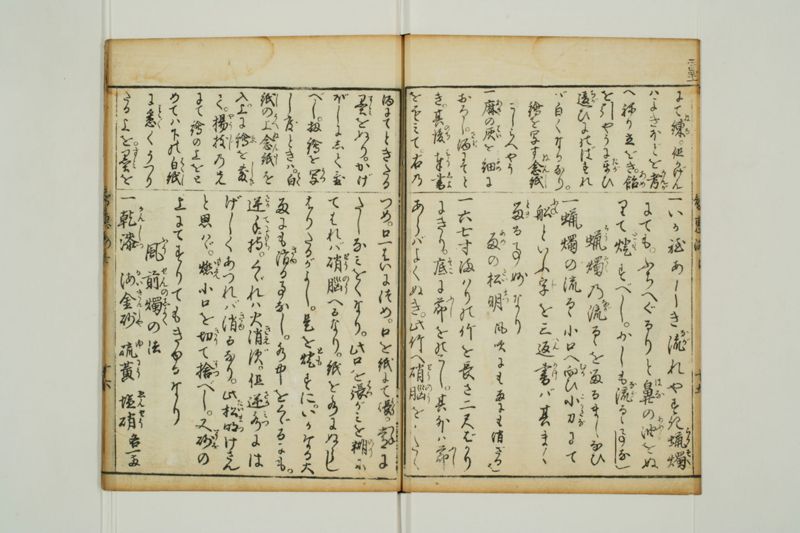
翻刻
【右丁】
【欄外上部】二百四十一
【上段】
にて練(ねる)。但かげん
はよきほどを考(かんが)
へねり立をき。飴(あめ)
を引やうに互(たが)ひ
違(ちが)ひにのばすれ
ば白くなるなり。
絵を写す念紙(ねんし)
こしらへやう
一 麻(あさ)の灰(はい)を細(こまめ)に
おろし。酒(さけ)にてと
き。其 後(のち)奉書(はうしよ)
をもみて。右の
【左丁・上段】
酒にてときたる
墨(すみ)をぬり。かげ
ぼしにして置
べし。扨絵を写(うつ)
し度ときは。白(はく)
紙(し)の上(うへ)念紙(ねんし)を
入。上に絵(ゑ)を敷(しき)
て。楊枝(やうじ)の先
にて絵の上をと
めては下の白紙(はくし)
に悉(こと〳〵)くうつり
たる上を。墨(すみ)を
【右丁・下段】
一いか程あしき流(なが)れやすき蠟燭(らうそく)
にても。ふつへぐるりと鼻(はな)の油(あふら)をぬ
りて灯(とも)すべし。少しも流(なが)るゝ事なし
蠟燭(らうそく)の流(なが)るゝを留るましなひ
一蠟燭の流るゝ小口へ向(むか)ひ小刀(こかたな)にて
舩(ふね)といふ字(じ)を三 返(へん)書(かけ)ば其まゝ
留(とま)る事妙なり
雨(あめ)の松明(たいまつ)風吹にも雨にも消ざる也
一六七寸まはりの竹を長さ二尺ばかり
にきり。底(そこ)に節(ふし)をのこし。其外は節(ふし)
あらばよくぬき。此竹へ硝脳(せうのう)を▢たく
【左丁・下段】
つめ。口一はいにつめ。口を紙にて張(はり)。常(つね)に
たしなみをくなり。此口を張(はつ)がみを糊(のり)に
てはれば硝脳(せうのう)へるなり。紙を水にぬらし
はりたるがよし。是を灯(とも)すに。いかなる大
雨にも消(きゆ)る事なし。水中をくゞるにも。
逆手(さかてに) ̄ニ持(もち)。くゞれは火 消(きえ)ず。但 逆水(さかみつ)には
げしくあつれば消(きゆ)るなり。此 松明(たいまつ)けさん
と思はゞ。燃(もえ)小口を切(きり)て捨(すつ)べし。又 砂(すな)の
上にてすりてもきゆるなり
風前燭(ふうせんのしよく)の法
一 乾漆(かんしつ) 海金砂(かいきんしや) 硫黄(ゆわう) 塩硝(ゑんせう)《割書:各一両|》
現代語訳
【右丁・上段】
(前頁より続き:弓の弦に引く脂の練り方)
で練る。ただし、加減は良い具合を考えながら練り上げておき、飴を引くように互い違いに延ばせば白くなるものである。
絵を写す念紙(ねんし)の
作り方
一 麻の灰を細かく下ろし、酒で溶く。その後、奉書紙(ほうしょがみ)を揉んで、右の
【左丁・上段】
酒で溶いた〔灰を混ぜた〕墨を塗り、陰干しにしておくべし。さて、絵を写したいときは、白紙の上に念紙を置き、その上に絵を敷いて、楊枝の先で絵の上をなぞれば、下の白紙にことごとく写り、その上から墨を
【右丁・下段】
(前頁より続き:蝋燭が流れない法)
一 どれほど垂れやすい(質の悪い)蝋燭であっても、鼻の油をぐるりと〔芯の周りに〕塗ってから灯せばよい。少しも垂れることがない。
蝋燭の垂れるのを止めるまじない
一 蝋燭の垂れている小口に向かい、小刀で「舩(船)」という字を三度書けば、そのまま止まることが不思議なほどである。
雨の松明——風が吹いても雨が降っても消えない
一 六、七寸まわりの竹を長さ二尺ほどに切り、底に節を残し、それ以外の節があればよく抜いておく。この竹へ樟脳(しょうのう)を〔できる限り〕た
【左丁・下段】
くさん詰め、口いっぱいに詰めて、口を紙で張っておくのである。日頃から用意しておくものである。この口を張る紙を糊で貼ると樟脳が減ってしまう。紙を水に濡らして貼るのがよい。これを灯すと、いかなる大雨にも消えることがない。水中をくぐるときも、逆手(さかて)に持ってくぐれば火は消えない。ただし、逆流(激流)に激しく当たると消えるものである。この松明を消したいと思うならば、燃えている小口を切って捨てるべし。また、砂の上でこすっても消えるものである。
風前燭(ふうぜんしょく)の法〔風の前でも消えない灯火の法〕
一 乾漆(かんしつ)・海金砂(かいきんしゃ)・硫黄(いおう)・塩硝(えんしょう)〈各一両〉
英語訳
【Right Page, Upper Section】
(Continued from previous page: Instructions for Making Wax to Apply to a Bow String)
— knead with [white-pressed sesame oil]. However, kneading to just the right consistency is important; work it until it is ready, then stretch it alternately in opposite directions as one pulls taffy, and it will turn white.
Method for Making Tracing Paper (*Nenshi*) for Copying Drawings
- Grind hemp ash finely, dissolve it in sake, then knead a sheet of *hōsho* paper (a high-quality Japanese paper), and apply the above
【Left Page, Upper Section】
— ash dissolved in sake [mixed with ink] — to it, then leave it to dry in the shade. When you wish to copy a drawing, place the *nenshi* (tracing paper) on top of a blank sheet of white paper, lay the drawing on top of that, and trace over the drawing with the tip of a toothpick; every line will transfer completely to the white paper below. Then, using ink over the transferred image —
【Right Page, Lower Section】
(Continued from previous page: Method for Preventing a Candle from Dripping)
- No matter how prone to dripping a candle may be, simply rub the oil from one's nose all around [the base of the wick] before lighting it. It will not drip in the slightest.
A Charm for Stopping a Dripping Candle
- Face the dripping edge of the candle and write the character 舩 (*fune*, "boat/ship") three times with a small knife; it will immediately stop, which is a wondrous thing.
A Rain-Proof Torch — It Will Not Go Out Even in Wind or Rain
- Cut a section of bamboo measuring six or seven *sun* in circumference and about two *shaku* in length. Leave one node at the base, and if there are any other nodes inside, remove them thoroughly. Fill this bamboo tube with camphor (*shōnō*) as tightly as possible,
【Left Page, Lower Section】
filling it all the way to the mouth, then seal the mouth with paper and keep it prepared at all times. If the paper seal is glued on with paste, the camphor will diminish; it is better to wet the paper with water and press it on. Once lit, this torch will not be extinguished by even the heaviest rain. Even when passing through water, if held upside down (inverted), the flame will not go out. However, if it is struck forcefully by a strong current flowing against it, it will be extinguished. If you wish to put this torch out, cut off the burning end and discard it. It can also be extinguished by rubbing it against sand.
Method for a Wind-Resistant Flame (*Fūzen no shoku*)
- Dried lacquer (*kanshitsu*) · *Kaikinsha* (a gold-bearing mineral) · Sulphur (*iō*) · Saltpetre (*enshō*) 〈one *ryō* each〉