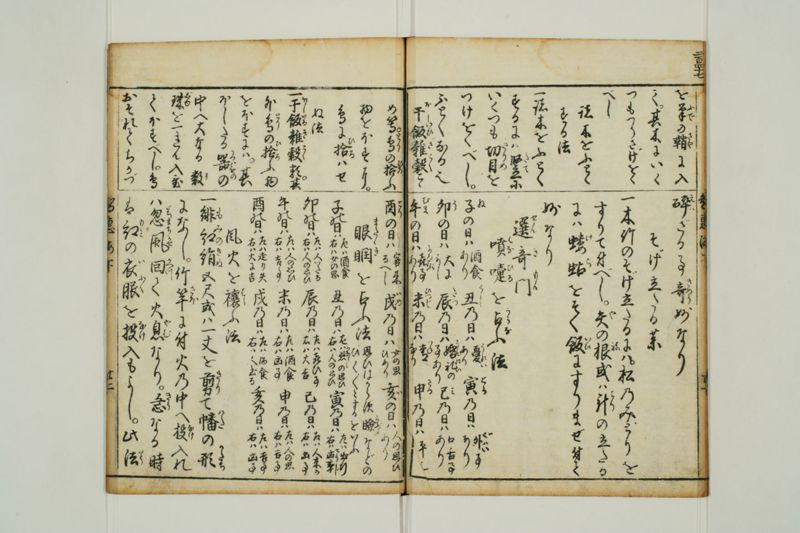
翻刻
【右丁】
【欄外上部】二百四十七
【上段】
を筆(ふで)の鞘(さや)に入
て。其木にいく
つもつりさげをく
べし
諸木をふとく
する法
一諸木をふとく
するには竪(たて)に
いくつも切目(きりめ)を
つけをくべし。
ふとくなる也。
干飯(ほしいひ)雑穀(ざこく)こゝ
【左丁・上段】
め等。鳥(とり)の拾(ひろ)ふ
物をほすに。
鳥に拾(ひろ)はせ
ぬ法
一 干飯(ほしいゐ)雑穀(ざこく)類。其
外 鳥(とり)の拾(ひろ)ふ物
をほすには。其
ほしたる器(うつはもの)の
中へ大なる数(す)
珠(じゆ)を一れん入置
てほすべし。鳥
おそれてちかづ
【右丁・下段】
酔(えは)ざる事 奇妙(きめう)なり
そげ立たる薬
一木竹のそげ立たるには。松のみどりを
すりて付べし。矢(や)の根(ね)或は針(はり)の立たる
には螻蛄(けら)をそく飯(いひ)にするまぜ付て
妙なり
選奇門(せんきもん)
噴嚏(はなひる)を占(うらな)ふ法
子(ね)の日は《割書:酒食|あり》 丑(うし)の日は《割書:憂(うれい)|あり》 寅(とら)の日は《割書:外(ぐはい)事|あり》
卯(う)の日は《割書:大に|よし》 辰(たつ)の日は《割書:婚礼(こんれい)の|事あり》 巳(み)の日は《割書:口舌事|あり》
午(むま)の日は《割書:喜(よろこぶ)事|あり》 未(ひつじ)の日は《割書:常(つね)|なり》 申(さる)の日は《割書:平▢|》
【左丁・下段】
酉(とり)の日は《割書:客来|るへし》 戌(いぬ)の日は《割書:女の思|ひあり》 亥(い)の日は《割書:人の思ひ|あり》
目瞤(またゝき)を占ふ法《割書:思ひはからす瞼(まぶた)などの|ひく〳〵とするをいふ》
子の日は《割書:左は酒食|右は女の思》 丑(うし)の日は《割書:左は悲(かなしみ)の思ひ|右は人の思ひ》 寅(とら)の日は《割書:左は出行|右は凶事(けうじ)》
卯の日は《割書:左は人いたる|右は人の思ひ》 辰の日は《割書:左は喜ひ事|右は大吉》 巳の日は《割書:左は人来る|右は凶事》
午の日は《割書:左は人の思ひ|右は吉事》 未の日は《割書:左は酒食|右は凶事》 申の日は《割書:左は人の思|右は吉事》
酉の日は《割書:左は走り失|右は大に吉》 戌の日は《割書:左は酒食|右は人至る》 亥の日は《割書:左は吉事|右は凶事》
風火を禳(はら)ふ法
一 緋紅絹(もみのきぬ)五尺或は一丈を剪(きり)て幡(はた)の形(かたち)
になし。竹 竿(さほ)に付火の中へ投(なけ)入れ
は忽(たちまち)風(かせ)回(かへつ)て火 息(やむ)なり。急(きう)なる時
は紅(もみ)の衣服(いふく)を投(なけ)入もよし。此 法(はう)
現代語訳
【右丁・上段】(前ページからの続き:するめのヒラヒラを)
筆の鞘(キャップ・筆管)に入れて、その木にいくつも吊り下げておくとよい。
諸木を太くする法
一 樹木を太くするには、(幹に)縦にいくつも切れ目を入れておくとよい。(すると)太くなるものである。
干飯・雑穀・胡麻などを干す際に、鳥に拾われないようにする法
一 干飯・雑穀の類、その他鳥が拾いやすいものを干す際には、その干している器(容器・ざるなど)の中へ大きな数珠を一連入れて干すとよい。鳥が恐れて近づか(ないものである)。
---
【右丁・下段】(前ページからの続き:船酔いの法)
酔うことがない。実に不思議なほど効果がある。
棘(とげ)が刺さった時の薬
一 木や竹のとげが刺さった場合は、松の緑(新芽・若葉)を擦り潰して付けるとよい。矢じりや針が刺さった場合は、螻蛄(けら)をご飯(炊いた飯)に混ぜて潰して付けると効果がある。
選奇門(せんきもん)
くしゃみを占う法
子の日は(酒食あり) 丑の日は(憂いあり) 寅の日は(外事あり)
卯の日は(大いによし) 辰の日は(婚礼の事あり) 巳の日は(口舌の事あり)
午の日は(喜ぶ事あり) 未の日は(常のこと) 申の日は(平□)
---
【左丁・下段】
酉の日は(客来るべし) 戌の日は(女の思いあり) 亥の日は(人の思いあり)
まばたき(目瞤)を占う法 ※思いがけず瞼などがひくひくとすることをいう
子の日は(左は酒食・右は女の思い) 丑の日は(左は悲しみの思い・右は人の思い) 寅の日は(左は出行・右は凶事)
卯の日は(左は人が来る・右は人の思い) 辰の日は(左は喜び事・右は大吉) 巳の日は(左は人来る・右は凶事)
午の日は(左は人の思い・右は吉事) 未の日は(左は酒食・右は凶事) 申の日は(左は人の思い・右は吉事)
酉の日は(左は走り失せ・右は大いに吉) 戌の日は(左は酒食・右は人至る) 亥の日は(左は吉事・右は凶事)
風火を鎮める(払う)法
一 緋色の絹(もみの絹)五尺あるいは一丈を切って、幡(はた)の形にして竹竿に付け、火の中へ投げ入れると、たちまち風が向きを変えて火が収まるものである。急な場合には、紅色(もみ色)の衣服を投げ入れるのもよい。この法(は)
英語訳
【Right Page, Upper Section】 *(Continued from the previous page: regarding the frilled membrane of dried squid)*
Place it inside the cap (sheath) of a writing brush, and hang several of these from the tree in question. This will keep the caterpillars away.
A Method for Making Trees Grow Thick
- To make trees grow thicker, score several vertical cuts into the trunk. The tree will grow thick as a result.
A Method for Preventing Birds from Picking Up Dried Rice, Grains, Sesame, and Similar Items Left Out to Dry
- When drying dried cooked rice (*hoshiī*), mixed grains, or other items that birds are likely to pick up, place one string of large prayer beads (*juzu*) inside the drying vessel or tray. Birds will be frightened and will not approach.
---
【Right Page, Lower Section】 *(Continued from the previous page: on the seasickness method)*
…(the person) will not become seasick at all. The effect is truly remarkable.
A Remedy for Splinters
- When a splinter of wood or bamboo has become lodged in the skin, grind up fresh green pine shoots and apply them to the wound. When an arrowhead or needle is embedded, mix and mash a mole cricket (*kera*) into cooked rice and apply it — the effect is excellent.
*Senkimon* (Selected Wondrous Methods / 選奇門)
A Method for Divining the Meaning of a Sneeze
- Day of the Rat (*ne*): (There will be food and drink.)
- Day of the Ox (*ushi*): (There will be sorrow or worry.)
- Day of the Tiger (*tora*): (There will be an external matter or outside affair.)
- Day of the Rabbit (*u*): (Great good fortune.)
- Day of the Dragon (*tatsu*): (A matter of marriage or wedding will arise.)
- Day of the Snake (*mi*): (There will be a quarrel or dispute.)
- Day of the Horse (*uma*): (There will be a joyful event.)
- Day of the Sheep (*hitsuji*): (Nothing in particular; ordinary.)
- Day of the Monkey (*saru*): (Peace and calm. [one character illegible])
---
【Left Page, Lower Section】
- Day of the Rooster (*tori*): (A guest will come.)
- Day of the Dog (*inu*): (A woman's feelings/affection will be on one's mind.)
- Day of the Boar (*i*): (Someone's feelings will be on one's mind.)
A Method for Divining the Meaning of Eye-Twitching (*matataki* / *mabuta no hikuhiku*)
*(This refers to the involuntary twitching or fluttering of the eyelid that occurs unexpectedly.)*
- Day of the Rat: (Left eye: food and drink; Right eye: a woman's affection.)
- Day of the Ox: (Left eye: sorrowful thoughts; Right eye: someone's feelings.)
- Day of the Tiger: (Left eye: going out on a journey; Right eye: an ominous event.)
- Day of the Rabbit: (Left eye: someone will arrive; Right eye: someone's feelings.)
- Day of the Dragon: (Left eye: a joyful event; Right eye: great good luck.)
- Day of the Snake: (Left eye: someone will come; Right eye: an ominous event.)
- Day of the Horse: (Left eye: someone's feelings; Right eye: an auspicious event.)
- Day of the Sheep: (Left eye: food and drink; Right eye: an ominous event.)
- Day of the Monkey: (Left eye: someone's feelings; Right eye: an auspicious event.)
- Day of the Rooster: (Left eye: something will flee or be lost; Right eye: great good luck.)
- Day of the Dog: (Left eye: food and drink; Right eye: a person will arrive.)
- Day of the Boar: (Left eye: an auspicious event; Right eye: an ominous event.)
A Method for Warding Off Wind-Driven Fire
- Cut five *shaku* or one *jō* of crimson silk (*momi no kinu*) into the shape of a banner (*hata*), attach it to a bamboo pole, and throw it into the fire. Instantly, the wind will reverse direction and the fire will be extinguished. In urgent situations, throwing in a garment of crimson (*momi*) cloth also works well. This method (continues on the next page…)