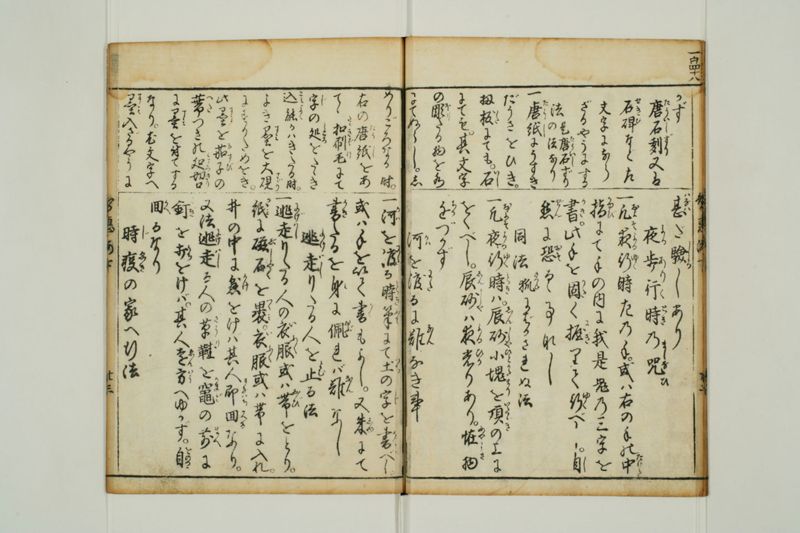
翻刻
【右丁】
【欄外上部】一百四十八
【上段】
かず
唐石刻(たういしずり)又は
石碑(せきひ)なと左
文字になら
ざるやうにする
法《割書:是 唐石(たういし)ずり|法なり》
一 唐紙(たうし)にうすき
だうさをひき。
扨 板(いた)にても。石(いし)
にても。其文字
の彫(ほり)たる物を水
にてぬらし。し
【左丁・上段】
めりごろなる時。
右の唐紙(たうし)をあ
てゝ扣刷毛(たゝきばけ)にて
字(じ)の処(ところ)をたゝき
込(こみ)能(よく)かはきたる時。
よき墨(すみ)を大 硯(すゞり)
にすりためをき。
此 墨(すみ)を茄子(なすび)の
蔕(へた)つきの処(ところ)切(きり)口
に墨(すみ)を付てする
なり。尤文字へ
墨(すみ)入ざるやうに
【右丁・下段】
甚(はなは)だ験(しる)しあり
夜(よる)歩行(ありく)時(とき)の呪(ましなひ)
一 凡(およそ)夜(よる)行(ゆく)時左の手。或は右の手の中(たけた)
指(かゆび)にて手の内に我是鬼の三字を
書(かき)。此手を固(かた)く握(にぎ)りて行(ゆく)べし。自(し)
然(ぜん)に恐(おそ)るゝ事なし
同法 狐(きつね)にばかされぬ法
一 凡(およそ)夜(よる)行(ゆく)時(とき)は。辰砂(しんしや)小塊(ひとかたまり)を頂(いたゞき)の上に
をくべし。辰砂(しんしや)は夜(よる)光(ひか)りあり。恠(あやしき)物
近(ちか)づかず
河(かは)を渡(わた)るに難(なん)なき事
【左丁】
一 河(かは)を渡(わた)る時(とき)筆(ふで)にて土(つち)の字(じ)を書(かく)べし。
或は手を以て書(かく)もよし。又 朱(しゆ)にて
書(かき)たるを身(み)に佩(おぶ)れば難(なん)なし
逃走(にけはし)りたる人を止(とむ)る法
一 逃走(にげはし)りたる人の衣服(いふく)或は帯(おび)をとり。
紙(かみ)に磁石(じしやく)を裹(つゝみ)。衣服(いふく)或は帯に入れ。
井の中に懸((かけ)をけば其人 即(すなはち)回(かへる)なり。
又法 逃走(にけはし)る人の草鞋(さうり)を竈(かまど)の前(まへ)に
釘(くぎ)を打(うち)をけば。其人 遠方(ゑんはう)へゆかず。自(をのつ)
回(かへ)るなり
時疫(じゑき)の家へ行法
現代語訳
【右丁・上段】(前ページからの続き)
(この法は効果が)数知れない。
拓本(唐石刷り)または石碑などを、文字が左右反転しないようにする法
※これが唐石(拓本)の刷り方の法である。
一 唐紙(中国製の薄紙)に薄いどうさ(礬水)を引いておく。そして板にせよ石にせよ、文字が彫ってある物を水で湿らせ、ちょうどよく湿り気を帯びた頃合いに、その唐紙を当てて、叩き刷毛で文字の部分を丁寧に叩き込む。よく乾いたところで、良質の墨を大きな硯に十分に磨り溜めておき、その墨を茄子の蔕(へた)が付いた部分の切り口に墨を含ませて(紙の上を)擦るようにするのである。特に文字の部分に墨が入らないように(注意する)。
【左丁・上段】(前ページからの続き:石碑拓本の法)
(文字のくぼみ以外の面に均一に墨がのるように注意すること。このようにすれば)非常に効果が著しい。
夜間に外を歩く時のまじない
一 夜に出かける時は、左手あるいは右手の中指(たけた指)で、自分の手の平の内側に「我是鬼」の三文字を書き、その手を固く握りしめて歩くとよい。自然と恐ろしいものが何もなくなる。
同法 狐に化かされない法
一 夜に出かける時は、辰砂(朱砂)のひとかたまりを頭の頂上(頭頂部)に置くとよい。辰砂は夜に光を帯びるため、怪しいものが近づかないのである。
川を渡る際に難儀しない法
【左丁・下段】
一 川を渡る時、筆で「土」の字を(手のひらに)書くとよい。あるいは指で書いてもよい。また、朱で書いたものを身に帯びていれば(川渡りに)難儀することがない。
逃げ走った人を引き戻す法
一 逃げ走った人の衣服あるいは帯を取り、紙に磁石を包んで、その衣服あるいは帯の中に入れ、井戸の中に掛けておけば、その人はすぐに帰ってくる。
また別の法:逃げ走った人の草履を竈(かまど)の前に釘で打ち付けておけば、その人は遠方へ行くことができず、自然に帰ってくるものである。
疫病(流行病)が出た家を訪問する法
英語訳
【Right Page, Upper Section】 *(Continued from previous page)*
…(this method) is effective beyond measure.
A Method for Making Rubbings of Carved Stones (*Tōishi-zuri*) or Stone Monuments Without the Text Appearing in Mirror Image
*(This is the method for making stone rubbings [*tōishi-zuri*].)*
- Apply a thin coating of *dōsa* (alum-and-glue sizing solution) to *tōshi* (Chinese paper). Then, whether working from a wooden board or a stone, moisten the object bearing the carved characters with water. When the surface has reached a suitably damp state, lay the prepared Chinese paper over it and use a tapping brush (*tataki-bake*) to carefully press the paper into the carved characters by tapping. Once the paper has dried thoroughly, grind a good-quality ink stick thoroughly on a large inkstone and collect plenty of ink. Then cut an eggplant (*nasu*) at the stem (*heta*), dip the cut surface in the ink, and rub it across the paper. Take great care that the ink does not enter into the recessed areas of the characters themselves.
【Left Page, Upper Section】 *(Continued: the stone rubbing method)*
…(the result will be) remarkably effective.
A Charm for Walking at Night
- When going out at night, use the middle finger of either your left or right hand to write the three characters 「我是鬼」(*Ware wa kore oni* — "I am a demon/ogre") on the inside of your palm, then clench your fist tightly and walk on. Naturally, nothing fearful will befall you.
The Same Method: A Method for Not Being Bewitched by Foxes
- When going out at night, place a small lump of *shinsha* (cinnabar / vermilion ore) on top of your head. Cinnabar glows at night, and therefore evil or strange beings will not approach you.
A Method for Crossing a River Without Difficulty
【Left Page, Lower Section】
- When crossing a river, write the character 「土」(*tsuchi*, meaning "earth/soil") with a brush (on your palm). Writing it with your finger also works. Alternatively, if you carry on your person a piece of paper on which this character has been written in vermilion ink, you will cross without difficulty.
A Method for Stopping a Person Who Has Run Away
- Take the clothing or sash (*obi*) of the person who has fled, wrap a magnet in paper, place it inside the clothing or sash, and hang it down into a well. The person will immediately return.
Alternatively: Nail the sandals (*zōri*) of the person who has run away in front of the cooking stove (*kamado*). The person will be unable to go far and will naturally return home.
A Method for Visiting a House Afflicted with Epidemic Disease (*jiei*)