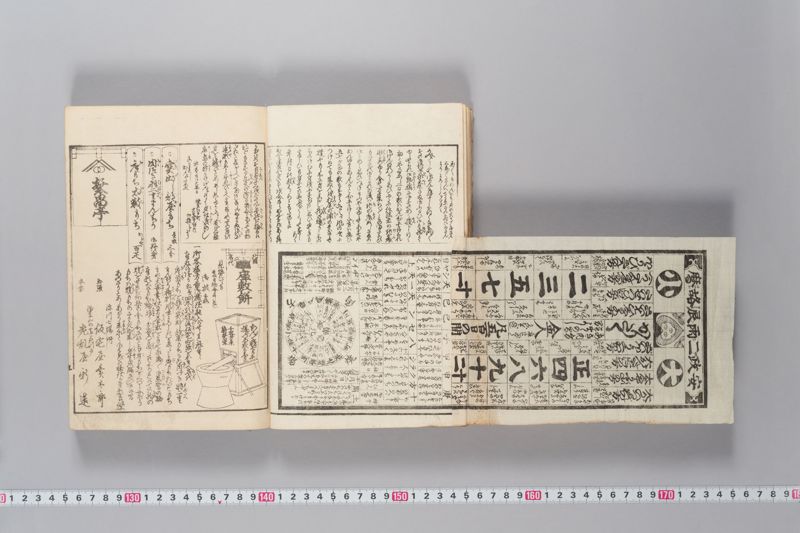
翻刻
【右丁下段の表のみ】
【一段目】
【横書】安政 二雨辰各古麿(ヂシンヲノ〳〵コマル)
【二段目】
大
火
【三段目】
大がいつぶれの方《割書:此方にのがれて| 万よし|但火を| ださず》
大しやうぶ山の方《割書:ばすへ| まで|あきだな| ふさがり》
大おんたすけの方《割書:此方にむかひて| おんを| かへす》
ざいほうくらの方《割書:むかひて| めを| かけず》
かりたく《割書:あき内方|みまゝの間|万よし》
さいはひしよくの方《割書:むかひてま| わたゝし| せず》
たいせつひけしの方《割書:此かた| けしくち| とらず》
へうたんなまづの方《割書:むかひて|いへ |みじめ| ■し》
ほうびぎんの方《割書:むかひて| 小べんせず|か■くそを| たれる》
【四段目】
あやうき
いのちを
たすかり
しは
正
ぢきの
かうべと
やら
こんどの
ぢしんの
ゆりはじめ
十月の
二
日の子は
よつを
うつと
【五段目】
かりたくの
はんじやうは
ちとけん
ぴきな
四
しゆく
の
ひま
金人《割書:寐よし。どら|たつ。むま。ひつし》
こぞに
ことしと
さる
わかまち
三
ざの
やぐらは
やけちかく
【六段目】
おすくひ
おてあて
そのほかに
まだ
六
ケ所に
たつ
おこや
【七段目】
いづくの
はても
やしろの
ぶじは
八
ひやく
ばん
じん
あはれは
■に
しんよし
はら
五
ちゆうの
やけは
十一年目
【八段目】
おれたは
やなかの
てんわう
じ
九
りんの
まがりは
きんりう山
凡五百日の間
ふるふた
うへに
くわじと
なり
七
もつ
やかぬいへも
なし
【九段目】
二日の
ばんから
とき〴〵
ふるひ
十
月すへ
まで大てい
のしく
【十段目】
ぢしんが
くわじ■
■ち〳〵は
ことし
十
二
たち
そろひて
元の江戸
十月三日を
はじめとし
たいてい
らいねん
十
一
日もやすみの
ない大工
しごとし
【十一段目】
【横書】庚申 甲子 巳巳 天シヤ日
【十二段目】
このそうどう
のなかにても
おやをたすけ
その身もたす
かりしかうしんあり
きのねは
ざいもくや
にてひき上ヶ
いたつて高
直きなり
かりたくの女
郎はおきやくと
身うけさるゝと
ねんあけと三ッを
待みまち也
まち〳〵いち
にんべつの者へ
御すくひ米を
くだしおかるゝは
これてんしや也
【十三段目】
【横書】十方クラシ 八セン 天一天上
【十四段目】
ちしんゆるく
いなやいへな
たをれつち
けぶりたち
人々とほう
くれたるを云
十六文のく
すりやはやり
八センのゆや
はやじまひ
なり尤古木を
おほくかひこむ
いづかたも
いへかたむき
かべやぶれ
かはらおち
やねなくして
天一を天井とス
【十五段目】
神午
■もとゟ出る
ひかん
さけとくりの
まゝあたゝめる
社日
ゑんにちなし
あき人こまる
丁申七ヤ
とうぶん休み
入梅
むろくづるゝ
半化粧
おしろいはげる
二百十日
ゟおそろしい
当時
のしゆくおほし
賞かん
にごりざけ
代かん
きんごくせ行
【十六段目】
【横書】土用
土蔵のくづれ土をねりなほす
寺〳〵のあなほり金まうけある
どてつち大いにわれる
やけつちにてきんへんみちぶしん
十月二日
月夜のことく
夜四時ヨリゆりたし出火はじまり
三十六ケ所もえたつ翌三日あさ
やう〳〵やけしづまる
十一月二日
日中ひる飯
朝四時ヨリ寺々にてせがき
くようはじまり八時甚しく
さんけいあり夕七時おほる
【横書】ヂイン
天台浅草寺 ぜん宗青松寺 門とは東ほんがんし
浄土回向院 同とうかいじ 同西本ぐわんし
真こん高野寺 日蓮しうは ゆきやう宗
同 同白金 たんぼけいうんじ 反甫日りん寺
同 くら前八まん 下谷宗延寺
【円形の図】
【円外四隅】焼場方角
【一重目の円の上から時計回り】
川芝柴井町 池之端茅町 千住小塚原 亀戸扇橋深
【二重目の円の上から時計回り】
仲丁通 れいがん島 てつはうず 中ばし 京ばし
小石川御門外 小川丁 丸の内 広小路 長者丁
さかもと 寺まち よしはらさるわか丁 こまかた 今戸はしば いし はら ほうおんじはし
たて川 六けんほり いせさき丁
【三重目の円の上から時計回り】
南西北東
【左丁上下段は前の10コマと同内容】
現代語訳
## 安政二年・地震をのの(各古麿)こまる
### 【方角と吉凶の表】
**大火**
- 大がいつぶれの方:〔此方に逃れて万よし。但し火を出さず〕
- 大しょうぶ山の方:〔場末まで空き店ふさがり〕
- 大おんたすけの方:〔此方に向かいて恩を返す〕
- 財宝蔵の方:〔向かいて目をかけず〕
- 仮宅:〔空き内方。見まま(なりゆきまま)の間、万よし〕
- 幸食(さいわいしょく)の方:〔向かいて間を渡し(まわたし)せず〕
- 大切火消しの方:〔此方、消し口とらず〕
- ひょうたんなまずの方:〔向かいて家みじめ(に)し〕
- ほうびぎんの方:〔向かいて小便せず。か■くそをたれる〕
---
### 【川柳風の段々】
**【四段目】**
危うき命を助かりしは、正直のかうべとやら。
今度の地震の揺り始め、十月の二日の子は四ツを打つと。
**【五段目】**
仮宅の繁盛は、ちと険引きな四宿の暇。
〔金人:寐よし。どら・丑・午・未〕
去年(こぞ)に今年と猿、若町三座の櫓は焼け近く。
**【六段目】**
お救い、お手当て、その他にまだ六か所に立つ小屋。
**【七段目】**
いずくの果ても、社(やしろ)の無事は八百万の神。
あわれは(…)身(心)よし、原中の焼けは十一年目。
**【八段目】**
折れたは谷中の天王寺。
隣の曲がりは金龍山(浅草寺)。
おおよそ五百日の間、
震えた上に火事となり、持ちて焼かぬ家もなし。
**【九段目】**
二日の晩から時々揺れ、十月末まで大抵のしく(激しく)。
**【十段目】**
地震が火事(に)(地)ちぢは今年、十二。
立ち揃いて元の江戸。
十月三日を始めとし、大抵来年、十一日も休みのない大工仕事し(た)。
---
### 【暦注の段】(庚申・甲子・巳巳・天赦日)
**【十二段目】**
この騒動の中にても、親を助け、その身も助かりし庚申あり。
木の根は材木屋にて引き上げ、いたって高直(こうじき)きなり。
仮宅の女郎は、お客と身受けさるると、年明けと三つを待ち待ちなり。
町々一人別の者へ御救い米を下し置かるるは、これ天赦なり。
---
### 【暦注の段】(十方暮らし・八専・天一天上)
**【十四段目】**
地震揺るくや否や、家など倒れ、土煙立ち、人々途方に暮れたるを云う。
十六文の薬屋は流行り、八専の湯屋は早仕舞いなり。もっとも古木を多く買い込む。
いずかたも家傾き、壁破れ、瓦落ち、屋根なくして天一を天井とす。
---
### 【暦注一覧】
- **神午(かみのうま)**:もとより出る
- **彼岸(ひがん)**:酒と瓶のまま温める
- **社日(しゃにち)**:縁日なし、商人困る
- **丁申七夜(ていしんしちや)**:当分休み
- **入梅(にゅうばい)**:室(むろ)崩れる
- **半化粧(はんげしょう)**:白粉(おしろい)はげる
- **二百十日**:よりおそろしい
- **当時**:の宿多し
- **賞寒(しょうかん)**:濁り酒
- **代換(だいかん)**:禁獄・せ行(施行)
---
### 【土用の段】
土蔵の崩れ、土を練り直す。
寺々の穴掘り、金儲けあり。
土手土(どてつち)大いに割れる。
焼け土にて近辺道普請(みちぶしん)。
---
### 【日時の記録】
**十月二日**
月夜のごとく、夜四ツ時より揺り出し、出火始まり、三十六か所燃え立つ。翌三日朝、ようやく焼き鎮まる。
**十一月二日**
日中昼飯(の時)、朝四ツ時より寺々にて施餓鬼(せがき)・供養はじまり、八ツ時(午後二時頃)甚だしく参詣あり。夕七ツ時(午後四時頃)おわる。
---
### 【寺院一覧】
- 天台:浅草寺
- 禅宗:青松寺
- 門徒(浄土真宗):東本願寺
- 浄土:回向院
- 同:東海寺
- 同:西本願寺
- 真言:高野寺
- 日蓮宗は(各寺)
- 遊行宗
- 同(白金)
- 田んぼ・経運寺
- 反甫・日輪寺
- 同・蔵前八幡
- 下谷・宗延寺
---
### 【円形の図:焼場方角】
【外側(四方)】:南・西・北・東
【内側】:
- 川・芝・柴井町/池之端茅町/千住小塚原/亀戸・扇橋・深(川)
- 仲丁通/霊岸島/鉄砲洲/中橋/京橋
- 小石川御門外/小川町/丸の内/広小路/長者町
- 坂本/寺町/吉原・猿若町/駒形/今戸・芝・石原/法恩寺橋
- 立川/六間堀/伊勢崎町
英語訳
## Ansei Year 2 – Each One Troubled by the Earthquake (地震をのの〳〵こまる)
*(This page is a complex broadsheet-style chart combining astrological/calendrical notations, comic verse (senryū), directional fortune-telling for earthquake/fire victims, disaster records, and a map of burned areas in Edo.)*
---
### [Directional Fortune Table: THE GREAT FIRE]
- **Direction of Great Ruin**: [Flee this way and all will be well. But don't start a fire.]
- **Direction of Great Showdown (Shōbu-yama)**: [Even the outskirts are full – no vacant shops.]
- **Direction of Great Divine Aid**: [Face this direction to have your grace returned.]
- **Direction of the Treasure Storehouse**: [Face this way but do not expect attention.]
- **Temporary Lodgings**: [For vacant inner quarters, as things stand – all is well.]
- **Direction of Fortunate Food**: [Face this way, but no sharing across.]
- **Direction of the Vital Fire Brigade**: [This direction – no fire hose position taken.]
- **Direction of the Gourd Catfish**: [Face this way – the house is made miserable.]
- **Direction of Reward Silver**: [Face this way – no urination. [Someone] drops their excrement instead.]
*(Note: This table parodies the traditional directional/fortune-telling almanac (koyomi) format, applying it satirically to earthquake and fire disaster situations.)*
---
### [Senryū-style Verse Sections]
**[4th Column]**
That one's life was saved in such danger —
they say it was because of an honest head (i.e., a straightforward person).
The earthquake this time began its shaking
on the night of the 2nd day of the 10th month, when the Hour of the Rat struck four.
**[5th Column]**
The prosperity of the temporary lodgings
is pulling somewhat hard on the four post-stations' spare time.
[Lucky Day – Gold Man: good for sleep; drum, hour of the dragon, horse, sheep]
Last year and this year, with the monkey — the young town of the three theater districts' yagura (tower) burned close by.
**[6th Column]**
For relief, for stipends, and beyond that —
small huts set up in six more locations.
**[7th Column]**
In every corner of the land, the shrines remaining safe
is thanks to the eight million gods.
How pitiful — the (spirit's) heart finds peace; the burning of the plain (harachu) is the eleventh year (since the last great fire).
**[8th Column]**
What collapsed was the Tennō-ji Temple of Yanaka.
The next bend is Kinryū-zan (Sensō-ji of Asakusa).
For approximately five hundred days,
on top of the shaking came the fires —
there is not a single house that was spared burning.
**[9th Column]**
From the night of the 2nd, earthquakes came from time to time;
until the end of the 10th month, they were mostly intense.
**[10th Column]**
Earthquakes, fires, the land shrinking — this is all happening this year: twelve.
Standing together, restored to the old Edo.
Starting from the 3rd day of the 10th month, carpenters worked without a single day of rest, right through to the following year — eleven days [of continuous work].
---
### [Auspicious/Inauspicious Days Section – Kōshin, Kinoe-ne, Mi-mi, Tenshā Days]
**[12th Column]**
Even in the midst of this great uproar, there was a kōshin (lucky day) where someone helped their parent and was themselves also saved.
Timber roots (tree stumps) were pulled up by the lumber merchants; prices were extremely high.
The women of the licensed quarters in temporary lodgings
waited and waited for three things: a patron to redeem them, their contract to expire (nenake), or a customer visit.
The distribution of relief rice to residents household by household in each town district — this is truly an act of divine grace (tenshā).
---
### [Almanac Notes – Jippō Kurashi (Ten-Direction Darkness), Hassen (Eight Specialists), Tenichi Tenjō]
**[14th Column]**
What it means when, as soon as the earthquake shook,
houses collapsed, clouds of earth rose, and people were at a total loss.
The medicine sellers charging sixteen mon were thriving;
the bathhouses during Hassen (inauspicious days) closed early.
Above all, they were buying up large quantities of old timber.
In every direction, houses were tilted, walls cracked, roof tiles had fallen — with no roofs left, the "Tenichi" (a calendar god) became the ceiling itself.
---
### [Almanac Notations – Satirical Disaster Correspondences]
- **Kami no Uma (God Horse day)**: naturally produces [issues]
- **Higan (Equinoctial week)**: sake and bottles warmed as-is
- **Sha-nichi (Earth deity day)**: no festival market; merchants troubled
- **Tei-shin Shichi-ya (7th night of certain cyclical days)**: closed for the time being
- **Nyūbai (Start of rainy season)**: underground storerooms (muro) collapse
- **Han-geshō (Mid-summer calendar day)**: white face powder (oshiroi) peels off
- **Nihyaku Tō-ka (210th day of year, typhoon season)**: more frightening than usual
- **Current times**: many lodging places needed
- **Shōkan (Slight cold period)**: cloudy/unrefined sake
- **Daikan (Major cold period)**: rationing and distribution of goods
---
### [Section on Do-yō (Midsummer Earth Days)]
The earth-walls of storehouses crumbled — the earth must be re-kneaded.
Digging graves and pits at temples — a source of income.
Earthen embankments greatly cracked.
Using burned earth for road repairs in the surrounding area.
---
### [Event Records]
**10th Month, 2nd Day:**
Bright as moonlight. From the Hour of the Rat (approximately midnight), shaking began; fires broke out, blazing up in 36 locations. The next morning, the 3rd, the fires were finally extinguished.
**11th Month, 2nd Day:**
At midday, lunchtime. From the Hour of the Rabbit (approximately 6 a.m.), memorial services (segaki) and memorial rites began at temples throughout the city. By the Hour of the Monkey (approximately 2 p.m.), attendance was at its most intense. By the evening Hour of the Rooster (approximately 6 p.m.), it concluded.
---
### [List of Temples Conducting Memorial Services]
- Tendai sect: Sensō-ji (Asakusa)
- Zen sect: Shōshō-ji
- Jōdo Shinshū (Montō): Higashi Hongan-ji
- Jōdo sect: Ekō-in
- Same: Tōkai-ji
- Same: Nishi Hongan-ji
- Shingon sect: Kōya-ji (Kōyasan branch temple)
- Nichiren sect: (various temples)
- Yūgyō sect (Ji sect)
- Same (Shirokin area)
- Tanbo: Keiun-ji
- Tanpo: Nichirin-ji
- Same: Kuramae Hachiman
- Shitaya: Shūen-ji
---
### [Circular Diagram: Compass Directions of Burned Areas]
**Outer ring (Cardinal Points):** South, West, North, East
**Inner zones (burned and affected locations):**
- Kawa / Shiba / Shibai-chō / Ikenohata Kayachō / Senjū Kozukahara / Kameido / Ōgibashi / Fuka(gawa)
- Nakachō-dōri / Reigan-jima / Teppōzu / Nakabashi / Kyōbashi
- Koishikawa Gomon-soto / Ogawa-chō / Marunouchi / Hirōkōji / Chōja-chō
- Sakamoto / Teramachi / Yoshiwara / Saruwaka-chō / Komagata / Imado / Shiba / Ishihara / Hōon-ji-bashi
- Tatekawa / Rokkembori / Isesaki-chō