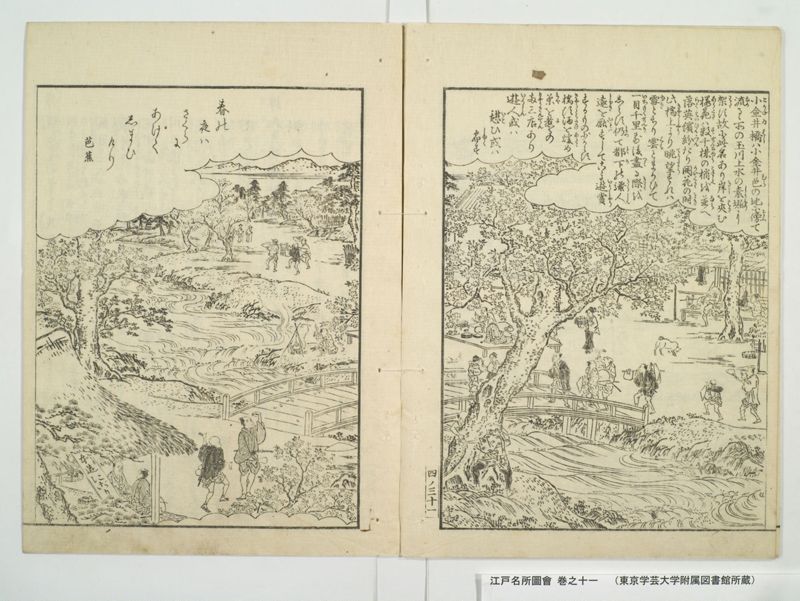
翻刻
【右丁】
小金井橋(こかねゐはし)は小金井邑( むら)の地に傍(そふ)て
流(なか)るゝ所の玉川上水の素堀(しらほり)に
架(わた)す故に此名あり岸(きし)を夾(はさ)む
桜花(あうくわ)は数千株(すせんちゆう)の梢(こすえ)を並(なら)へ
落英繽紛(らくえいひんふん)たり開花(かいくわ)の時(とき)
此 橋上(きやうしやう)より眺望(てうまう)すれは
雪(ゆき)とちり雲(くも)とまかひて
一目千里(いちもくせんり)前後 尽(つく)る際(きわ)を
しらす仍(よつ)て都下(とか)の騒人(さうしん)
遠(とほき)を厭(いとは)すしてこゝに遊賞(いうしやう)
するもの少からす
橋頭(きやうとう)酒(さけ)を煖(あたゝ)め
茶(ちや)を煮(に)るの
両三店(りやうさんてん)あり
遊人(いうしん)或は
憩(いこ)ひ或は
宿(しゆく)す
【左丁】
春の
夜は
さくらに
あけて
しまひ
けり
芭蕉
【店看板】
《割書:上くま》
本造にごり
現代語訳
【右丁】
小金井橋は、小金井村の地に沿って流れる玉川上水の素堀(自然の掘り割り)に架けられた橋であることから、この名がある。岸の両側には数千株の桜の梢が並び、花びらが美しく舞い散る。花の盛りの頃、この橋の上から眺めると、雪のように散り、雲のように漂って、見渡す限りどこまでも続き、前後の果てが知れないほどである。それゆえ、江戸の詩人や風流人たちは、遠い道のりをいとわずここに遊び、景色を楽しむ者が少なくない。橋のたもとには、酒を燗し、お茶を沸かす二、三軒の店があり、訪れた人々はそこで休んだり、宿泊したりする。
【左丁】
春の夜は
桜に明けて
しまひけり
芭蕉
【店の看板】
上くま
本造にごり(本醸造のにごり酒)
英語訳
【Right Page】
Koganei Bridge takes its name from the fact that it spans the unlined earthen channel (*shirabori*) of the Tamagawa Aqueduct, which flows alongside the village of Koganei. Along both banks, thousands of cherry trees line up their treetops, and fallen petals swirl down in cascading profusion. When the blossoms are at their peak, looking out from atop this bridge, the petals scatter like snow and drift like clouds, stretching as far as the eye can see in every direction, with no discernible end before or behind. For this reason, poets and refined aesthetes of the capital think nothing of the long journey and come here in no small number to enjoy the scenery. At the foot of the bridge, there are two or three shops where warmed sake and brewed tea are served; visitors may rest awhile or even stay the night.
【Left Page】
*The spring night
ended with the cherry blossoms—
and then it was dawn*
— Bashō
【Shop Sign】
*Jō-kuma*
*Honzō Nigori* (Genuine Cloudy Sake)
</translation_ja>