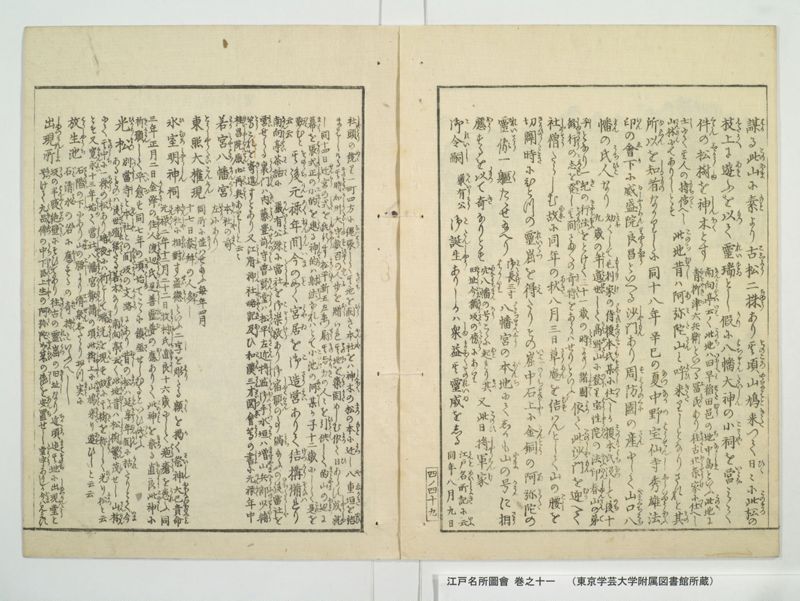
翻刻
【右丁】
謀(はか)る此山(このやま)に素(もと)より古松(こしよう)二株( ちゆう)あり其頃(そのころ)山鳩(やまはと)来(きた)つて日々(ひゝ)に此松(このまつ)の
枝上(えたうへ)に遊(あそ)ふを以(もつ)て霊瑞(れいすゐ)とし仮(かり)に八幡大神(はちまんたいしん)の小祠(こみや)を営(いとな)みて
件(くたん)の松樹(しようしゆ)を神木(しんほく)とす《割書:南向亭(なんかうてい)云(いは)く此地(このち)は旧(いにしへ)早稲田邑(わせたむら)の地(ち)中島(なかしま)といふ此地(このち)に|青柳津六兵衛(あをやきつ )といへる冨民(ふみん)あり往古(そのかみ)北条家(ほうてうけ)に仕(つか)へし》
《割書:士(し)にて其人の持伝(もちつた)へし|山林(さんりん)にてありしとそ》此地(このち)昔(むかし)は阿弥陀山(あみたさん)と呼来(よひきた)りしとなりされと其(その)
所以(ゆゑん)を知者(しるもの)なかりしに同十八年辛巳の夏(なつ)中野(なかの)宝仙寺(はふせんし)秀雄法(しういやうほふ)
印(いん)の会下(ゑか)に威盛院良昌(ゐしやうゐんりやうしやう)といへる沙門(しやもん)あり周防国(すはうのくに)の産(さん)にして山口八(やまくちはち)
幡(まん)の氏人(うちひと)なり《割書:幼(をさな)くして毛利家(もうりけ)の侍(さむらひ)榎本氏(えのもとうち)某(それかし)に仕(つか)へしか榎本氏(えのもとうち)没(ほつ)して後(のち)十|九歳の年(とし)遁世(とんせい)して高野山(かうやさん)に登(のほ)り宝性院(はうしやうゐん)の法印(ほふゐん)春山(しゆんさん)の弟(て)》
《割書:子(し)となり一紀( き)の行法(きやうほふ)をとけて三十一歳の時(とき)より諸国(しよこく)|修行(しゆきやう)の志(こゝろさし)を発(おこ)し其間(そのあひた)さま〳〵の奇特(きとく)をあらはせりといふ》依(よつ)て此(この)沙門(しやもん)を迎(むか)へて
社僧(しやそう)たらしむ故(ゆゑ)に同年の秋(あき)八月三日 草庵(さうあん)を結(むす)はんとして山の腰(こし)を
切闢(きりひらく)時(とき)にひとつの霊崫(れいくつ)を得(え)たりその崫中(いはやのうち)石上(せきしやう)に金銅(こんとう)の阿弥陀(あみた)の
霊像(れいさう)一躯( く)たゝせ給へり《割書:御長(みたけ)三寸|はかり》八幡宮(はちまんくう)の本地(ほんち)にてしかも山(やま)の号(かう)に相(さう)
応(おう)するを以(もつ)て奇(き)なりとす《割書:穴八幡(あなはちまん)の号(かう)こゝに起(おこ)れり其(その)|旧址(きうし)今猶(いまなほ)坂(さか)の傍(かたはら)にあり》又 此日(このひ)将軍家(しやうくんけ)
御令嗣(これいし)《割書:厳有公(けんいうこう)》御誕生(こたんしやう)ありしかは衆(しゆ)益(ます〳〵)其(その)霊威(れいゐ)をしる《割書:江戸名所記(えとめいしよき)に云(いふ) |同年八月九日》
【左丁】
《割書:社頭(しやとう)の繞(めく)り一町四方に縄張(なははり)して其地(そのち)を開(ひら)き本社(ほんしや)をは神木(しんほく)の松(まつ)の本(もと)に遷(うつ)し八重垣(やゑかき)を結(ゆひ)|まはしける其時(そのとき)加州太守(かしうたいしゆ)数百(すひやく)の人歩(にんふ)を贈(おく)られ其地(そのち)を築固(つきかた)めしむ依(よつ)て日(ひ)あらす成就(しやうしゆ)》
《割書:し同十四日 遷宮(せんくう)の式(しき)を執行(しゆきやう)す松平新五左衛門尉(まつたひら せう)其(その)与力(よりき)の人々を引供(ひきく)して的山(まとやま)の辺(ほとり)に|幕(まく)を張(はり)式正(しきしやう)の小的(こまと)を建(たつ)る神的(しんてき)は射法(しやほふ)なれはとて小池(こいけ)の何某(なにかし)か子十二歳にして是(これ)を》
《割書:勤(つと)むと|云々》其後(そのゝち)元禄年間(けんろくねんかん)今(いま)の如(こと)く宮居(みやゐ)を御造営(こさうえい)ありて結搆(けつかう)備(そなは)れり
《割書:南向亭茶話(なんかうていさわ)に 厳有公(けんいうこふ)殊(こと)に当社(たうしや)を御崇敬(こすうけう)あり御宿願( しゆくくわん)の事 満(みち)給ふの後(のち)当社(たうしや)を|営(えい)せらる裏門(うらもん)は内藤豊前守(ないとうふせんのかみ)普賢堂(ふけんたう)は松平左近将監(まつたひらさこんしやうけん)御手水垣(おんてうつかき)は増山兵部少輔(ますやまへうふのせういう)》
《割書:等(とう)これを寄進(きしん)すとあり又 江府神社略記(こうふしんしやりやくき)及(およ)ひ和漢三才図会(わかんさんさいつゑ)等(とう)の書(しよ)に元禄年中(けんろく )|桂昌院殿(けいしやうゐんてん)御再興(こさいこう)ありしと云々》
若宮八幡宮(わかみやはちまんくう)《割書:本社(ほんしや)の前(まへ)|左(ひたり)にあり》
東照大権現(とうしやうたいこんけん)《割書:同所に並(なら)はせ給ふ毎年四月|十七日 参拝(さんはい)の人 多(おほ)し》
氷室明神祠(ひむろみやうしん )《割書:本社(ほんしや)に相対(あひたい)す盛徳(せいとく)といふ二字( し)を彫(えり)たる額(かく)を掲(か)く祭神(さいしん)大己貴命(おほなむちのみこと)|元禄(けんろく)二年十二月二十二日 牧村氏直良(まきむらうちなほよし)十六歳にして疱瘡(はうさう)を患(うれ)ふ同》
《割書:三年正月二日 金沢(かなさは)の住人(ちゆうにん)渡辺氏是善(わたなへうちこれよし)霊夢(れいむ)の応(おう)ありて此神(このかみ)を祭(まつ)る直良(なほよし)此神(このかみ)に|祈願(きくわん)して平愈(へいゆ)す同七年の頃(ころ)始(はしめ)てこゝに鎮座(ちんさ)せしむるといひ伝(つた)ふ》
光松(ひかりまつ)《割書:別当寺(へつたうし)と本社(ほんしや)との間(あひた)坂(さか)の支路(えたみち)にあり昔(むかし)の松(まつ)は延享年間(えんきやうねんかん)に枯(かれ)たりとて今(いま)|あるものは後世(こうせい)殖継(うゑつき)たる若木(わかき)なり南向亭(なんかうてい)云(いは)く此地(このち)昔(むかし)は松樹(しやうしゆ)繁茂(はんも)せし山林(さんりん) 》
《割書:にて其中(そのうち)に一株( ちゆう)の松(まつ)あり暗夜(あんや)には折(をり)として瑞光(すゐくわう)を現(けん)す故(ゆゑ)に其樹(そのき)を称(しよう)して《振り仮名:光り松|ひか まつ》と云|とそ又 寛永(くわんえい)十三年 始(はしめ)て当社(たうしや)八幡宮(はちまんくう)勧請(くわんしやう)の頃(ころ)此(この)樹上(しゆしやう)に山鳩(やまはと)来(きた)り遊(あそ)ひしと云々》
放生池(はうしやうち)《割書:石階(せきかい)の下(した)にあり山(やま)の腰(こし)より清泉(せいせん)したゝりおつ実(まこと)に|石清水(いはしみつ)の名(な)に応(おう)するの奇特(きとく)といふへし》
出現所(しゆつけんしよ)《割書:坂(さか)の半腹(はんふく)絶壁(せつへき)にそひてあり往古(そのかみ)の霊崫(れいくつ)の旧址(きうし)なり近頃迄(ちかころまて)其地(そのち)に出現堂(しゆつけんたう)と|号(なつ)けて九品仏(くほんふつ)の中(うち)下品上生(けほんしやうしやう)の阿弥陀如来(あみたによらい)の像(さう)を安置(あんち)せし堂宇(たうう)ありしか今(いま)は見えす》
現代語訳
【右丁】
この山にはもともと古松が二株あった。そのころ山鳩が来て、日ごとにこの松の枝の上で遊ぶのを霊験あらたかな瑞兆として、仮に八幡大神の小祠を設け、その松樹を神木とした。
〔割注:南向亭(なんこうてい)が言うには、この地はかつて早稲田村の地で「中島」と呼ばれていた。この地に青柳津六兵衛という富裕な民がいて、往古に北条家に仕えた武士であり、その人が持ち伝えた山林であったという。〕
この地は昔、「阿弥陀山」と呼び来たりしとのことであるが、その由来を知る者はなかった。同(寛永)十八年辛巳の夏、中野の宝仙寺、秀雄法印の会下(門弟)に、威盛院良昌という沙門がいた。周防国の出身で、山口八幡の氏人(氏子)である。
〔割注:幼くして毛利家の侍・榎本氏某に仕えていたが、榎本氏が没した後、十九歳の年に遁世して高野山に登り、宝性院の法印・春山の弟子となり、一紀(十二年)の行法を終えて、三十一歳のときより諸国修行の志を発し、その間さまざまの奇特(不思議な霊験)を現したという。〕
そこでこの沙門を迎えて社僧とした。そのため同年の秋、八月三日に草庵を結ぼうとして山の腰を切り開いたとき、一つの霊窟(霊験ある洞穴)を得た。その洞穴の中の石の上に、金銅の阿弥陀の霊像一躯がお立ちになっていた。
〔割注:御丈は三寸ほど。〕
八幡宮の本地仏(本来の姿)であり、しかも山の号(阿弥陀山)にも相応することから、不思議なことと皆が感じた。
〔割注:「穴八幡」の号はここに起こった。その旧址は今も坂の傍らにある。〕
また、この日に将軍家の御令嗣
〔割注:厳有公(家綱公)〕
の御誕生があったので、人々はますますその霊威を知ることとなった。
〔割注:『江戸名所記』には「同年八月九日」とある。〕
【左丁】
〔割注:社頭の周り一町四方に縄張りをして、その地を開き、本社は神木の松の根元に遷し、八重垣を結い回した。そのとき加州(加賀)の太守が数百の人夫を贈られ、その地を築き固めさせた。それにより日をおかずして成就し、同十四日に遷宮の式が執行された。松平新五左衛門尉がその与力の人々を引き連れて、的山の辺りに幕を張り、式正の小的を建てた。神的は射法であるとして、小池の何某の子・十二歳がこれを勤めたと、云々。〕
その後、元禄年間に今のように宮居を御造営あって、結構(建築の構え)が整った。
〔割注:『南向亭茶話』に、厳有公はとりわけ当社を御崇敬あり、御宿願のことが満たされた後に当社を御造営あそばされた。裏門は内藤豊前守が、普賢堂は松平左近将監が、御手水垣は増山兵部少輔などがこれを寄進したとある。また『江府神社略記』および『和漢三才図会』等の書に、元禄年中に桂昌院殿が御再興あったと云々。〕
**若宮八幡宮**〔割注:本社の前、左にある。〕
**東照大権現**〔割注:同所に並んで鎮座なさる。毎年四月十七日は参拝の人が多い。〕
**氷室明神祠**〔割注:本社に相対する。「盛徳」という二字を彫った額を掲げている。祭神は大己貴命。元禄二年十二月二十二日、牧村氏直良は十六歳にして疱瘡を患った。同三年正月二日、金沢の住人・渡辺氏是善に霊夢の応答があって、この神を祀った。直良はこの神に祈願して平癒した。同七年のころ、初めてここに鎮座させたと言い伝える。〕
**光松**〔割注:別当寺と本社との間、坂の枝道にある。昔の松は延享年間に枯れたといって、今あるものは後世に植え継いだ若木である。南向亭が言うには、この地はかつて松樹が繁茂した山林で、その中に一株の松があり、暗夜には折として(時として)瑞光を現した。それゆえその樹を称して「光り松(ひかりまつ)」と云うとのこと。また、寛永十三年に初めて当社・八幡宮を勧請したころ、この樹上に山鳩が来て遊んだと云々。〕
**放生池**〔割注:石段の下にある。山の腰より清泉が滴り落ちる。まことに「石清水」の名に応ずる奇特(霊験)というべきである。〕
**出現所**〔割注:坂の中腹、絶壁に沿ってある。往古の霊窟の旧址である。近頃まで、その地に「出現堂」と称して、九品仏の中の下品上生の阿弥陀如来の像を安置した堂宇があったが、今は見えない。〕
英語訳
**【Right Page】**
This mountain originally had two old pine trees. At that time, wood pigeons would come daily to play upon the branches of these pines, and taking this as a sacred omen, a small provisional shrine to the Great Deity Hachiman was established, with the pine trees designated as sacred trees (shinboku).
[Interlinear note: According to Nankōtei, this land was formerly part of the village of Waseda and was called "Nakashima." A wealthy commoner named Aoyagi-tsu Rokubei lived here; he was descended from a samurai who had served the Hōjō clan, and this forested mountain had been passed down in his family.]
This land had long been called "Amidasan" (Mount Amida) from ancient times, though no one knew the reason for this name. In the summer of the eighteenth year of Kan'ei (1641, the year of the Metal Ox), at Hōsen-ji Temple in Nakano, among the disciples of Dharma-seal Priest Shūyō, there was a monk called Ishōin Ryōshō. He was a native of Suō Province and a parishioner of the Yamaguchi Hachiman Shrine.
[Interlinear note: As a child he had served a samurai of the Mōri clan named Enomoto, but after Enomoto's death, at the age of nineteen he renounced the world, ascended Mount Kōya, and became a disciple of Dharma-seal Priest Shunzan of Hōshōin. After completing twelve years of religious practice, from the age of thirty-one he undertook the aspiration to travel and train throughout the provinces, and during that time he is said to have manifested various wondrous and miraculous deeds.]
Therefore, this monk was invited to serve as the shrine monk (shaso). Accordingly, in the autumn of that same year, on the third day of the eighth month, when they were cutting into the hillside to build a hermitage, they discovered a sacred cave (reikutsu). Inside the cave, upon a rock, stood a single gilt-bronze image of Amida Buddha.
[Interlinear note: Its height was approximately three sun (about 9 cm).]
As Amida is the original Buddhist manifestation (honji) of the Hachiman deity, and moreover corresponded with the name of the mountain, everyone found this most wondrous.
[Interlinear note: The name "Ana Hachiman" (Cave Hachiman) originated here. The site of the former cave still remains to this day beside the slope.]
Furthermore, on that very day, the heir of the Shogunal house
[Interlinear note: Lord Kenyū (Tokugawa Ietsuna)]
was born, and so the people came to recognize the divine power of the shrine all the more.
[Interlinear note: The Edo Meisho Ki records that this occurred on the ninth day of the eighth month of the same year.]
**【Left Page】**
[Interlinear note: A rope boundary of one chō square was laid around the shrine precincts, the land was cleared, the main shrine was relocated to the base of the sacred pine trees, and an eightfold fence was erected around it. At that time, the lord of Kaga Province donated several hundred laborers to consolidate and firm up the ground. Thus the work was completed without delay, and on the fourteenth day of the same month, the ceremony of the enshrinement transfer (senkū) was conducted. Matsudaira Shingozaemon-no-jō, accompanied by his followers, erected a curtain near the archery hill (Matoyama) and set up a formal small target. As the divine archery ceremony was to be performed in the traditional manner, it is said that a twelve-year-old child, the son of a certain person named Koike, performed the duty, and so forth.]
After that, during the Genroku era, the shrine buildings were constructed as they now stand, and the full complement of structures was completed.
[Interlinear note: According to the Nankōtei Sawa, Lord Kenyū held particular reverence for this shrine, and after the fulfillment of his long-cherished vow, had the shrine buildings constructed. The rear gate was donated by Naitō Buzen-no-kami, the Fugen-dō Hall by Matsudaira Sakon-shōgen, and the purification water fence by Masuyama Hyōbu-no-shōyū, among others. Also, various texts such as the Kōfu Jinja Ryakki and the Wakan Sansai Zue record that Lady Keishōin had the shrine restored during the Genroku era.]
**Wakamiya Hachiman Shrine** [Interlinear note: Located to the front-left of the main shrine.]
**Tōshō Daigongen** [Interlinear note: Enshrined alongside in the same location. Each year on the seventeenth day of the fourth month, many people come to pay their respects.]
**Himuro Myōjin Shrine** [Interlinear note: Facing the main shrine. A plaque inscribed with the two characters "Seitoku" (Flourishing Virtue) is displayed. The enshrined deity is Ōnamuchi-no-Mikoto. On the twenty-second day of the twelfth month of Genroku 2 (1689), Makimura-uji Naoyoshi fell ill with smallpox at the age of sixteen. On the second day of the first month of the following year (Genroku 3), a resident of Kanazawa named Watanabe-uji Koreyoshi received a divine dream in response, and enshrined this deity. Naoyoshi prayed to this deity and recovered. It is said to have been first enshrined here around the seventh year of Genroku (1694).]
**Hikari-matsu (Radiant Pine)** [Interlinear note: Located along a branch path on the slope between the administrative temple (bettō-ji) and the main shrine. The original pine tree is said to have withered during the Enkyō era (1744–1748), and what stands now is a young tree planted in later times to replace it. According to Nankōtei, this land was formerly a forested mountain thick with pine trees, and among them was one pine that would, from time to time, emit an auspicious light on dark nights. For this reason, the tree was called "Hikari-matsu" (Radiant Pine). Furthermore, it is also said that around the time of the initial enshrinement of Hachiman at this shrine in the thirteenth year of Kan'ei (1636), wood pigeons came to play upon the branches of this tree.]
**Hōjō-ike (Life-Releasing Pond)** [Interlinear note: Located at the base of the stone steps. A clear spring trickles down from the hillside. This is indeed a wondrous thing that corresponds well with the name "Iwashimizu" (Spring Water from the Rocks).]
**Shutsugen-sho (Place of Manifestation)** [Interlinear note: Located partway up the slope, along a sheer cliff face. It is the former site of the ancient sacred cave (reikutsu). Until fairly recently, there stood here a hall called the "Shutsugen-dō," which housed an image of Amida Nyorai of the "lower-grade, higher-birth" (gebon-jōshō) category among the Nine Grades of the Buddha, but it can no longer be seen today.]