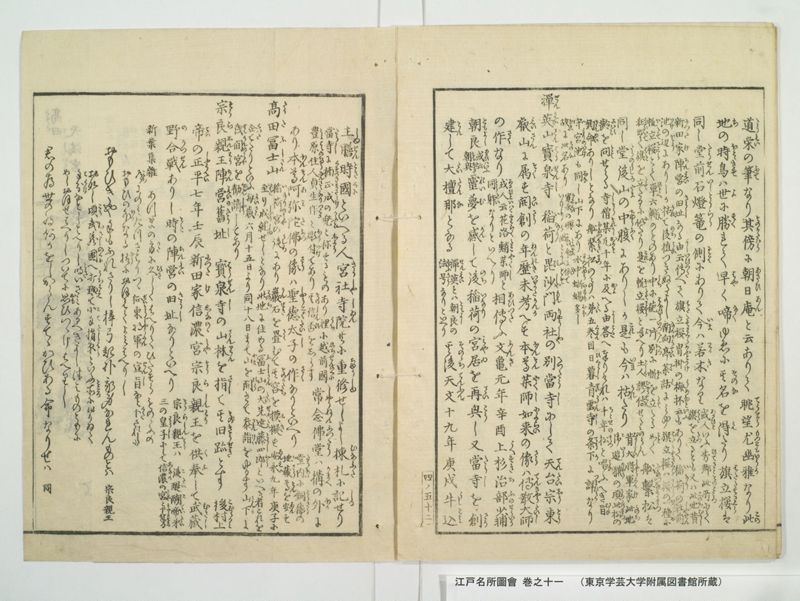
翻刻
【右丁】
道栄(たうえい)の筆(ふて)なり其傍(そのかたはら)に朝日庵(あさひあん)と云ありて眺望(てうまう)尤(もつとも)幽雅(いうか)なり此(この)
地(ち)の時鳥(ほとゝきす)は世(よ)に勝(すく)れて早(はや)く啼(なく)ゆゑに其名(そのな)を得(え)たり旗立桜(はたたてさくら)は
同し堂前(たうせん)石灯篭(いしとうらう)の側(そは)にありて今(いま)は若木(わかき)なり《割書:或人(あるひと)いふ秀郷(ひてさと)此所(このところ)にて|旗(はた)を立(たつ)るとも又は此地(このち)昔(むかし)》
《割書:新田家(につたけ)陣営(ちんえい)の旧址(きうし)なる由(よし)云伝(いひつた)へて旗立桜(はたたてさくら)《振り仮名:冑掛の梅|かふとかけ うめ》抔(なと)云(いふ)もありて稲荷(いなり)の社前(しやせん)|池(いけ)の辺(ほとり)にありしか枯(かれ)て後(のち)植(うゑ)つきぬるよし南向亭茶話(なんかうていさわ)にみゆ旗立桜(はたたてさくら)は桜(さくら)の一種(いつしゆ)に》
《割書:帆立桜(ほたてさくら)とて単(ひとへ)六弁( へん)のものあり中(うち)に葩(はなひら)一片(いつへん)別(へつ)に帆(ほ)を立(たて)たる如(こと)く|狂出(くるひいて)て旗(はた)を立(たて)たるに似(に)たり是(これ)を帆立桜(ほたてさくら)と呼(よ)へり土人(としん)謬伝(ひやうてん)せるならん》船繋松(ふなつなきまつ)は
同し堂後(たうのうしろ)山(やま)の中腹(ちゆうふく)にありしか是(これ)も今(いま)は枯(かれ)たり《割書:昔(むかし)大将軍家(たいしやうくんけ)此地(このち)|御游猟(こいうりやう)の頃(ころ)此松(このまつ)の》
《割書:齢(よはひ)を問(とは)せらる寺僧(しそう)某(それかし)凡(およそ)千年に及(およ)へる由(よし)答(こた)へ奉けれは千年松(ちとせのまつ)と唱(とな)ふへき旨(むね) |鈞命(きんめい)ありしとなり船繋松(ふなつなきまつ)の事は弟五巻目(たい くわん )日暮(ひくらし)青雲寺(せいうんし)の条下(てうか)に詳(つまひらか)なり》
《割書:守宮池(いもりのいけ)も同(おな)し山下にあり水中(すゐちゆう)蜥蜴(いもり)多(おほ)し|故(ゆゑ)に此名(このな)あり《割書:寛永(くわんえい)の頃(ころ) 台命(たいめい)に依(よつ)て|《振り仮名:いもりか池| いけ》とよふとそ》》
禅英山(せんえいさん)宝泉寺(はうせんし) 稲荷(いなり)と毘沙門(ひしやもん)両社(りやうしや)の別当寺(へつたうし)にして天台宗(てんたいしう)東(とう)
叡山(えいさん)に属(そく)す開創(かいさう)の年歴(ねんれき)未考(いまたかんか)へす本尊(ほんそん)薬師如来(やくしによらい)の像(さう)は伝教大師(てんきやうたいし)
の作(さく)なり《割書:或人云(あるひといはく)花洛(くわらく)鮹薬師(たこやくし)と|同体(とうたい)なりといへり》相伝(あひつた)ふ文亀(ふんき)元年辛酉 上杉治部少輔(うえすきちふのせういう)
朝良(ともよし)《割書:或云(あるひはいふ) |朝興(ともおき)》霊夢(れいむ)を感(かん)して後(のち)稲荷(いなり)の宮居(みやゐ)を再興(さいこう)し又 当寺(たうし)を創(さう)
建(こん)して大檀那(たいたんな)となる《割書:禅英(せんえい)とは朝良(ともよし)の|法号(ほふかう)なりといへり》其後(そのゝち)天文(てんふん)十九年庚戌 牛込(うしこみ)
【左丁】
主膳時国(しゆせんときくに)といへる人 宮社(きうしや)寺院(しゐん)共に重修(ちゆうしゆ)せしよし棟札(むなふた)に記(しる)せり
《割書:当寺(たうし)に楠正成(くすのきまさしけ)の兜(かふと)と称(しよう)するものあり裡(うち)に越前国(ゑちせんのくに)
|豊原住人(とよはらのちゆうにん)貞生(さたなり)作(つくる)と彫付(ほりつけ)てあり其(その)信否(しんひ)をしらす》常念仏堂(しやうねんふつたう)は搆(かまへ)の外(ほか)に
あり本尊(ほんそん)阿弥陀仏(あみたふつ)の像(さう)は聖徳太子(しやうとくたいし)の作(さく)なりといへり《割書:堂内(たうない)に銅像(とうさう)の|地蔵尊(ちさうそん)を安(あん)す》
高田富士山(たかたふしさん)《割書:稲荷宮(いなりのみや)の後(うしろ)にあり巌石(かんせき)を畳(たゝ)むて其容(そのかたち)を摸擬(もき)す安永(あんえい)九年庚子に|至(いた)り成就(しやうしゆ)せしとなり此地(このち)に住める富士山(ふしさん)の大先達(たいせんたつ)藤四郎(とうしらう)といへる者これを》
《割書:企(くはた)てたりといふ毎歳(まいさい)六月十五日より同十八日まて山(やま)を開(ひら)きて参詣(さんけい)をゆるす山下(さんか)に
|浅間宮(せんけんのみや)を勧請(くわんしやう)してあり》
宗良親王(そうらしんわう)陣営旧址(ちんえいのきうし) 宝泉寺(はうせんし)の山林(さんりん)を指(さし)て其(その)旧跡(きうせき)とす 後村上(こむらかみ)
帝(てい)の正平(しやうへい)七年壬辰 新田家(につたけ)信濃宮宗良親王(しなのゝみやそうらしんわう)を供奉(くふ)して武蔵(むさし)
野合戦(のかつせん)ありし時(とき)の陣営(ちんえい)の旧址(きうし)なりといへり《割書:宗良親王(そうらしんわう)は 後醍醐帝(こたいこてい)第(たい)|三の皇子(わうし)にして《振り仮名:信濃の宮|しなの みや》と申奉(まふしたてまつ)る》
《割書:新葉集雑 あつまの方(かた)に久(ひさ)しくはへりてひたすらものゝふの| 道(みち)にのみたつさはりつゝ征東将軍(せいとうしやうくん)の宣旨(せんし)なと下(くた)されしも| おもひの外(ほか)なる様(やう)におほえてよみはへりし》
おもひきや手もふれさりし梓弓起臥我身なれんものとは 宗良親王
《割書:おなし頃(ころ)武蔵国(むさしのくに)へ打越(うちこえ)て小手指原(こてさしはら)といふ所(ところ)におりゐて|手分(てわけ)なとしはへりし時(とき)いさみあるへきよしつはものともに》
《割書:めしおほせはへりしついてに思(おも)ひつゝけはへりし》
君の為世の為何かをしからんすてゝかひある命なりせは 同
現代語訳
【右丁】
(多聞天の額は長崎の)道栄の筆である。その傍らに朝日庵という庵があり、眺望はことのほか幽雅である。この地の時鳥(ほととぎす)は世に抜きんでて早く鳴くゆえに、その名を得た。旗立桜は同じ堂前の石灯篭の側にあって、今は若木である。
(ある人は言う。秀郷がこの場所で旗を立てたとも、またこの地は昔、新田家の陣営の旧址であるとも云い伝えられており、旗立桜・冑掛の梅などと呼ばれるものもあって、稲荷の社前の池のほとりにあったが、枯れた後に植え付けたとのことが、「南向亭茶話」に見える。旗立桜は桜の一種で、帆立桜といって一重六弁のものがあり、その中に花びらが一片だけ別に帆を立てたように突き出て、旗を立てたように見える。これを帆立桜と呼ぶ。土地の人が誤り伝えたのであろう。)
船繋松は同じ堂の裏手の山の中腹にあったが、これも今は枯れた。
(昔、大将軍家がこの地を御遊猟(鷹狩り)の折に、この松の齢(樹齢)をお尋ねになると、寺僧某がおよそ千年に及ぶ由をお答え申し上げたところ、「千年松と称えるべし」とのお言葉(鈞命)があったとのことである。船繋松のことは第五巻の日暮里・青雲寺の条に詳しい。)
(守宮池も同じ山の下にある。水中に蜥蜴(いもり)が多いゆえにこの名がある。寛永の頃、台命によって「いもりが池」と呼ぶとのことである。)
---
**禅英山(ぜんえいさん)宝泉寺(ほうせんじ)**
稲荷と毘沙門両社の別当寺であり、天台宗・東叡山(寛永寺)に属す。開創の年歴はいまだ考証できていない。本尊・薬師如来の像は伝教大師の作である。
(ある人は言う。花洛(京都)の蛸薬師と同体であるという。)
伝えるところによれば、文亀元年(1501)辛酉、上杉治部少輔朝良(ある説では朝興とも)が霊夢を感じた後、稲荷の宮居を再興し、また当寺を創建して大檀那となった。
(禅英とは朝良の法号であるという。)
その後、天文十九年(1550)庚戌、牛込
【左丁】
主膳時国という人が宮社・寺院ともに重修したことが棟札に記されている。
(当寺に楠正成の兜と称するものがある。裏に「越前国豊原住人貞生作」と彫り付けてある。その真偽は知れない。)
常念仏堂は境内の外にある。本尊・阿弥陀仏の像は聖徳太子の作であるという。
(堂内に銅像の地蔵尊を安置する。)
---
**高田富士山(たかたふじさん)**
(稲荷宮の後ろにある。岩石を積み重ねてその姿を模したものである。安永九年(1780)庚子に至り成就したとのことである。この地に住む富士山の大先達・藤四郎という者がこれを企てたという。毎年六月十五日より同十八日まで山を開いて参詣を許す。山の麓に浅間宮を勧請してある。)
---
**宗良親王(むねよししんのう)陣営旧址(ちんえいのきゅうし)**
宝泉寺の山林を指してその旧跡とする。後村上帝の正平七年(1352)壬辰、新田家が信濃宮宗良親王を奉じて武蔵野の合戦があった時の陣営の旧址であるという。
(宗良親王は後醍醐帝の第三皇子であり、「信濃の宮」と申し上げる。)
(「新葉集」の雑の部に、「東の方(坂東)に久しく滞在して、ひたすら武士の道にのみ従い、征東将軍の宣旨などが下されたのも、思いのほかに感じられて詠みましたもの」として、次の歌がある。)
おもひきや 手もふれさりし 梓弓
起き臥し我が身 慣れんものとは
(「思いもしなかった。手にも触れたことのなかった梓弓を、起き伏し、身に慣れ親しむことになろうとは。」) ―宗良親王
(同じ頃、武蔵国へ打ち越えて小手指原という所に居を置き、軍の手分けなどをしていた時に、勇気を奮うべき旨を武士たちに仰せ付けた折についでに思い続けた歌。)
君の為 世の為 何か惜しからん
捨ててかひある 命なりせば
(「君のため、世のために、何が惜しかろうか。捨てても甲斐のある命であったならば。」) ―同(宗良親王)
英語訳
**【Right Page】**
(The votive tablet of Tamonten in the worship hall was written by) Dōei of Nagasaki. Beside it stands a small hermitage called Asahi-an, which commands a particularly elegant and refined view. The cuckoos (hototogisu) of this place are renowned for calling earlier than anywhere else, and it is from this that the area derives its name. The Hatatate-zakura (Flag-Raising Cherry Tree) stands beside the stone lantern before the same hall; it is now a young tree.
*(One person says: it is also passed down that Hidesato raised his flag here, or alternatively that this land was once the site of the Nitta clan's encampment, and there are things called "Hatatate-zakura" and "Kabuto-kake-no-ume" (Helmet-Hanging Plum). These are said to have stood by the pond before the Inari shrine but withered, after which new ones were planted, as recorded in the "Nankōtei Sawa." The Hatatate-zakura is a variety of cherry blossom called "Hotate-zakura" (Scallop Cherry), a single-petaled variety with six petals, among which one additional petal protrudes separately like a raised sail, resembling a raised flag. This is called "Hotate-zakura." It is likely that the local people have transmitted an erroneous account.)*
The Funatsunagi-matsu (Ship-Mooring Pine) was at the midpoint of the hill behind the same hall, but it too has now withered.
*(In former times, when the Generalissimo (the shōgun) was hunting at this location, he asked about the age of this pine tree. A certain temple monk replied that it was approximately a thousand years old, whereupon His Excellency commanded that it should henceforth be called the "Thousand-Year Pine" (Chitose-no-Matsu). Details concerning the Ship-Mooring Pine are given in the entry on Higurashi and Seiun-ji in the fifth volume.)*
*(Imori-no-ike (Newt Pond) is also located at the foot of the same hill. It is so named because there are many newts (imori) in the water. It is said that during the Kan'ei era, by shogunal command it came to be called "Imori-ga-ike.")*
---
**Zen'ei-zan (禅英山) Hōsen-ji Temple**
This is the bettō-ji (administrative Buddhist temple) for both the Inari and Bishamonten shrines, and belongs to the Tendai sect under Tōei-zan (Kan'ei-ji). The date of its founding has not yet been established. The principal image, a statue of Yakushi Nyorai (Bhaisajyaguru), is said to be the work of Dengyō Daishi.
*(One person says that it is the same sacred body as the Tako Yakushi of Karakku (Kyoto).)*
According to tradition, in the first year of Bunki (1501), the year of Kanoto-Tori, Uesugi Jibu-shōyu Tomoyoshi (some say Tomooki), after receiving a divine dream, rebuilt the Inari shrine and also founded this temple, becoming its chief patron.
*(It is said that "Zen'ei" was Tomoyoshi's posthumous Buddhist name.)*
After that, in the 19th year of Tenbun (1550), the year of Kanoe-Inu, a man called Ushigomi
**【Left Page】**
Shuzen Tokikuni undertook a major restoration of both the shrine and the temple, as recorded on the ridge plaque.
*(The temple possesses an object said to be the helmet of Kusunoki Masashige. On the inside is engraved: "Made by Sadanari, a resident of Toyohara in Echizen Province." Its authenticity is unknown.)*
The Jōnembutsu-dō (Constant Nembutsu Hall) is located outside the main precinct. The principal image, a statue of Amida Butsu, is said to be the work of Prince Shōtoku.
*(Inside the hall, a bronze statue of Jizō Bodhisattva is enshrined.)*
---
**Takata Fuji-san (High-田 Fuji Mountain)**
*(This is located behind the Inari shrine. Rocks are piled up to simulate its shape. It was completed in the year Kanoe-Ne of Hōreki 9 (1780). It is said to have been initiated by a man called Tōshirō, the great spiritual leader (daisentatsu) of Mt. Fuji who lived in this area. Each year, from the 15th to the 18th day of the sixth month, the mountain is "opened" and pilgrimage visits are permitted. At the foot of the mountain, a Sengen Shrine has been invited and enshrined.)*
---
**Former Site of Prince Muneyoshi's (宗良親王) Military Encampment**
The woodland of Hōsen-ji Temple is identified as this historic site. It is said to be the site of the encampment from the time of the Battle of Musashino in the 7th year of Shōhei (1352), the year of Mizunoe-Tatsu, when the Nitta clan accompanied Prince Shinano-no-Miya Muneyoshi (Sōryō Shinnō) into battle.
*(Prince Muneyoshi was the third son of Emperor Go-Daigo and is referred to as "Shinano-no-Miya.")*
*(In the miscellaneous section of the "Shinyōshū" (New Leaf Collection), with the headnote: "Having long remained in the eastern provinces [Kantō], engaging wholly in the ways of the warrior, and finding that such things as the edict appointing me征東将軍 (Commander for the Pacification of the East) had been issued, which seemed altogether unexpected, I composed this poem.")*
*Omoiki ya te mo fure-zarishi azusa-yumi*
*okifushi wa ga mi naren mono to wa*
"Who could have thought it — that the azusa-bow, which I had never even touched, would become something my body would grow accustomed to, waking and sleeping."
— Prince Muneyoshi (Sōryō Shinnō)
*(At the same time, having crossed over into Musashi Province and stationed ourselves at a place called Kotesashi-hara, while arranging the disposition of troops, I encouraged the warriors to show valor, and composed this poem as it came to mind.)*
*Kimi no tame yo no tame nani ka oshikaran*
*sutete kai aru inochi nari seba*
"For the sake of our lord, for the sake of the world — what is there to regret? If only this life were one worth casting aside."
— The same (Prince Muneyoshi)