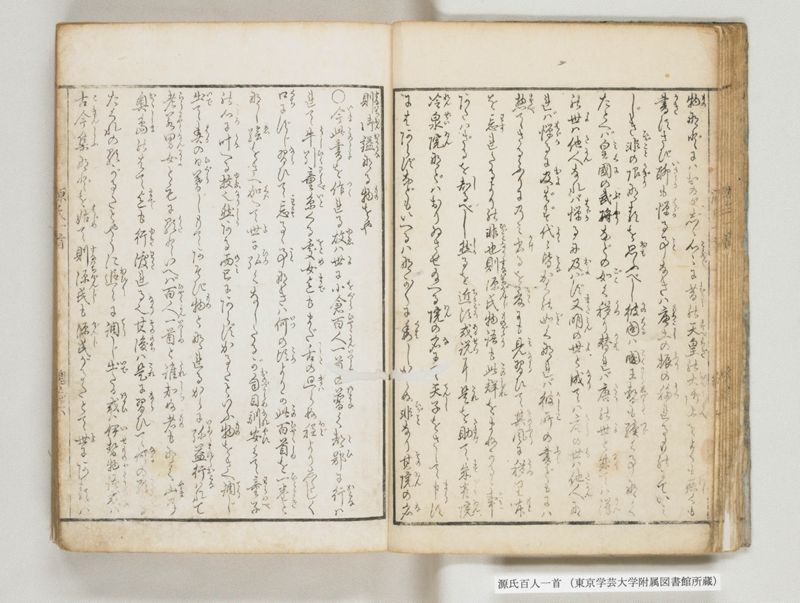
翻刻
【右丁】
物(もの)などにはおのがじし心々(こゝろ〴〵)に昔(むかし)の天皇(すべらぎ)の大御上(おほみうへ)をよくも悪(あし)くも
書(かき)すざび聊(いさゝか)も憚(はゞか)る事(こと)なきは唐土(もろこし)の振(ふり)の移(うつ)れるものにていみ
じき非(ひがこと)の限(かぎり)なるを思(おも)ふべし彼(かの)国(くに)は国王(こくわう)暫(しばらく)も続(つゞ)く事なく
たとへば皇国(みくに)の武将(ぶしやう)などの如(ごと)く移(うつ)り替(かは)れば唐(たう)の世(よ)と成(なり)ては漢(かん)
の世(よ)は他人(たにん)なれば憚(はゞか)るに及(およ)ばず又(また)明(みん)の世(よ)と成(なり)ては唐(たう)の世(よ)は他人(たにん)な
れば憚(はゞか)るに及(およ)ばず代々(よゝ)皆(みな)かくの如(ごと)くなれば彼所(かしこ)の書(ふみ)どもには
総(すべ)【惣】てさるふりにのみ書(かけ)るを爰(こゝ)にも見習(みなら)ひて其風(そのふう)に移(うつ)り本(もと)
を忘(わす)れたるよりの非(ひがこと)也(なり)則(すなはち)源氏物語(げんじものがたり)も此群(このむれ)をまぬかるゝ事(こと)
あたはざるを知(し)るべし然(しか)るを近頃(ちかごろ)或説(あるせつ)に是(これ)を助(たすけ)て朱雀院(すざくゐん)
冷泉院(れんぜいゐん)などはおりゐさせ給へる院(ゐん)の名(な)にて天子(てんし)をさして申(まう)す
にはあらずなどもいへるはなか〳〵に委(くは)しからぬ非(ひがこと)なり其(その)院(ゐん)の名(な)
【左丁】
則(すなはち)御謚(おんおくりな)なる物(もの)をや
○今(いま)此書(このしよ)を作(つく)れる故(ゆゑ)は世(よ)に小倉百人一首(をぐらひやくにんいつしゆ)の普(あまね)く都鄙(とひ)に行(おこな)は
れて牛引(うしひく)童(わらべ)糸(いと)くる処女(をとめ)迄(まで)もまだ舌(した)の廻(まは)らぬ程(ほど)よりしたしく
口(くち)にずじ習(なら)ひて忘(わす)るゝ事(こと)なきは何(いつ)の頃(ころ)よりか此(この)百首(ひやくしゆ)を一巻(ひとまき)と
なし絵(ゑ)をさへ加(くは)へて世(よ)に弘(ひろ)くなしたるが自(おのづから)目(め)馴(なれ)安(やす)くて童子(わらはべ)
の心(こゝろ)に叶(かな)へる故(ゆゑ)也(なり)然(しか)ある而已(のみ)にあらずかるたといふ物(もの)をさへ調(てう)じ
出(いで)て春(はる)の日暮(ひぐら)しもてあそび物(もの)となれるからに弥(いよ〳〵)益(ます〳〵)行(おこな)はれて
老若男女(らうにやくなんによ)ともに歌(うた)といへば百人一首(ひやくにんいつしゆ)と誰(たれ)知(しら)ぬ者(もの)もなく山(やま)の
奥(おく)島(しま)のはて迄(まで)も行渡(ゆきわた)れる也(なり)其後(そののち)は是(これ)に習(なら)ひて何(なに)の歌(うた)がる
たくれの歌がるたとやうに追々(おひ〳〵)に調(てう)じ出(いで)たる或(あるひ)は伊勢物語(いせものがたり)或(あるひ)は
古今集(こきんしふ)などを始(はじめ)て則(すなはち)源氏(げんじ)も源氏(げんじ)がるたとて世(よ)にあるは
現代語訳
【右丁】
書物などには、それぞれが心のままに昔の天皇の御事を良くも悪くも書き散らし、少しも憚ることがないのは、中国の風習が移ってきたものであって、非常に間違ったことの極みであることを思うべきである。あの国は国王が少しも長続きすることなく、たとえば皇国の武将などのように移り変われば、唐の世となっては漢の世は他人であるから憚る必要もなく、また明の世となっては唐の世は他人であるから憚る必要もない。代々皆このようであるから、あちらの書物には総てそのような調子でのみ書かれているのを、ここでも見習ってその風に移り、本来を忘れたことからの間違いである。すなわち源氏物語もこの仲間を免れることができないことを知るべきである。しかるに近頃ある説では、これを弁護して「朱雀院、冷泉院などは譲位なさった院の名前であって、天子を指して申すのではない」などとも言っているが、かえって不十分な間違いである。その院の名前は
【左丁】
すなわち御謚名であるものを。
○今この書を作った理由は、世に小倉百人一首が広く都市部から地方まで行われて、牛を引く童や糸を繰る処女までも、まだ舌が回らない程度の頃から親しく口ずさんで習い、忘れることがないのは、いつの頃からかこの百首を一巻とし、絵をさえ加えて世に広く普及させたのが、自然と目に馴染みやすくて童子の心に適う故である。そうであるだけでなく、かるたという物をさえ作り出して、春の日暮らしの遊び物となったことから、ますます行われて、老若男女ともに歌といえば百人一首と誰も知らない者はなく、山の奥や島の果てまでも行き渡っている。その後はこれに習って、何々の歌かるた、これの歌かるたというように次々に作り出した。ある時は伊勢物語、ある時は古今集などを始めとして、すなわち源氏も源氏かるたとして世にあるのは
英語訳
【Right Page】
In various writings, people freely write about ancient emperors' affairs, whether favorably or unfavorably, without any restraint whatsoever. This is due to the adoption of Chinese customs and represents the height of grave error. In that country, kings never continue for long, and like the military generals of our imperial land, when dynasties change—when the Tang era comes, the Han era becomes that of strangers, so there is no need for restraint; when the Ming era comes, the Tang era becomes that of strangers, so there is no need for restraint. Since all generations have been like this, all their writings are written only in such a manner. Here too, people have imitated this style, adopting that custom and forgetting the original principles, which is the source of this error. One should know that The Tale of Genji also cannot escape from this group. However, recently some theory has defended this, saying that "Suzaku-in, Reizei-in, and such are names of retired emperors who have abdicated, not referring to reigning emperors." But this is an even more inadequate error. Those imperial names are
【Left Page】
precisely posthumous titles.
○The reason for creating this book now is that the Ogura Hundred Poets collection has spread widely throughout the capital and provinces, with even ox-driving boys and thread-spinning maidens familiarizing themselves with it from the time their tongues can barely move, reciting it and never forgetting it. This is because at some point these hundred poems were compiled into a single volume, with pictures even added to spread it widely in the world, making it naturally easy on the eyes and suited to children's hearts. Not only that, but they even created something called karuta, making it a pastime for spring evenings, so it became even more widespread. Young and old, men and women alike, when speaking of poetry think of the Hundred Poets collection, with no one unaware of it, spreading even to remote mountains and distant islands. After that, following this example, they successively created various poetry karuta sets—sometimes based on the Tales of Ise, sometimes on the Kokin Collection, and so forth. Thus there is also Genji karuta based on the Tale of Genji in the world