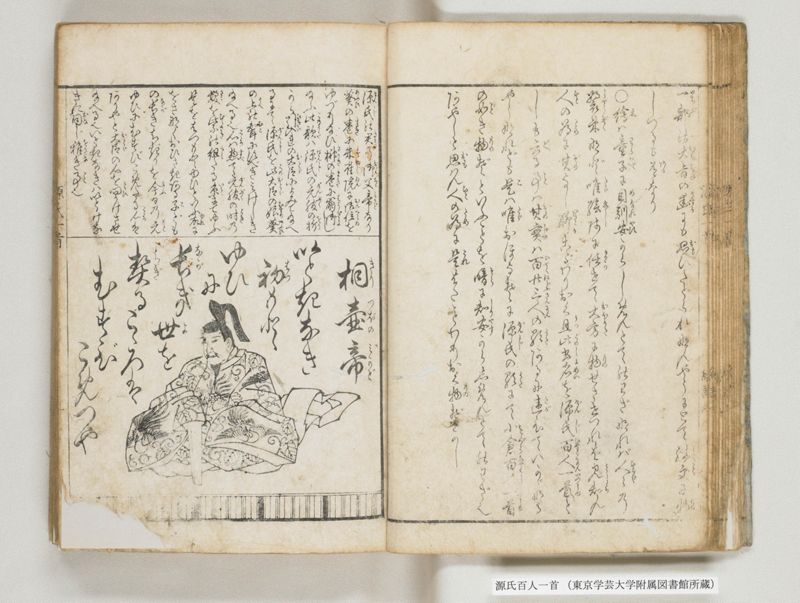
翻刻
【右丁】
一部(いちぶ)の大旨(おほむね)の幽(かすか)にも思(おも)ひたどられなんやうにとて殊更(ことさら)に物(もの)
しつるも有(ある)なり
○絵(ゑ)は童子(わらはべ)に目(め)馴(なれ)安(やす)からしめんとてのわざなれば人々(ひと〴〵)の
装束(しやうぞく)【𫌏は『大漢和辞典』にも見当たらず】など唯(たゞ)絵師(ゑし)に任(まか)せて大方(おほかた)に物(もの)せさせつれば見知(みしら)ん
人(ひと)の為(ため)に其(その)よし聊(いさゝか)ことわりおく且(かつ)此(この)書名(しよめい)を源氏百人一首(げんじひやくにんいつしゆ)と
しも云(いへ)る事(こと)は其実(そのじつ)は百廿三人(ひやくにじふさんにん)の歌(うた)あるに違(たが)ひていかゞなる
やうなれども是(こ)は唯(たゞ)おほよそに源氏(げんじ)の歌(うた)にて小倉百人一首(をぐらひやくにんいつしゆ)
の如(ごと)き物(もの)ぞといふことを暗(そら)に知安(しりやす)からしめんとてのわざ也
あやしと思(おも)はん人(ひと)の為(ため)に是(これ)はたことわりおく物(もの)ぞかし
【左丁 上段】
源氏(けんじ)の君(きみ)の御父(おんちゝ)帝(みかど)なり
葵(あふひ)の巻(まき)に朱雀院(すざくゐん)に御位(おんくらゐ)を
ゆづり給ひ榊(さかき)の巻(まき)に崩御(はうぎよ)し
給ふ此歌(このうた)は源氏(げんじ)の元服(げんぶく)の折(をり)
から引入(ひきい)れの大臣(おとゞ)によみて給へ
るにて源氏(げんじ)を此(この)大臣(おとゞ)の娘(むすめ)葵(あふひ)
の上(うへ)の聟(むこ)にすべきみけしき
給へる也 心(こゝろ)は総(すべ)【惣】て元服(げんぶく)の時(とき)の
髪(かみ)を紫(むらさき)の組(くみ)たる糸(いと)にてゆふ
是をはつもとゆひといふ故(ゆゑ)に
をさなくおひさきある子(こ)ども
の長(なが)きちぎりを今日(けふ)の元(もと)
ゆひにむすびこめたる心(こゝろ)は
ありやと大臣(おとゞ)の心を問(とひ)かけさせ
給へる也いときなきはいとけな
きに同(おな)じ稚(をさな)き事(こと)也
【同 下段】
桐壺帝(きりつぼのみかど)
いときなき
初(はつ)もと
ゆひ
に
長(なが)き世(よ)を
契(ちぎ)るこゝろは
むすび
こめつや
現代語訳
【右丁】
源氏物語一部の大要を、かすかにでも思い辿れるようにと、特に工夫したものもある。
○絵は童子に親しみやすくするためのものなので、人々の装束などはただ絵師に任せて大まかに描かせたが、見識のある人のためにその理由を少し説明しておく。かつこの書名を「源氏百人一首」と言うことについては、その実は百二十三人の歌があるのと違っているのはいかがなものかと思われるだろうが、これはただおおよそ源氏の歌で小倉百人一首のような物だということを、暗に知りやすくするためのものである。
不思議に思う人のために、これもまた説明しておくものである。
【左丁 上段】
源氏の君の御父君である帝である。
葵の巻で朱雀院に御位を
譲られ、榊の巻で崩御
される。この歌は源氏の元服の折、
左大臣が詠んで差し上げた
もので、源氏をこの大臣の娘である葵
の上の婿にしたいという御意向を
示されたものである。歌の意味は、すべて元服の時に
髪を紫の組紐で結ぶ、
これを初元結いというので、
幼くして将来ある子どもの
長い契りを今日の元
結いに結び込めた心は
あるのかと大臣の心を問いかけ
なさったものである。「いときなき」は「いとけなき」
に同じで、幼いということである。
【同 下段】
桐壺帝
いときなき
初元
結いに
長き世を
契るこころは
結び
こめつや
英語訳
【Right Page】
Some [explanations] were deliberately crafted so that the general outline of the entire Tale of Genji could be faintly traced and understood.
○The illustrations are intended to make [the work] familiar to children, so I had the artist draw the people's clothing and such in a general manner, but for the sake of knowledgeable readers, I will briefly explain the reasoning. Moreover, regarding calling this book "Genji Hundred Poems," while it actually contains one hundred twenty-three people's poems, which might seem inconsistent, this is simply to make it implicitly clear that these are generally poems from Genji, like the Ogura Hundred Poems.
For those who might find this strange, I also provide this explanation.
【Left Page, Upper Section】
This is the emperor who was Prince Genji's father.
In the "Aoi" (Heartvine) chapter, he abdicated to
Suzaku-in, and in the "Sakaki" (Sacred Tree) chapter
he passed away. This poem was composed
by the Minister of the Left at the time of Genji's coming-of-age ceremony
and presented to the emperor, expressing
the minister's intention to make Genji the
son-in-law of his daughter, Lady Aoi.
The meaning is that during coming-of-age ceremonies, one's
hair is tied with purple braided cord—
this is called the "first motoyui" (hair-binding), so [the emperor asks]
whether there might be a heart that has bound
a long pledge for young children
with promising futures into today's
motoyui. He is inquiring about the minister's intentions.
"Itoki naki" is the same as "itoke naki,"
meaning young or childlike.
【Same, Lower Section】
Emperor Kiritsubo
In the tender
first hair-
binding,
is there a heart that
pledges a long life—
bound
within?