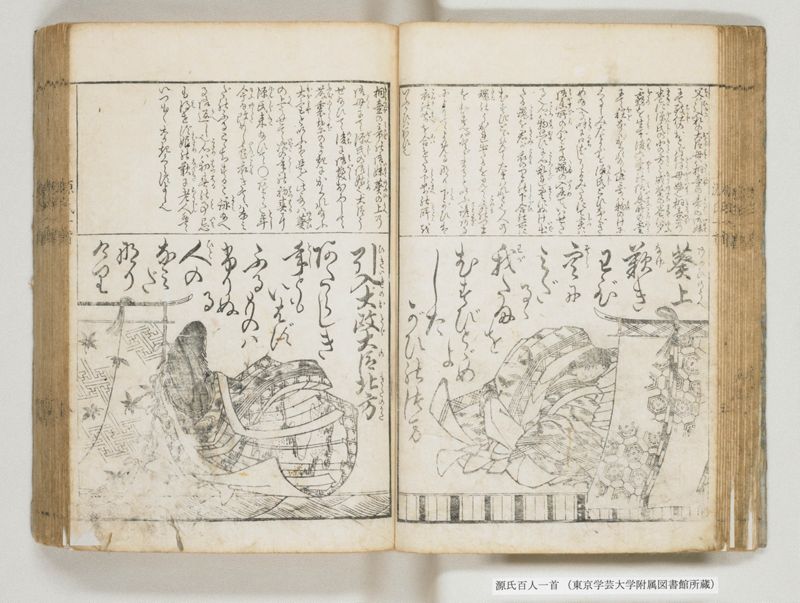
翻刻
【右丁 上段】
父(ちゝ)は引入(ひきい)れの大臣(おとゞ)母(はゝ)は桐壺(きりつぼ)の帝(みかど)の御 妹(いもと)
にて致仕(ちじ)のおとゞの同母(どうぼの)妹(いもと)也 桐壺(きりつぼ)の
巻(まき)に源氏(げんじ)の北(きた)の方(かた)と成(なり)葵(あふひ)の巻(まき)に夕(ゆふ)
霧(ぎり)を生(うみ)て後(のち)六 条(でう)の御息所(みやすどころ)の霊(れう)
にて程(ほど)なくかくれ給ふ此哥は物(もの)のけに
くるしみたまふを源氏(けんじ)とひなぐさ
め給へる時(とき)に口(くち)ばしりよみたるにて実(じつ)は
御息所(みやすどころ)の心をその魂(たま)の入居(いりゐ)ていはせた
る也 心(こゝろ)は物(もの)思(おも)ひに心(こゝろ)乱(みだ)れ空(そら)にぬけ出(いで)
たる魂(たま)を君(きみ)が衣(ころも)のつまの下合(したがひ)の所に
むすびとゞめてたまはれと也人の
魂(たま)のうかれ出たるを見て衣(ころも)のつま
をむすべばとゞまるといふ諺(ことわざ)ある
によりてよめるなり下(した)がひは
衣(ころも)の前(まへ)を合(あは)せたる下前(したまへ)の所(ところ)を
いふかひはあひ也
【同 下段】
葵上(あふひのうへ)
歎(なげ)き
わび
空(そら)に
みだ
るゝ
我(わが)たまを
むすびとゞめ
よ
した
がひのつま
【左丁 上段】
桐壺(きりつぼ)の帝(みかど)の御 妹(いもと)葵(あふひ)の上(うへ)の
御 母(はゝ)にて源氏(げんじ)の御 姑(しうとめ)也大臣う
せ給ひて後(のち)に御髪(みぐし)おろして
藤裏葉(ふぢのうらば)のまきにかくれ給ふ
大宮(おほみや)といふは是也此哥は葵(あふひ)
の上(うへ)うせて次(つぎ)の年(とし)の初春(はつはる)に
源氏(げんじ)来(き)給ひて○あまた年(とし)
今日(けふ)改(あらた)めし色衣(いろごろも)きてはなみ
だのふるこゝちすると詠(よみ)給へ
る御 返(かへ)し也 心(こゝろ)は初春(はつはる)の事(こと)忌(いみ)
も得(え)せず娘(むすめ)の歎(なげき)に老人(らうじん)は
いつも〳〵なきくらすよし也
【同 下段】
引入(ひきいれの)大政大臣(おとゞの)北方(きたのかた)
あたらしき
年(とし)とも
いはず
ふるものは
ふりぬ
る
人(ひと)の
なみ
だ
なり
けり
現代語訳
【右丁 上段】
父は頭中将(後の致仕の大臣)、母は桐壺帝の御妹で、致仕の大臣の同母妹である。「桐壺」の巻で源氏の北の方となり、「葵」の巻で夕霧を産んだ後、六条御息所の霊によって程なく亡くなってしまう。この歌は物の怪に苦しんでいる時に、源氏が訪ねて慰めてくださった際に、口走って詠んだもので、実は六条御息所の心がその魂に憑依して言わせたものである。歌の意味は、物思いに心が乱れて空中に抜け出てしまった魂を、あなたの衣の褄の下合わせの所に結び留めてくださいということである。人の魂が浮遊して出てしまったのを見て衣の褄を結べば留まるという諺があることに基づいて詠んだのである。「下合い」は衣の前を合わせた下前の部分を指す。「かひ」は「あい(合い)」のことである。
【同 下段】
葵上
嘆き侘びて
空に乱るる
我が魂を
結び留めよ
下合いの褄
【左丁 上段】
桐壺帝の御妹、葵上の御母で、源氏の御姑である。大臣が亡くなった後に出家して、「藤裏葉」の巻で亡くなる。大宮というのはこの方である。この歌は葵上が亡くなって翌年の初春に源氏が来訪して、「あまた年今日改めし色衣着てはなみだのふるこゝちする」と詠まれたお返事である。歌の意味は、初春の物忌みもできず、娘への嘆きに老人はいつも泣き暮らしているということである。
【同 下段】
頭中将大政大臣の北の方
新しき年とも
言わず
古るものは
降りぬる人の
涙なりけり
英語訳
【Right Page, Upper Section】
Her father is Tō no Chūjō (later the retired Chancellor), and her mother is the sister of Emperor Kiritsubo, who is the same-mother sister of the retired Chancellor. She became Genji's principal wife in the "Kiritsubo" chapter, gave birth to Yūgiri in the "Aoi" chapter, and died shortly after due to the vengeful spirit of Lady Rokujō. This poem was uttered spontaneously when she was suffering from spirit possession and Genji came to visit and comfort her; in reality, it was Lady Rokujō's heart that had entered her soul and made her speak. The meaning is: please bind and hold my soul that has become disturbed by anguished thoughts and has drifted out into the air, at the underlap of your robe's hem. This was composed based on the proverb that if you tie the hem of clothing when you see a person's soul floating away, it will remain. "Shitagahi" refers to the front part where the robe is folded over. "Kahi" means "ai" (joining/matching).
【Same, Lower Section】
Lady Aoi
Grieving and troubled,
my soul that wanders
disturbed in the air—
please bind it fast
at your robe's underlap.
【Left Page, Upper Section】
She is the sister of Emperor Kiritsubo, the mother of Lady Aoi, and Genji's mother-in-law. After her husband the Chancellor died, she took religious vows and passed away in the "Fuji no Uraba" chapter. "Ōmiya" (Great Lady) refers to this person. This poem is her reply when Genji visited in the early spring the year after Lady Aoi's death and composed: "Wearing mourning robes changed today after many years, I feel as though tears are falling." The meaning is that she cannot even observe the New Year purification rituals, and the old woman always spends her days weeping in grief for her daughter.
【Same, Lower Section】
The Principal Wife of Chancellor and Great Minister
I do not call it
a new year—
what grows old
are the tears of one
who has grown old with grief.