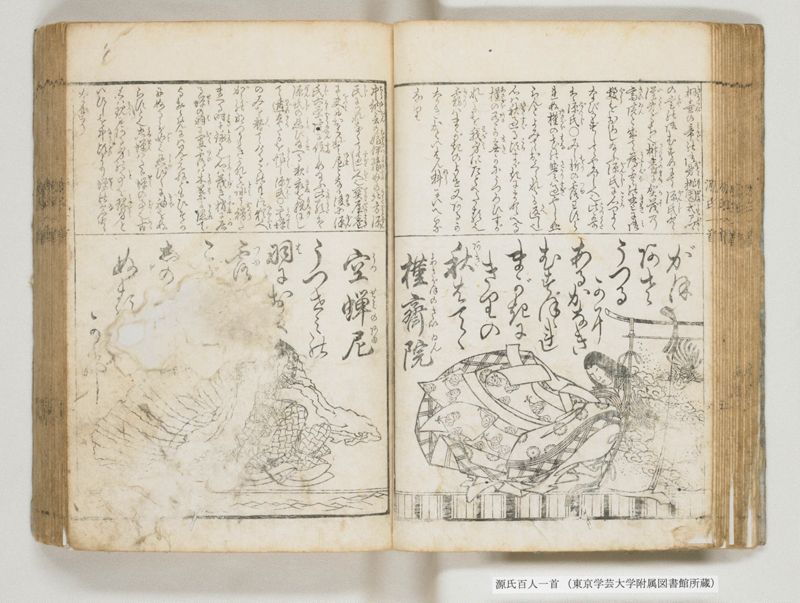
翻刻
【右丁 上段】
桐壺(きりつぼ)の帝(みかど)の御 弟(おとゝ)桃園式部卿(もゝぞのしきぶけう)
の宮(みや)の御むすめは源氏(げんじ)と
従弟(いとこ)どち也 榊巻(さかきのまき)に賀茂(かも)の
斎院(さいゐん)と成て薄雲(うすぐも)の巻(まき)に御(み)
髪(ぐし)をおろし給ふ源氏(げんじ)に心(こゝろ)つよく
なびかずしてやみし人也 此哥(このうた)
は源氏(げんじ)○みし折(をり)の露(つゆ)わすら
れぬ槿(あさがほ)の花(はな)の盛(さかり)は過(すぎ)やしぬ
らんとよみておくられたる返(かへ)し也
心は秋(あき)過(すぐ)る頃(ころ)まがきにまとへる
槿(あさがほ)の有(ある)か無(なき)かにうつろひすが
れたるを我身(わがみ)にたとへたる也
霧(きり)はまがきのよせ又あるか
なきかといはん料(れう)にいへる
なり
【同 下段 左から読む】
がほ
あさ
うつる
かに
あるかなき
むすぼゝれ
まがきに
きりの
秋(あき)はてゝ
槿斎院(あさがほのさいゐん)
【左丁 上段】
中納言(ちうなごん)の娘(むすめ)伊予介(いよのすけ)の北方(きたのかた)源(げん)
氏(じ)につれなくて過(すぎ)し人(ひと)也 関屋巻(せきやのまき)
に夫(をつと)におくれて尼(あま)となる後(のち)に源(げん)
氏(じ)六条院(ろくでうのゐん)に住(すま)しめ給ふ此歌(このうた)は
源氏(げんじ)の忍(しの)び給(たま)へる夜(よ)衣(きぬ)を脱(もぬけ)にし
て遁(のがれ)去(さり)たるを恨(うらみ)て源氏(げんじ)○空蝉(うつせみ)
のみを替(かへ)てけるこのもとに猶(なほ)人(ひと)
がらのなつかしきかなと詠(よみ)て贈(おくり)た
まへる時(とき)に詠(よめ)る也 心(こゝろ)は茂(しげ)き梢(こずゑ)に居(ゐ)
る蝉(せみ)の羽(は)に置(おく)露(つゆ)は木葉(このは)に隠(かくれ)て
よそめには見えねどもひそか
にぬるゝが如(ごと)く忍(しの)び〳〵に袖(そで)をぬ
らすと也 空蝉(うつせみ)はたゞ蝉(せみ)の事(こと)也 古(ふる)
くは現(うつゝ)にある身(み)の事(こと)を現身(うつせみ)と
いひしを中頃(なかごろ)より蝉(せみ)の名(な)と
なれり
【同 下段】
空蝉尼(うつせみのあま)
うつせみの
羽(は)におく
露(つゆ)の
こが□□□
しの□□□□□
ぬる□□
かな 【注】
【注 この歌の全文は「うつせみの羽におく露のこがくれてしのびしのびにぬるる袖かな」】
現代語訳
【右丁 上段】
桐壺帝の御弟である桃園式部卿宮の御娘で、源氏とは従兄弟同士である。「榊」の巻で賀茂の斎院となり、「薄雲」の巻で出家する。源氏に対して心を強く持ち、靡くことなく終わった人である。この歌は源氏が「見し折の露忘られぬ槿の花の盛りは過ぎやしぬらん」と詠んで送られた返歌である。歌の意味は、秋が過ぎる頃、垣根に絡まっている槿が、あるかないかわからないほどに色あせ枯れてしまったのを我が身に例えたものである。「霧」は垣根の縁語でもあり、また「あるかなきか」と言うための修辞として用いられている。
【同 下段】
槿斎院
秋果てて
霧の
垣根に結ぼぼれ
あるかなきかに
うつる槿
【左丁 上段】
中納言の娘で伊予介の北の方。源氏に対してつれなく過ごした人である。「関屋」の巻で夫に先立たれて尼となった後、源氏が六条院に住まわせてくださった。この歌は源氏が忍んで通われた夜、衣を脱け殻にして逃げ去ったのを恨んで、源氏が「空蝉の身をかへてけるこの木もとに猶人がらのなつかしきかな」と詠んで贈られた時に詠んだものである。歌の意味は、茂った梢にいる蝉の羽に置く露は木の葉に隠れて外からは見えないけれども、ひそかに濡れるように、忍び忍びに袖を濡らすということである。空蝉はただの蝉のことである。古くは現実にある身のことを「現身(うつせみ)」と言ったが、中世頃から蝉の名前となった。
【同 下段】
空蝉尼
空蝉の
羽に置く露の
木隠れて
忍び忍びに
濡るる袖かな
英語訳
【Right Page, Upper Section】
She is the daughter of Prince Momozono Shikibu-kyō, the younger brother of Emperor Kiritsubo, making her Genji's cousin. She becomes the Kamo Vestal Virgin in the "Sakaki" chapter and takes religious vows in the "Usugumo" chapter. She was someone who remained strong-hearted toward Genji and never yielded to him. This poem is her reply to Genji's poem: "The dew I saw that day cannot be forgotten—has the prime of the morning glory flowers passed away?" The meaning is that as autumn passes, the morning glories entangled in the hedge have faded and withered to the point of being barely visible, which she compares to herself. "Mist" is both an associated word with hedges and used rhetorically to express "being there or not being there."
【Same, Lower Section】
Asagao Vestal Virgin
Autumn having ended,
in the misty hedge
entangled and clinging,
the morning glories fade
to barely visible.
【Left Page, Upper Section】
She is the daughter of a Middle Counselor and the principal wife of the Governor of Iyo. She was someone who remained cold toward Genji. In the "Sekiya" chapter, after being widowed, she became a nun, and later Genji had her live at Rokujō-in. This poem was composed when Genji, lamenting that she had escaped by leaving only her robe behind on a night when he was secretly visiting her, sent her the poem: "Having left only her cicada shell at the base of this tree, how dear her character still remains." The meaning is that like the dew on a cicada's wings in thick treetops, hidden by the leaves and invisible from outside yet secretly moistening them, she too secretly wets her sleeves with tears. "Utsusemi" simply means cicada. In ancient times, one's actual living body was called "utsusemi," but from the medieval period onward it became the name for cicadas.
【Same, Lower Section】
Utsusemi the Nun
Like dew upon
the cicada's wings,
hidden in the leaves,
secretly, secretly
my sleeves grow wet.