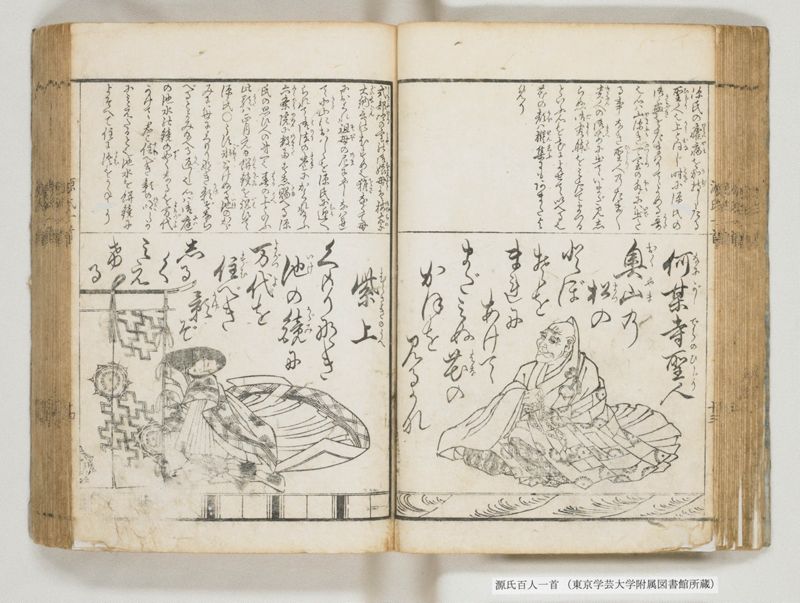
翻刻
【右丁 上段】
源氏の瘧病(わらはやみ)を加持(かぢ)したる
聖人(ひじり)也 上(かみ)と同(おな)じ時(とき)に源氏の
御 盃(さかづき)をたまはりてよめる哥(うた)
也心は山(やま)深(ふか)き一室(いつしつ)の外(ほか)には出(いで)た
る事なき聖人(ひじり)のたま〳〵
貴人(きにん)の御 前(まへ)に出ていまだ見し
らぬ御容体(ごようたい)をみたてまつる
といふ心を花によせていへる也
花の顔(かほ)は撰集(せんしふ)にもあまたよ
めり
【同 下段】
何某寺聖人(なにがしでらのひじり)
奥山(おくやま)の
松(まつ)の
とぼ
そを
まれに
あけて
まだみぬ花(はな)の
かほを
見るかな
【左丁 上段】
式部卿(しきぶけう)の宮(みや)の御 娘(むすめ)母(はゝ)は按察(あぜちの)
大納言(だいなごん)のむすめ也 稚(をさ)なくて母
におくれ祖母(そぼ)の尼(あま)にやしなはれ
て北(きた)山におはしゝを源氏に迎(むか)へ
られて御法(みのり)の巻(まき)にかくれ給ふ
六条院(ろくでうのゐん)に数多(あまた)すゑ賜(たま)へる源
氏の思ひ人の第一也 春(はる)の上(うへ)といふ
此 歌(うた)は正月元日 餅鏡(もちかゞみ)を祝(いは)ひて
源氏○うす氷(ごほり)とけぬる池(いけ)のかゞ
みには世にみのりなき影(かげ)ぞなら
べるとよみ給へる返(かへ)し也心は御 庭(には)
の池水の鏡の如(ごと)くなるを万代(よろづよ)
かけて君と住(すむ)べき影の明(あき)らか
にみえたると也池水を餅鏡に
よそへて住に澄(すむ)をかねたり
【同 下段】
紫上(むらさきのうへ)
くもりなき
池(いけ)の鏡(かゞみ)に
万代(よろづよ)を
住(すむ)べき
影(かげ)
しる ぞ
く
みえ
け
る
現代語訳
【右丁 上段】
源氏の瘧病(おこり)を加持祈祷した聖人である。上記と同じ時に源氏のお杯をいただいて詠んだ歌である。歌の意味は、山深い庵室の外には出たことのない聖人が、たまたま貴人のお前に出て、まだ見たことのないご容貌を拝見するという心を花に託して詠んだものである。「花の顔」は撰集にも多く詠まれている。
【同 下段】
何某寺の聖人
奥山の
松の扉を
まれに開けて
まだ見ぬ花の
顔を見るかな
【左丁 上段】
式部卿の宮のお娘で、母は按察大納言の娘である。幼くして母に死に別れ、祖母の尼に養われて北山にいらしたのを、源氏にお迎えされて「御法」の巻で姿を隠される。六条院に多く住まわせなさった源氏の恋人の第一である。「春の上」という。この歌は正月元日に餅鏡を祝って、源氏が「薄氷解けぬる池の鏡には世に実りなき影ぞ並べる」と詠みなさった返歌である。歌の意味は、お庭の池水が鏡のようになっているのを、万代にわたって君とお住みになるべき姿が明らかに見えている、ということである。池水を餅鏡に例えて、「住む」に「澄む」を掛けている。
【同 下段】
紫上
曇りなき
池の鏡に
万代を
住むべき影
しるく見えける
英語訳
【Right Page, Upper Section】
This is the holy man who performed prayers to cure Genji's ague (malaria). This is a poem composed when he received a cup of sake from Genji at the same time as mentioned above. The meaning is that a holy man who had never left his deep mountain hermitage happened to appear before a noble person and see an unfamiliar countenance for the first time - this sentiment is expressed through the metaphor of flowers. "The face of flowers" appears frequently in poetry collections.
【Same, Lower Section】
Holy Man of Such-and-Such Temple
In the deep mountains,
rarely opening
the pine door,
I see the face
of an unknown flower.
【Left Page, Upper Section】
She is the daughter of Prince Shikibu-kyō, and her mother was the daughter of Azech no Dainagon. Having lost her mother at a young age, she was raised by her grandmother, a nun, in Kitayama, from where Genji brought her, and she disappears in the "Minori" (The Law) chapter. She is the foremost among Genji's beloved women who resided at Rokkō-in. She is called "Haru no Ue" (Lady of Spring). This poem is a reply to Genji's New Year's Day poem celebrating the rice-cake mirror: "In the pond's mirror where thin ice has melted, shadows without substance in this world are reflected together." The meaning is that the garden pond water, mirror-like, clearly shows the image of one who should dwell with her lord for ten thousand generations. The pond water is compared to the rice-cake mirror, with a play on words between "sumu" (to dwell) and "sumu" (to be clear).
【Same, Lower Section】
Lady Murasaki
In the unclouded
mirror of the pond,
the image of one who should dwell
for ten thousand generations
is clearly visible.