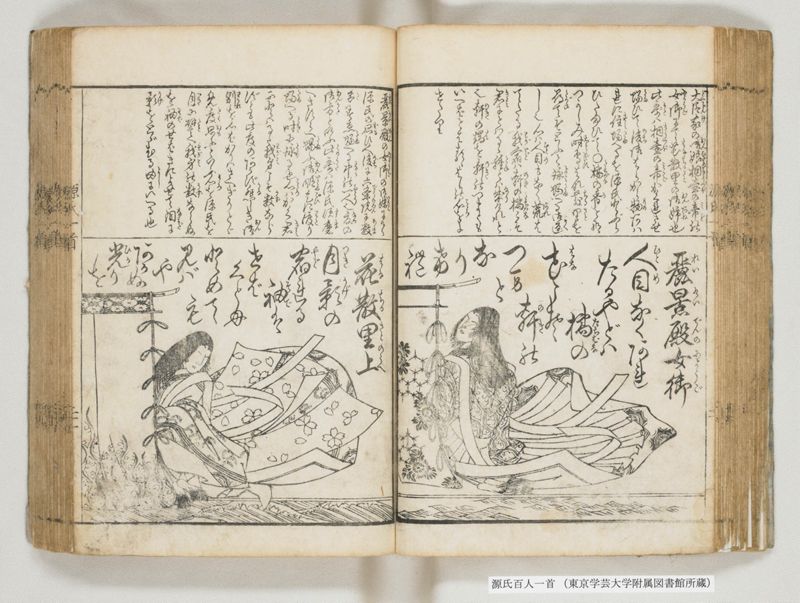
翻刻
【右丁 上段】
大臣家(だいじんけ)の御娘(おんむすめ)桐壺(きりつぼ)の帝(みかど)の
女御(にようご)にて花散里(はなちるさと)の御姉(おんあね)也
此 哥(うた)は桐壺(きりつぼ)の帝(みかど)かくれさせ
賜(たま)ひて後(のち)御はらから物(もの)あは
れに住(すみ)賜(たま)へるを源氏とぶら
ひたまひて○橘(たちばな)の香(か)をな
つかしみ時鳥(ほとゝぎす)はな散里(ちるさと)を
尋(たづね)てぞとふと詠(よみ)賜(たま)へる御 返(かへ)
し也心は人目(ひとめ)もなく荒(あれ)は
てたる我宿(わがやど)は軒(のき)の橘(たちはな)こそ
君(きみ)にとはるゝ種(たね)とは成(なり)けれと
也 軒(のき)の端(は)を軒(のき)のつまとも
いへばとはるゝはしの心(こゝろ)をよ
せたり
【同 下段】
麗景殿女御(れいけいでんのにようご)
人目(ひとめ)なくあれ
たるやどは
橘(たちばな)の
花(はな)こそ
軒(のき)の
つま
と
な
り
け
れ
【左丁 上段】
麗景殿(れいけいでん)の女御(にようご)の御 妹(いもと)にて
源氏の思(おも)ひ人 後(のち)に六 条院(でうのゐん)に数(あま)
多(た)すゑ賜(たま)へる中(なか)の一人(ひとり)也 夏(なつ)の
御方(おんかた)といふ此哥(このうた)は源氏 須磨(すま)
へさすらへ賜(たま)ふ御暇乞(おんいとまごひ)に渡(わた)り
賜(たま)へる時(とき)に詠(よめ)る也 心(こゝろ)はかく君(きみ)
にとはるゝ我身(わがみ)こそ数(かず)なら
ずとも此度のあかず悲(かな)しき御(おん)
別(わかれ)を心ばかりはさへぎりとゞ
め度(たく)思(おも)ふといふ心(こゝろ)を源氏を
月(つき)に譬(たと)へ我身(わがみ)の数(かず)ならぬ
を袖(そで)のせばきによせて泪(なみだ)に
影(かげ)をとゞむる由(よし)にいへる也
【同 下段】
花散里上(はなちるさとのうへ)
月影(つきかげ)の
宿(やど)れる
袖(そで)は
せば
くとも
とめて
も
見ば
や
あかぬ
光(ひか)り
を
現代語訳
【右丁 上段】
大臣家のお嬢様で、桐壺帝の女御であり、花散里の姉である。この歌は、桐壺帝が崩御された後、姉妹がもの悲しく住まわれているのを源氏が見舞われて、「橘の香をなつかしみ時鳥花散里を尋ねてぞ問う」と詠まれたその返歌である。歌の意味は、人目もなく荒れ果てた我が家は、軒の橘こそが君に訪ねられる理由となったのですね、ということである。軒の端を「軒のつま」とも言うので、「問はるる」と「はし」の心を掛けて表現している。
【同 下段】
麗景殿女御
人目なく荒れ
たる宿は
橘の
花こそ
軒の
つま
と
なりけれ
【左丁 上段】
麗景殿女御の妹で、源氏の恋人である。後に六条院に数多く住まわされた女性たちの中の一人である。夏の御方という。この歌は、源氏が須磨へ流謫される際の暇乞いに訪れた時に詠んだものである。歌の意味は、このように君に訪ねられる私の身は取るに足らないものですが、今度の名残惜しく悲しいお別れを、心だけでも遮り留めたいと思う、という気持ちを、源氏を月に譬え、我が身の取るに足らないことを袖の狭いことに寄せて、涙に影を留める様子で表現したものである。
【同 下段】
花散里上
月影の
宿れる
袖は
狭くとも
留めても
見ばや
飽かぬ
光を
英語訳
【Right Page, Upper Section】
She was the daughter of a Minister's family, a consort to Emperor Kiritsubo, and the elder sister of Hanachirusato. This poem is her reply when Genji visited to comfort the sisters who were living in melancholy after Emperor Kiritsubo's death, and he composed: "Drawn by the nostalgic fragrance of orange blossoms, the cuckoo seeks out Hanachirusato to visit." The meaning is: in my home that has fallen into ruin with no visitors, it is the orange tree by the eaves that has become the reason for your visit. She plays on words using "tsuma" (edge/wife) for the eaves' edge and the concept of being "visited" or "asked about."
【Same, Lower Section】
Lady Reikeiden
In this dwelling
fallen to ruin
with no visitors,
the orange blossoms
have become
the edge
of the eaves.
【Left Page, Upper Section】
She was the younger sister of Lady Reikeiden and one of Genji's beloved women. Later, she was one of many women housed at Rokujō-in. She was called the Summer Lady. This poem was composed when Genji came to bid farewell before his exile to Suma. The meaning is: though my person who is thus visited by you may be insignificant, I wish my heart could at least block and detain you from this reluctant and sorrowful parting. She expresses this by comparing Genji to the moon, likening her own insignificance to the narrowness of sleeves, and describing how she would capture his reflection in her tears.
【Same, Lower Section】
Lady Hanachirusato
Though the sleeves
where the moon's reflection
dwells
may be narrow,
I would detain
and gaze upon
that inexhaustible
light.