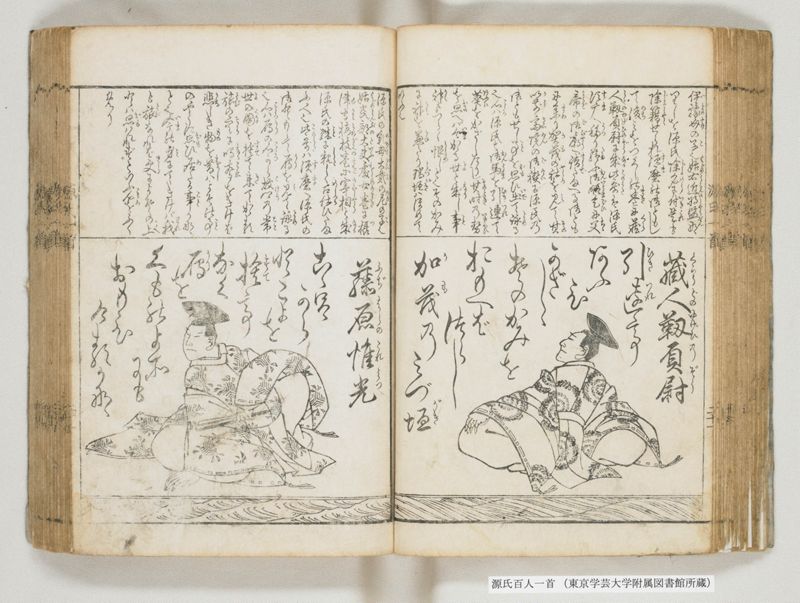
翻刻
【右丁 上段】
伊予介(いよのすけ)の子(こ)也 始(はじめ)右近将監(うこんのしやうげん)な
りしを源氏 除名(じよめう)に付(つき)是(これ)も
除籍(じよしやく)せられ須磨(すま)の御ともし
て後(のち)みをつくしの巻(まき)に蔵(くら)
人靫負尉(うどのゆげひのぞう)に成(なり)此哥(このうた)は源氏
須磨(すま)へ移(うつ)り給(たま)ふ御暇乞(おんいとまごひ)に父(ちゝ)
帝(みかど)の御廟(ごびやう)へ詣(まうで)たまへる御とも
に参(まゐ)り賀茂(かも)の社(やしろ)を見(み)て其(その)
以前(かみ)斎院(さいゐん)の御禊(ごけい)に源氏の
御ともせし事(こと)を思(おも)ひ出(いで)て詠(よめ)る
也 心(こゝろ)は源氏と御馬(おんうま)を引連(ひきつれ)て
葵(あふひ)をかざしたりし其時(そのとき)の勢(いきほひ)
を思(おも)へば今(いま)かゝる世(よ)と成(なり)し事(こと)
神(かみ)もつらく恨(うらめ)しと也そのかみ
に神(かみ)を兼(かね)たり瑞垣(みづがき)はほめて
いふ也
【同 下段】
蔵人靫負尉(くらうどのゆげひのぞう)
引連(ひきつれ)て
あふ
ひ
かざし
そのかみを
おもへば
つらし
加茂(かも)のみづ垣(がき)
【左丁 上段】
源氏の乳母(めのと)大弐(だいに)の尼(あま)の子(こ)也
始(はじめ)民部大夫(みんぶのたいふ)処女巻(をとめのまき)に摂(つ)
津守(のかみ)梅枝巻(うめがえのまき)に宰相(さいしやう)と成(なる)
源氏の殊(こと)に親(した)しく召仕(めしつか)ひたま
ふ人也 此哥(このうた)は須磨(すま)へ源氏の
御ともして鴈(かり)を見(み)て詠(よめ)る
也 心(こゝろ)は鴈(かり)の心(こゝろ)から故郷(こけう)の常(とこ)
世(よ)の国(くに)を捨(すて)て来(き)てかゝる
旅(たび)の空(そら)に鳴(なく)声(こゑ)をきけば
悲(かな)しき物(もの)を昔(むかし)はよその事(こと)
のやうに思(おも)ひ居(ゐ)たる事(こと)かな
と也 今(いま)の身(み)にてきけば我(われ)
も旅(たび)なれば更(さら)によその上(うへ)
とは思(おも)はれずといふ心(こゝろ)をふく
めり
【同 下段】
藤原惟光(ふぢはらのこれみつ)
こゝろ
から
とこよを
捨(すて)て
なく
鴈(かり)を
くものよそ
にも
おもひ
けるかな
現代語訳
【右丁 上段】
伊予介の息子である。最初は右近将監であったが、源氏の除名に伴い、この人も除籍され、須磨への御供をして、後に「澪標」の巻で蔵人靫負尉となった。この歌は、源氏が須磨へ移られる際の暇乞いで、父帝の御陵に参詣された時の御供に参り、賀茂神社を見て、その以前に斎院の御禊で源氏の御供をしたことを思い出して詠んだものである。歌の意味は、源氏と共に馬を引き連れて葵の葉を冠に挿していたその時の勢いを思えば、今このような世の中になったことを、神も辛く恨めしく思われることだろう、ということである。「そのかみ」に「神」を掛けている。「瑞垣」は賀茂神社を褒めて言った表現である。
【同 下段】
蔵人靫負尉
引き連れて
葵を
飾し
その昔を
思えば辛し
賀茂の瑞垣
【左丁 上段】
源氏の乳母である大弐の尼の息子である。最初は民部大夫、「乙女」の巻では摂津守、「梅枝」の巻では宰相となる。源氏が特に親しく召し使われた人である。この歌は、須磨への源氏の御供をして雁を見て詠んだものである。歌の意味は、雁が心から故郷の常世の国を捨てて来て、このような旅の空で鳴く声を聞けば悲しいものだが、昔はよその出来事のように思っていたことだなあ、ということである。今の身で聞けば、自分も旅の身なので、なおさらよその身の上とは思えない、という気持ちを含んでいる。
【同 下段】
藤原惟光
心から
常世を
捨てて
鳴く
雁を
雲のよそ
にも
思いけるかな
英語訳
【Right Page, Upper Section】
He was the son of Iyo-no-suke (Governor of Iyo). Initially he held the position of Ukon-no-shōgen (Assistant Captain of the Right Division), but when Genji was stripped of his court rank, he too was removed from the court register. He accompanied Genji to Suma and later, in the "Miotsukushi" (Channel Buoys) chapter, became Kurōdo-no-yugehi-no-jō (Palace Attendant and Assistant of the Quiver-Bearer). This poem was composed when he accompanied Genji on a farewell visit to the former emperor's mausoleum before Genji's move to Suma. Upon seeing Kamo Shrine, he recalled the time when he had accompanied Genji to the Saiin's purification ceremony and composed this verse. The meaning is: remembering the grandeur of that time when we rode alongside Genji wearing hollyhock leaves in our caps, even the gods must find it painful and resentful that the world has come to this. He plays on the word "sono kami" (that time/the gods). "Mizugaki" (sacred fence) is an honorific reference to Kamo Shrine.
【Same, Lower Section】
Kurōdo-no-yugehi-no-jō (Palace Attendant)
Leading horses together,
adorned with hollyhock—
remembering those days
brings pain
at Kamo's sacred fence.
【Left Page, Upper Section】
He was the son of Genji's wet nurse, the nun Daini. Initially he was Minbu-no-taibu (Senior Secretary of Popular Affairs), in the "Otome" (The Maiden) chapter he became Settsu-no-kami (Governor of Settsu), and in the "Umegae" (Plum Blossoms) chapter he became Saishō (Minister). He was someone whom Genji employed with particular intimacy. This poem was composed when he accompanied Genji to Suma and saw wild geese. The meaning is: hearing the voices of geese who have willingly left their homeland of the eternal world to cry in this traveler's sky is sorrowful—something I used to think of as other people's business in the past. Now, listening as one who is also a traveler, I can no longer think of it as someone else's affairs. This sentiment is implied in the poem.
【Same, Lower Section】
Fujiwara-no-Koremitsu
These geese who
willingly
abandoned
the eternal world
to cry—
even in distant clouds
I had thought of them
with indifference.