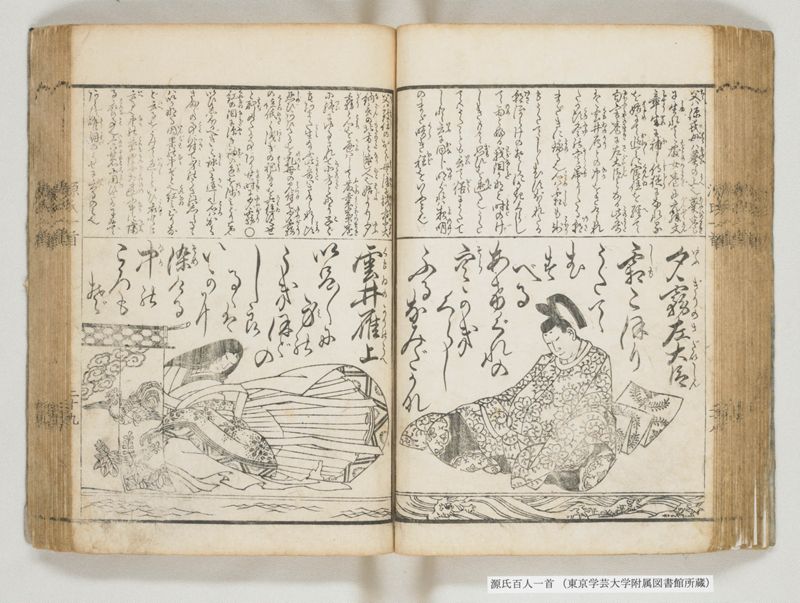
翻刻
【右丁 上段】
父(ちゝ)は源氏 母(はゝ)は葵(あふひ)の上(うへ)也 葵巻(あふひのまき)
に生(うま)れて処女巻(をとめのまき)に元服(げんぶく)文(もん)
章生(じやうせい)に補(ほ)し侍従(じじう)になれる
を始(はじめ)にて追々(おひ〳〵)に官位(くわんゐ)を経(へ)て
匂宮巻(にほふみやのまき)に左大臣(さだいじん)となる此哥(このうた)
は雲井鴈(くもゐのかり)との中(なか)をさけられ
たる頃(ころ)冬(ふゆ)の空(そら)曇(くも)りたる朝(あさ)
まだきに詠(よめ)る也 心(こゝろ)は霜(しも)も氷(こほり)
もうたてしくむすぼゝれたる
朝(あさ)ぼらけのそらにかきくらし
て雨(あめ)とふる我(わが)泪(なみだ)かなと時(とき)のけ
しきもて思(おも)ひを述(のぶ)る也うた
てはうたゝとも言(いひ)て俗(ぞく)にうたて
しと云(いふ)は同(おな)じ明(あけ)ぐれは夜明(よあけ)
のまだ暗(くら)き程(ほど)をいふこと也
【同 下段】
夕霧左大臣(ゆふぎりのさだいしん)
霜(しも)こほり
うたて
む
す
べる
あけぐれの
空(そら)かき
くらし
ふるなみだかな
【左丁 上段】
父(ちゝ)は致仕(ちじ)のおとゞ母(はゝ)は後(のち)に按察(あぜちの)大(だい)
納言(なごん)の北方(きたのかた)と成(なり)し人(ひと)也 始(はじめ)より夕(ゆふ)
霧(ぎり)と心(こゝろ)を通(かよ)はして藤裏葉巻(ふじのうらばのまき)
に終(つひ)にゆるされて北方(きたのかた)となり子(こ)ど
もあまた生(うみ)給ふ此哥(このうた)はさけられし頃(ころ)
忍(しの)びあひたるを乳母(めのと)の見付(みつけ)て夕霧(ゆふぎり)
の位(くらゐ)低(ひき)く浅(あさ)ぎの袍(はう)なるを六位(ろくゐ)すくせ
と恥(はぢ)しめたる事あり其時(そのとき)に夕霧(ゆふぎり)○
紅(くれなゐ)の泪(なみだ)に深(ふか)き袖(そで)の色(いろ)を浅(あさ)みどりとや
いひしほるべきと詠(よみ)たる返(かへ)し也 心(こゝろ)はかく
さま〴〵の事(こと)に付(つき)て身(み)のうさ【ママ】のしらるゝ
はいかなる因果(いんぐわ)の中(なか)ぞと也 紅(くれなゐ)みどりな
ど云(いへ)るをうけて色々(いろ〳〵)といひ衣(ころも)とも
云(いへ)る也 中(なか)の衣(ころも)は男女(なんじよ)相逢(あひあ)ふ中(なか)に隔(へだつ)
る衣(ころも)の事(こと)也 今(いま)は其心(そのこゝろ)に用(もち)ひたるには
あらず唯(たゞ)詞(ことば)のよせに云(いへ)るのみ也
【同 下段】
雲井雁上(くもゐのかりのうへ)
いろ〳〵に
身(み)の
うきほど
の
しら
るゝは
いかに
染(そめ)ける
中(なか)の
ころも
ぞ
現代語訳
【右丁 上段】
父は源氏、母は葵の上である。葵の巻で生まれ、少女の巻で元服し、文章生に任じられ侍従になったのを始めとして、次第に官位を経て、匂宮の巻で左大臣となる。この歌は雲井雁との仲を裂かれた頃、冬の空が曇った朝早くに詠んだものである。歌の意味は、霜も氷もひどく結ばれた夜明けの空を暗くして雨と降る我が涙であることよ、と時節の様子で思いを述べたものである。「うたて」は「うたた」とも言い、俗に「うたてし」というのと同じである。「明けぐれ」は夜明けのまだ暗い時を言うことである。
【同 下段】
夕霧左大臣
霜氷
ひどく結べる
明け暮れの
空をかき暗し
降る涙かな
【左丁 上段】
父は致仕の大殿、母は後に按察大納言の北の方となった人である。初めから夕霧と心を通わせて、藤裏葉の巻でついに許されて北の方となり、子供をたくさんお産みになる。この歌は引き裂かれていた頃、忍んで逢っていたのを乳母が見つけて、夕霧の位が低く浅葱の袍であるのを「六位の宿世よ」と恥じさせたことがある。その時に夕霧が「紅の涙に深き袖の色を浅緑とや言いしおるべき」と詠んだ返歌である。歌の意味は、このようにさまざまなことによって身の辛さが知られるのは、いかなる因果の仲であろうか、ということである。「紅」「緑」などと言ったのを受けて「色々」と言い、「衣」とも言っている。「中の衣」は男女が相逢う仲に隔てる衣のことである。今はその意味で用いたのではなく、ただ言葉の縁で言っただけである。
【同 下段】
雲井雁の上
色々に
身の憂き程の
知らるるは
いかに染めける
中の衣ぞ
英語訳
【Right Page, Upper Section】
His father is Genji, his mother is Aoi-no-ue. Born in the Aoi chapter, he came of age in the Otome chapter, was appointed as a monjōsei (student of Chinese literature) and became a jijū (chamberlain) to begin with, then gradually rose through the ranks to become Sadaijin (Minister of the Left) in the Niou-no-miya chapter. This poem was composed early on a cloudy winter morning during the period when he was separated from Kumoi-no-kari. The meaning of the poem is that frost and ice bind together harshly, and my tears fall like rain, darkening the dawn sky, expressing his feelings through the seasonal atmosphere. "Utate" can also be said as "utata," the same as the common expression "utateshi." "Akegure" refers to the still-dark time of daybreak.
【Same, Lower Section】
Yūgiri Sadaijin (Minister of the Left Yūgiri)
Frost and ice
binding so harshly—
in the dawn sky
darkened by falling tears
【Left Page, Upper Section】
Her father is the retired minister (chiji-no-otodo), her mother is the person who later became the consort of the Azech Dainagon (Great Counselor Inspector). From the beginning she exchanged hearts with Yūgiri, and in the Fuji-no-uraba chapter was finally permitted to become his consort, bearing him many children. This poem was composed as a response during the period when they were separated and meeting in secret. The wet nurse discovered them and shamed Yūgiri for his low rank and light blue court robe, calling it "the fate of a sixth-rank courtier." At that time Yūgiri had composed: "Should the deep crimson color of my tear-stained sleeves be disparaged as mere light green?" The meaning of the poem is: through various circumstances, the extent of my life's sorrows becomes known—what karmic relationship has caused this? Taking up his words about "crimson" and "green," she says "iro-iro" (various colors) and also mentions "koromo" (garments). "Naka-no-koromo" refers to the garments that separate men and women when they meet. Here it is not used in that sense, but merely as a play on words.
【Same, Lower Section】
Kumoi-no-kari-no-ue
In various ways
the extent of my life's sorrows
becomes known—
how was this middle garment
dyed with such fate?