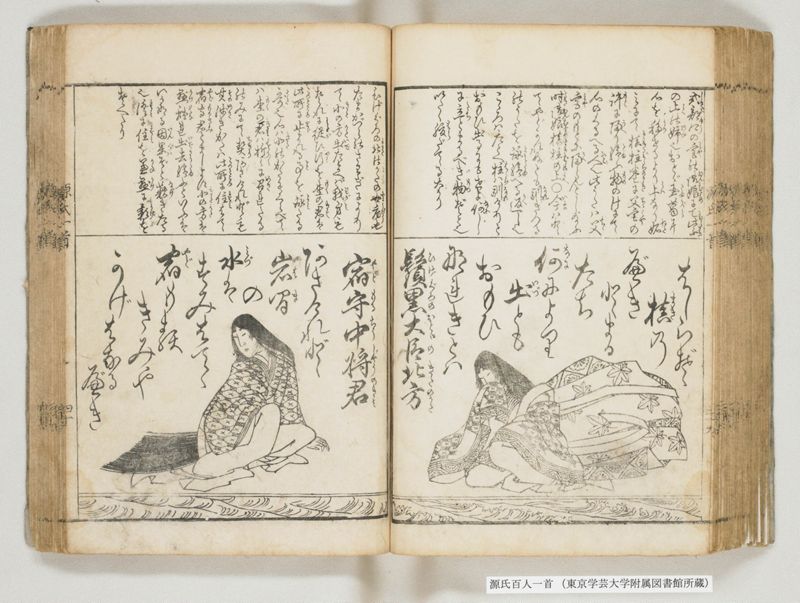
翻刻
【右丁 上段】
式部卿(しきぶけう)の宮(みや)の御娘(おんむすめ)にて紫(むらさき)
の上(うへ)の姉(あね)也おとゞ玉葛(たまかづら)に
心を移(うつ)せるより上(うは)なり妬(ねた)
みにて槙柱巻(まきばしらのまき)に父宮(ちゝみや)の
許(もと)に帰(かへ)り給(たま)ふ物(もの)のけにて
心のくるへる人(ひと)也此のうたは父(ちゝ)
宮(みや)のもとに帰(かへ)らんとし給ふ
時(とき)御娘(おんむすめ)槙柱(まきばしら)の上(うへ)○今(いま)はと
てやどかれぬとも馴(なれ)きつる
のうたを詠(よみ)給(たま)へる返(かへ)し也
こゝろはたとへ柱(はしら)は馴(なれ)けりと
おもひ出るにもせよ何(なに)し
に立(たち)とまるべき物(もの)ぞと也
いたく腹(はら)だてるなり
【同 下段 左から読む】
はしらぞ
槙(まき)の
べき
とまる
たち
何(なに)により
出(いづ)とも
おもひ
なれきとは
鬚黒大臣北方(ひげぐろのおとゞのきたのかた)
【左丁 上段】
ひげぐろの北(きた)のかたの女房(にようばう)也
たまかづらのさわぎにより
て北(きた)の方(かた)出(いで)たまへば我身(わがみ)も
それに従(したが)ひ行(ゆく)を杢(もく)の君(きみ)は
此所(このところ)に止(とゞ)まれる事(こと)を詠(よみ)たる
哥(うた)也心は北(きた)のかたにくらべて
は杢(もく)の君(きみ)は折々(をり〳〵)に召(めさ)れたる
のみにて契(ちぎり)あさけれども
其(その)浅(あさ)きかたは此所(このところ)に住(すみ)はて
宿守君(やどもるきみ)とまします北(きた)の方(かた)は
懸離(かけはな)れ出去(いでさり)給(たま)ふといふは
いかなる因果(いんぐは)ぞと歎(なげ)きたる
也 澄(すみ)に住(すみ)を兼(かね)懸(かけ)に影(かげ)を
そへたり
【同 下段】
宿守中将君(やどもるちうじやうのきみ)
あきけれど
岩間(いはま)
の
水(みづ)は
すみはてゝ
宿(やど)もる
きみや
かげはなる
べき
現代語訳
【右丁 上段】
式部卿宮の御娘で紫の上の姉である。大臣が玉鬘に心を移したことから、嫉妬して槙柱の巻で父宮のもとに帰られた。物の怪によって心が狂った人である。この歌は父宮のもとに帰ろうとされる時、御娘槙柱の上が「今はとて宿離れぬとも馴れきつる」の歌を詠まれたことへの返歌である。歌の意味は、たとえ柱は馴れ親しんだと思い出すにしても、なぜ立ち止まる必要があるのかということである。ひどく腹を立てているのである。
【同 下段 左から読む】
髭黒大臣北方
何によりて
立ちとまるべき
思い出づとも
馴れきとは
槙の柱ぞ
【左丁 上段】
髭黒の北の方の女房である。玉鬘の騒ぎによって北の方が出て行かれると、我が身もそれに従って行くのに、杢の君はこの所に留まることを詠んだ歌である。歌の意味は、北の方に比べて杢の君は時々召されるだけで契りが浅いけれども、その浅い方がこの所に住み続けて宿を守る君となられ、北の方は遠く離れて出て行かれるというのは、いかなる因果であろうかと嘆いたのである。「澄み」に「住み」を掛け、「懸け」に「影」を添えている。
【同 下段】
宿守中将君
浅けれど
岩間の水は
澄みはてて
宿守る君や
影離るべき
英語訳
【Right Page, Upper Section】
She was a daughter of Prince Shikibu-kyō and elder sister of Murasaki no Ue. Due to jealousy arising from the lord transferring his affections to Tamakazura, she returned to her father the prince, as described in the Makibashira chapter. She was a person whose mind was disturbed by spiritual possession. This poem is a response to the poem that began "Ima wa tote yado karenu tomo narekitsuru" which her daughter Makibashira no Ue composed when she was about to return to her father the prince. The meaning is: even if one might recall that the pillar was familiar, why should one stop and linger? She was extremely angry.
【Same, Lower Section, read from left】
Higekuro no Otodo no Kita no Kata
Why should one
stop and linger—
even if one recalls
having grown familiar,
it is but a maki pillar.
【Left Page, Upper Section】
She was a lady-in-waiting to Higekuro's principal wife. This poem was composed about Moku no Kimi remaining at this place while she herself followed the principal wife when she departed due to the Tamakazura affair. The meaning is: Compared to the principal wife, Moku no Kimi was only occasionally summoned and their bond was shallow, yet this shallow one remains here as the guardian of the dwelling, while the principal wife departs to distant places—what kind of karma is this? She laments this situation. There is wordplay between "sumi" (clear/pure) and "sumi" (dwell), and "kake" (hang) is paired with "kage" (shadow/reflection).
【Same, Lower Section】
Yadomoru Chūjō no Kimi
Though shallow,
the water between rocks
remains perfectly clear—
should the lord who guards
this dwelling have his reflection depart?