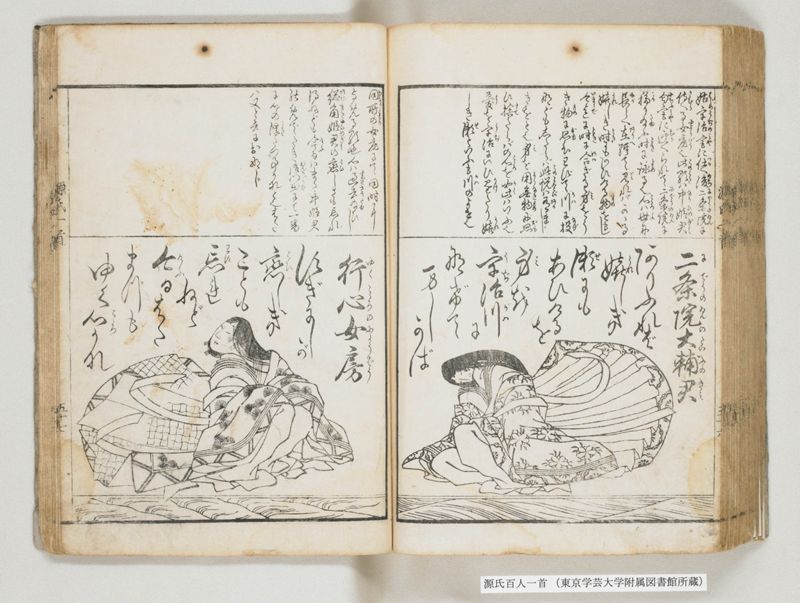
翻刻
【右丁 上部】
始(はじめ)宇治宮(うぢのみや)に仕(つか)へ後(のち)二条院(にでうのゐん)に
侍(さむら)へる女房(にようばう)也 此歌(このうた)は中姫君(なかひめぎみ)
匂宮(にほふみや)に迎(むか)へられて二条院(にでうのゐん)に
移(うつ)り給(たま)ふ時(とき)に詠(よめ)る也 心(こゝろ)は世(よ)に
長(なが)しく在(あり)経(へ)て見(み)ればかゝる
嬉(うれ)しき時(とき)にもあひける物(もの)をもし
今迄(いまゝで)に時(とき)に合(あは)ざる身(み)をう
き物(もの)に思(おも)ひわびて川(かは)に投(なげ)
などもしたらば此悦(このよろこび)は有(ある)まじ
きをと也 身(み)を用(よう)無(なき)物(もの)に思(おも)
ひ捨(すて)たらばの心(こゝろ)を如此(かく)はいふ也
憂(う)を宇治(うぢ)にいひ懸(かけ)たり嬉(うれ)
しき瀬(せ)といふも川(かは)のよせ也
【同 下段】
二条院大輔君(にでうのゐんのたいふのきみ)
ありふれば
嬉(うれ)しき
瀬(せ)にも
あひける
を
身(み)を
宇治川(うぢがは)
に
なげて
まし
かば
【左丁 上段】
同所(おなじところ)の女房にて同時に
よめる歌也心は過去(すぎさり)給(たま)ひし
総角(あげまきの)姫君(ひめぎみ)の恋(こひ)しさも忘れ
得ねども今日(けふ)はまた中姫君
のめでたき御門出(おんかどで)にて一番
に心の浮(うき)たつ事かなと也はた
は又と云におなじ
【同 下段】
行心女房(ゆくこゝろのにようばう)
すぎにしが
恋(こひ)しき
ことも
忘(わす)れ
ねど
今日(けふ)はた
まつも
ゆく心(こゝろ)かな
現代語訳
【右丁 上部】
初めは宇治宮に仕え、後に二条院に仕えた女房である。この歌は中の姫君が匂宮に迎えられて二条院に移られる時に詠んだものである。歌の心は、世の中に長く生きて見ていれば、このような嬉しい時にも巡り合うものである。もし今まで運に恵まれない身を辛いものに思い悩んで川に身を投げなどしていたら、この喜びはなかったであろう、ということである。身を無用なものに思い捨てていたならば、という心をこのように言うのである。「憂」を「宇治」に言葉を掛けており、「嬉しき瀬」というのも川の縁語である。
【同 下段】
二条院大輔君
生きていれば
嬉しい瀬にも
巡り合うことよ
身を宇治川に
投げていたならば
【左丁 上段】
同じ所の女房で、同じ時に詠んだ歌である。歌の心は、亡くなられた総角の姫君への恋しさも忘れることはできないけれども、今日はまた中の姫君の素晴らしいご門出で、何よりも心が浮き立つことであるということである。「はた」は「また」と同じ意味である。
【同 下段】
行心女房
過ぎ去った方への
恋しい思いも
忘れはしないが
今日はまた
心も晴れやかに
向かう気持ちである
英語訳
【Right Page, Upper Section】
She is a court lady who first served at Uji Palace and later at Nijō-in (Second Avenue Palace). This poem was composed when the Middle Princess was welcomed by Prince Niou and moved to Nijō-in. The heart of the poem is: if one lives long in this world and observes it, one will encounter such joyful times as well. If I had despaired over my unfortunate circumstances up until now and thrown myself into a river, this joy would not have existed. This expresses the sentiment "if I had thought my life worthless and abandoned it." The word "u" (sorrow) is used as a pun on "Uji," and "joyful rapids" is also a river-related word association.
【Same, Lower Section】
Nijō-in no Taifu no Kimi (Lady Assistant of Nijō-in)
Living on,
I have encountered
even joyful rapids—
had I thrown
myself into
the Uji River
【Left Page, Upper Section】
This is a poem composed by another court lady from the same place at the same time. The heart of the poem is: although I cannot forget my longing for the departed Princess Agemaki, today once again brings the wonderful departure ceremony of the Middle Princess, which lifts my spirits above all else. "Hata" has the same meaning as "mata" (again/also).
【Same, Lower Section】
Yuku-kokoro no Nyōbō (Lady of the Moving Heart)
Though I cannot
forget my longing
for the one
who passed away,
today again
my heart moves
forward with joy