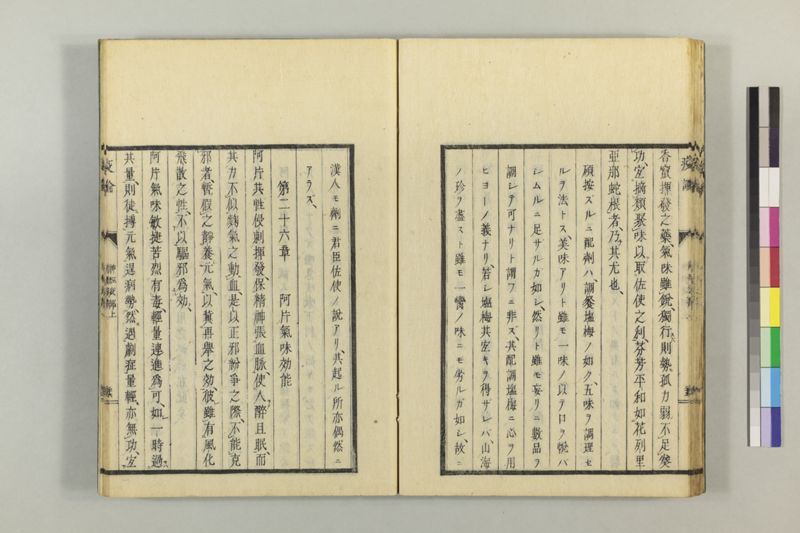
翻刻
香-竄揮-発之薬、気味雖_レ鋭、独-行 ̄スレハ則勢 ̄ヒ孤力弱 ̄ノ不_レ足_レ奏
_レ功、宜_三摘_レ類聚_レ味以 ̄テ取_二佐-使之利_一、芬-芳平-和如_二花-列-里-
亜-那蛇-根_一者、乃 ̄チ其尤也、
碩按ズルニ配剤ハ、調-餐塩-梅ノ如ク、五味ヲ調理セ
ルヲ法トス、美味アリト雖モ一味ノ以テ口ヲ悦バ
シムルニ足ザルガ如シ、然リト雖モ妄リニ数品ヲ
調シテ可ナリト謂フニ非ズ、其配-調塩-梅ニ心ヲ用
ヒヨーノ義ナリ、若シ塩梅其宜キヲ得ザレバ、山海
ノ珍ヲ尽スト雖モ一臠ノ味ニモ劣ルガ如シ、故ニ
漢人モ剤ニ君臣佐使ノ説アリ、其起ル所亦偶然ニ
アラズ、
第二十六章 阿片気味効能
阿片其性侵-刺揮-発、保_二精神_一張_二血脈_一、使_二 人 ̄ヲシテ酔且眠_一、而
其力不_レ似_二麴-気之動_一_レ ̄ニ血、是-以正邪紛争之際、不_レ能_レ克
_レ邪者、暫 ̄ク仮_レ之静_二-養 ̄シ元気_一、以冀_二再-挙之効_一、彼 ̄レ雖_レ有_二風-化
飛-散之性_一、不_下以_二駆邪_一為_上_レ効 ̄ト、
阿片気味敏-捷苦-烈有_レ毒、軽-量連-進為_レ可、如 ̄シ一-時過_二 ̄セハ
其量_一、則徒 ̄ニ搏_二元気_一逞_二病勢_一、然 ̄トモ遇_二劇症_一量軽 ̄モ亦無_レ功、宜_下
現代語訳
香竄揮発の薬は、気味が鋭いとはいえ、単独で用いれば勢いが孤立し力が弱く、功を奏するに足りない。類を摘み味を聚めて佐使の利を取るべきである。芬芳平和なる花列里亜那蛇根のような者が、すなわちその最たるものである。
碩が按ずるに、配剤は調餐塩梅のごとく、五味を調理することを法とする。美味があるとはいえ、一味だけでは口を悦ばせるに足りないようなものである。しかしながら、みだりに数品を調合すればよいというわけではない。その配調は塩梅に心を用いるの義である。もし塩梅がその宜しきを得なければ、山海の珍を尽くしても一臠の味にも劣るようなものである。故に漢人も剤に君臣佐使の説があり、その起こるところもまた偶然ではない。
第二十六章 阿片気味効能
阿片はその性質が侵刺揮発で、精神を保ち血脈を張らせ、人をして酔わせかつ眠らせるが、その力は麴気が血を動かすのとは似ていない。これゆえに正邪紛争の際、邪に克つことができない者は、暫くこれを仮り借りして元気を静養し、再挙の効を冀うのである。彼は風化飛散の性があるとはいえ、駆邪を効とするものではない。
阿片の気味は敏捷苦烈で毒がある。軽量を連続して進めるのがよい。もし一時にその量を過ごせば、徒に元気を搏ち病勢を逞しくする。しかしながら劇症に遇えば軽量でもまた無功である。
英語訳
Aromatic penetrating and volatile medicines, though sharp in qi and flavor, when used alone have isolated momentum and weak power, insufficient to achieve success. One should select similar types and gather flavors to obtain the benefits of adjuvant and messenger [medicines]. Those that are fragrant and mild like valerian root are indeed the best examples.
According to my [Shaku's] understanding, compounding is like preparing seasoned dishes - the method is to harmonize the five flavors. Even if there are delicious tastes, a single flavor alone is insufficient to please the palate. However, this does not mean one can randomly combine several ingredients. The principle is to apply careful attention to seasoning like salt and plum. If the seasoning does not achieve proper balance, even exhausting all the delicacies of mountains and seas would be inferior to a single morsel of properly seasoned food. Therefore, the Chinese also have the theory of sovereign, minister, adjuvant, and messenger in prescriptions, and its origin is not accidental.
Chapter 26: The Qi, Flavor, and Efficacy of Opium
Opium has a penetrating, stimulating, and volatile nature. It preserves the spirit, strengthens the blood vessels, and makes people intoxicated and sleepy, but its power is not like the movement of blood by alcoholic qi. Therefore, when there is conflict between righteous and pathogenic [qi], those who cannot overcome the pathogenic [qi] temporarily borrow this to calm and nourish the original qi, hoping for the effect of renewed effort. Although it has the nature of volatilization and dispersion, its effect is not in expelling pathogenic [qi].
Opium's qi and flavor are swift, bitter, intense, and poisonous. It is suitable to administer light doses continuously. If one exceeds the proper amount at one time, it merely strikes the original qi and strengthens the disease momentum. However, when encountering severe symptoms, light doses are also ineffective.