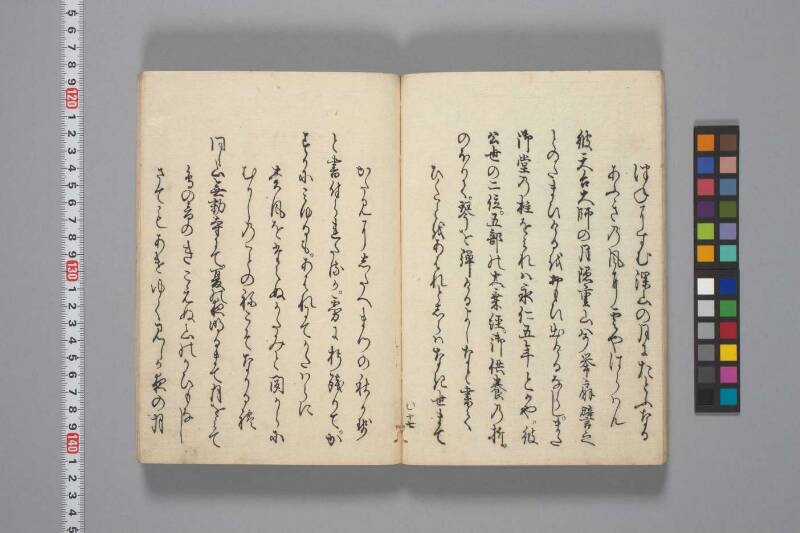
翻刻
【22コマ】
【右丁】
つねにすむ深山の月にたとふなる
あふきの風に雲やはらはん
彼天台大師の月隠重山兮挙扇譬之#1
とのたまひけるをおもひ出けるならし。また
御堂の柱をみれは永仁五年とかや。彼
公世の二位。五部の大乗経。御供養の折。
のほりて。琴を弾けるよしなと書て
ひくことをあはれとしらはなき世まて
【左丁】
かたみにしたへまつの秋かせ
と書付られたるか。霧に𣏓残りて。か
すかにみゆるも。あはれにてかたはらに
枩風をたえぬかたみと聞からに
むかしのことのねこそなかるれ
同し山無動寺にて。夏の夜明るまて月をみて
鳥の音のきこえぬ山のかひもなし
さてもあけゆく見しか夜の月
現代語訳
【右丁】
常に澄む 深山の月に 譬ふなる
扇の風に 雲やはらはん
これは、かの天台大師が「月は重山に隠れ、扇を挙げてこれに譬えた」とおっしゃったことを思い出したからであろう。また、御堂の柱を見れば「永仁五年」とかや書かれていた。かの公世の二位が、五部の大乗経の御供養の折に、(柱に)登って琴を弾いたとのことなどを書いて——
弾くことを あわれと知らば 亡き世まで
【左丁】
形見にしたへ 松の秋風
と書き付けられたものが、霧に半ば残って、かすかに見えるのも、しみじみと感じられ、その傍らに——
松風を 絶えぬ形見と 聞くからに
昔のことの 音こそ流るれ
同じ山(比叡山)の無動寺にて、夏の夜が明けるまで月を眺めて——
鳥の音の 聞こえぬ山の 甲斐もなし
さてもあけゆく 見しか夜の月
英語訳
【Right Page】
*Tsune ni sumu / miyama no tsuki ni / tatofunaru / ōgi no kaze ni / kumo ya harawan*
(Just as the moon that ever shines clear in the deep mountains is likened [to a fan], may the breeze from this fan sweep away the clouds.)
This was apparently written in recollection of the words of the Great Teacher Tiantai [Zhiyi], who, [gazing at the moon hidden behind a range of mountains], raised his fan and used it as a simile. Furthermore, upon looking at a pillar of the hall, he found inscribed upon it something to the effect that in the fifth year of Einin [1297], the "Nijō of Kose" — during the memorial offering of the five divisions of the Mahāyāna sūtras — had climbed up and played the koto there. Next to this inscription was written:
*Hiku koto wo / aware to shiraba / naki yo made*
【Left Page】
*(katami ni shitae / matsu no aki kaze)*
(If you would know the pathos of this playing, then even from beyond the grave — take as a keepsake [the sound of] the autumn wind through the pines.)
The inscription, half-obscured by the mist, was faintly visible — a moving sight — and beside it he wrote:
*Matsukaze wo / taenu katami to / kiku kara ni / mukashi no koto no / ne koso nagarure*
(When I hear the wind through the pines as an undying keepsake, the notes of that koto from long ago seem to flow anew.)
At Mudōji Temple on that same mountain [Mt. Hiei], having gazed at the moon until a summer's night turned to dawn:
*Tori no ne no / kikoenu yama no / kai mo nashi / satemo akeyuku / mishika yo no tsuki*
(There is no reward in a mountain where no bird's song is heard — and yet, how beautiful is the moon of this night, now fading as dawn breaks.)