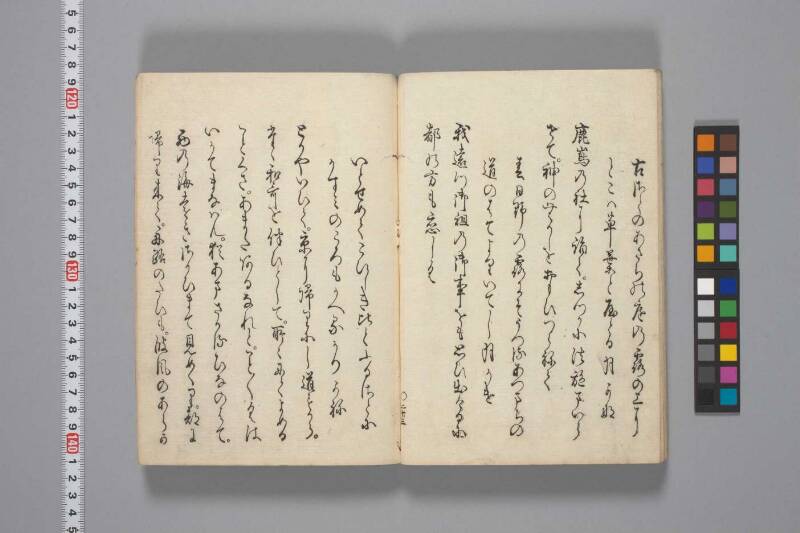
翻刻
【29コマ】
【右丁】
古さとのあさちの庭の露の上に
とこは草葉とやとる月かな
鹿嶌の社に詣て。しつかに法施まいら
せて。神のむかしをおもひつらねて
春日野の露にそうつるあつまちの
道のはてよりいてし月かけ
我遠つ御祖の御事をも思ひ出けるに
都の方も恋しく
【左丁】
いとせめてこひしき比とふるさとに
かすみのころもかへるかりかね
とかやいひて。京に帰りにし道すから。
たゝ和哥を伴ひとして。所々にてよめる
ことくさ。あまたあるなれと。こと〳〵くは
いかてまなはん。猶あまさかるひなのはて。
西の海遠きさかひまて見めくり。都に
帰り来て。舟路のたひも。波風のあらか
現代語訳
【右丁】
古さとのあさちの庭の露の上に
とこは草葉とやとる月かな
(故郷の浅茅の生い茂る庭に降りた露の上に、床としての草葉に宿る月よ——荒れ果てた我が旧居に、月の光だけが変わらず宿っている。)
鹿島の社に参詣して、静かに法施を捧げ、神の往古のことをおもい連ねて、
春日野の露にぞうつる東路の
道の果てよりいでし月かげ
(春日野の露に映し出されるのは、遠く東国の道の果てからやってきた、その月の光——故郷奈良の春日と、東国の旅路とを、月影が結びつける。)
我が遠つ御祖(とおつみおや)のことをも思い出されるにつけ、都の方も恋しくなって、
【左丁】
いとせめてこいしき頃とふるさとに
かすみのころもかえるかりかね
(この上なく都が恋しい折しも、故郷のほうへ霞の衣をまとって帰ってゆく雁の声よ——。)
とか言って、京に帰る道すがら、ただ和歌を伴として、あちこちで詠んだ歌の種々が数多くあるけれど、それをすべてどうして学ぶことができようか(とても記しきれない)。さらに、天遠く離れたひなの果て、西の海の遠い境まで見て回り、都に帰り来て、舟路の旅も、波風の荒か——
(以下次丁へ続く)
英語訳
【Right Page】
*Furusato no / asaji no niwa no / tsuyu no ue ni / tokowa kusaba to / yatoru tsuki kana*
(Upon the dew that falls upon the reedy, overgrown garden of my old home — the moon takes its lodging in the grass and leaves, as if making a bed there. The moonlight alone remains unchanged in this ruined dwelling.)
He made a pilgrimage to the shrine at Kashima, and there quietly offered prayers and religious devotion. Meditating upon the ancient history of the god enshrined there, he composed:
*Kasugano no / tsuyu ni zo utsuru / azumaji no / michi no hate yori / ideshi tsukikage*
(Reflected in the dew of Kasuga Plain — the light of the moon that rose from beyond the far end of the eastern road. The moonlight binds together Kasuga of the homeland and the far reaches of the eastern provinces through which he has wandered.)
He was then moved to think upon his distant ancestors, and a longing for the capital arose within him.
【Left Page】
*Ito semete / koishiki koro to / furusato ni / kasumi no koromo / kaeru karigane*
(At the very time when I long most intensely for my homeland, the wild geese fly homeward wearing robes of mist — their cries echo my own yearning.)
So it is said that he composed, and set out on the road back to Kyoto. Taking only waka poetry as his companion, he composed poems at many places along the way — there are a great many such verses, but how could one possibly learn or record them all? Furthermore, he traveled even to the remote hinterlands far beneath the heavens, and to the distant shores of the western sea, and after seeing all of these, he returned to the capital. His travels by sea, too, amid rough winds and waves —
(Continued on the following page.)