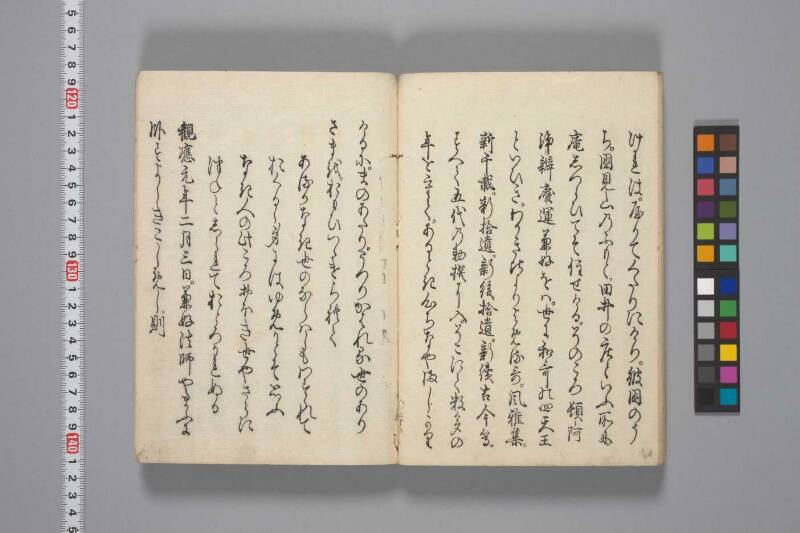
翻刻
【31コマ】
【右丁】
けれは。やかてくたりにけり。彼国のう
ち。国見山のふもと。田井の庄といふ所に。
庵しつらひてそ住せける。そのころ頓-阿
浄-辨慶-運兼-好をは。世に和哥の四天王
といひき。わかき比よりよめる哥。風雅集。
新干載。新拾遺。新後拾遺。新續古今等。
すへて五代の勅撰に入。そこにて数多の
年を重て。あるとき心ちなやましかり
【左丁】
けるに。まのあたり。うつりかはれる世のあり
さまを。おもひつゝけられて
あるかなき世のならはしもわすられて
おくるゝ身にはゆめかとそ思ふ
なき人の此ころおほき世やさらに
つねとしられておとろかれぬる
観應元年二月三日。兼好法師やまふに
卧すよしきこしめし。則
現代語訳
【右丁】
(播成忠が兼好を)招いたので、やがて(兼好は伊賀に)下って行った。その国の中に、国見山の麓、田井の庄というところに、庵を設けて住まわれた。そのころ、頓阿・浄弁・慶運・兼好の四人は、世に「和歌の四天王」と称された。若い頃より詠んだ歌は、『風雅集』・『新千載』・『新拾遺』・『新後拾遺』・『新続古今』など、合わせて五代の勅撰集に入った。そこで(伊賀にて)数多くの年を重ねて、あるとき気分がすぐれなかった
【左丁】
折に、まのあたり(目の前で)移り変わってゆく世のありさまを、思い続けられて、
あるかなき世のならわしも忘られて
遅れる身にはゆめかとぞ思ふ
(あるかなきかのはかない世の習いも忘れてしまうほど、(先立った人々に)後れをとった身には、(この世に生き残っていること自体が)夢かと思われる。)
なき人の此ごろ多き世やさらに
常と知られておどろかれぬる
(亡くなった人がこのごろ多い世の中に、さらにまた(人の死が)当たり前のことと知られながらも、改めて驚かされることよ。)
観応元年(一三五〇年)二月三日、兼好法師が病に臥しているとの由を(某が)お聞きになって、すなわち——
(以下次丁へ続く)
英語訳
【Right Page】
(Harinari Tada having invited Kenkō,) he presently set out and made his way down to that province. Within that land, at the foot of Mount Kunimi, in a place called Tai no Shō, he had a hermitage prepared and took up residence there. Around this time, Tonna, Jōben, Keiun, and Kenkō were known to the world as "the Four Heavenly Kings of Waka poetry." The poems he had composed since his youth were included in the *Fūgashū*, the *Shinsenzan*'i*, the *Shinshuii*, the *Shingoshūi*, and the *Shinzoku Kokin* — altogether entering five successive imperial anthologies. There, in Iga, he accumulated many years, and at a certain time, when he was feeling unwell,
【Left Page】
he continued to reflect upon the changing state of the world unfolding before his very eyes, and composed:
*Aruka naki yo no / narawashi mo wasurarete / okururu mi ni wa / yume ka to zo omou*
(The fleeting customs of this uncertain world are forgotten; for one who has been left behind by so many, it all seems as though it must be a dream.)
*Naki hito no / kono goro ōki / yo ya sara ni / tsune to shirarête / odorokareruru*
(In this world where those who have passed away have become so numerous of late, and yet — knowing that death is a thing most ordinary — one is struck with wonder anew.)
On the third day of the second month of the first year of Kannō (1350), upon hearing that the Monk Kenkō was bedridden with illness, (someone) immediately —
(Continued on the following page.)