翻刻
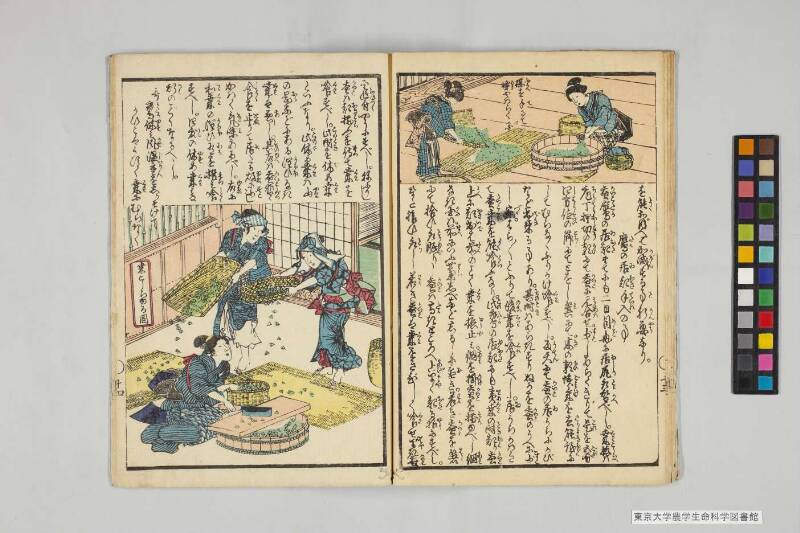
【右丁上段】【挿絵】
椹(ふかへ)を手(て)にて
揉(もみ)やはらく図(づ)
【右丁下段】
を能(よく)おぼへて加減(かげん)する事(こと)肝要(かんやう)なり。
鷹(たか)の居起(ゐおき)手入(ていれ)の事
蚕(かいこ)鷹(たか)の居起(ゐおき)まてにも二日/目毎(めごと)に居尻(ゐしり)取替(とりかへ)べし。桑拵(くわこしらへ)は
庖丁(ほうてう)押切(おしきり)の類(るひ)にて蚕(かいこ)に見合(みあは)せ。少(すこ)しあらくきりて是(これ)を五分(ごぶ)
四方(しはう)位(くらい)の篩(こほし)にてとをし箕(み)にて。木(き)の類(るひ)埃気(ごみけ)を去(さり)能(よき)程(ほど)に
してむらなくふりかけ喰(くわ)すべし。雨天(うてん)にて蚕(かいこ)の居(ゐ)うらにかび
など出来(でき)る事あり。其時(そのとき)はあらきすりぬかを蚕(かいこ)のうへに少(すこ)
し宛(づゝ)。はら〳〵とふりて後(のち)桑(くわ)を喰(くは)すべし。居(ゐ)うらかはき
て蚕(かいこ)桑(くわ)を能(よく)喰(くら)ふなり。此(この)鷹(たか)の居起(ゐおき)にも責桑(せめくわ)の時(とき)起(おこ)り蚕(かいこ)
上(うへ)に起出(おきいで)は前(まへ)のことく桑(くわ)を振止(ふりや)み。網(あみ)を掛(かけ)蚕(かいこ)を揃(そろ)ゆべし網(あみ)
なき国(くに)は。前(まへ)にいふ藁(わら)しべなどしるしに置(お)き。若(わか)き蚕(かいこ)を箸(はし)
にて拾ひ取(とり)眠(ねむ)りし蚕(かいこ)は高(たか)きところへ上(あげ)早(はや)く起(おき)る様(やう)にすべし。
また拾ひ取(とり)し若(わか)き蚕(かいこ)は桑(くわ)をきびしく喰(くわ)せ。早(はや)き蚕(かいこ)
【右丁上段】
に追付(おひつく)やうにすべし。ねふりし
蚕(かいこ)は起揃(おきそら)ふを待(まつ)て桑(くわ)を
喰(くわ)すべし。此時(このとき)を休(や)め桑(くわ)
といふなり。此(この)休(や)め桑(くわ)は山(やま)
の岡(おか)などにある潤(うるほ)ひなき
桑(くわ)は悪(あし)し。其(その)故(ゆへ)は蚕(かいこ)暫(しばら)く
食(しよく)を止(とま)りて居(ゐ)たる故(ゆゑ)に少(すこ)し
かはく気味(きみ)あるべし。故(ゆゑ)に
和桑(わくわ)の潤(うるほ)ひ有(あり)を撰(えら)み喰(しよく)
すべし。四/度(ど)の休(やす)め桑(くわ)みな
斯(かく)のごとくなるへし。
《割書:哥に》鷹休(たかやす)み風(かぜ)湿(しつ)寒(かん)をしりそけて
かひこはうすく桑(くわ)にむらなく
【左丁下段】【挿絵】
桑こしらゆる図
【「椹」の振り仮名「ふかへ」は「ふなへ」ヵ。「ふなべ」は「桑の実」と「桑の花」の三丹の方言】
【「篩」の振り仮名「こほし」は「とほし」「とをし」ヵ】
【「休め桑」の振り仮名に「やめくわ」二件と「やすめくわ」一件が有り。前者は「す」脱ヵ】
現代語訳
【右丁上段】【挿絵】
桑の実を手で揉んで柔らかくする図
【右丁下段】
をよく覚えて加減することが肝要である。
二齢の眠起と手入れのこと
蚕の二齢の眠起まで、二日目ごとに敷き藁を取り替えるべきである。桑の準備は包丁や押切などの類で蚕に見合うように、少し粗く切って、これを五分四方ほどの篩で通し、箕で木の破片やごみを取り除き、よい程度にして、むらなく振りかけて食べさせるべきである。雨天で蚕の敷き藁にカビなどができることがある。その時は粗い糠を蚕の上に少しずつぱらぱらと振ってから桑を食べさせるべきである。敷き藁が乾いて蚕はよく桑を食べるようになる。この二齢の眠起でも、桑を多く与える時期が起こり、蚕が上に起き出たら、前のように桑を与えるのをやめ、網をかけて蚕を揃えるべきである。網のない国では、前に言った藁しべなどを目印に置き、若い蚕を箸で拾い取り、眠った蚕は高いところへ上げて早く起きるようにすべきである。また拾い取った若い蚫は桑を十分に食べさせ、早い蚕に追いつくようにすべきである。眠った蚕は起き揃うのを待って桑を食べさせるべきである。この時を休め桑という。この休め桑は山の岡などにある潤いのない桑は悪い。その理由は蚕がしばらく食事を止めていたため、少し乾く気味があるからである。故に和桑の潤いのあるものを選んで食べさせるべきである。四度の休め桑はみなこのようにするべきである。
《割書:歌に》二齢休み風湿寒を退けて
蚕は薄く桑にむらなく
【左丁下段】【挿絵】
桑を準備する図
英語訳
【Right Page, Upper Section】【Illustration】
Diagram of softening mulberry fruits by rubbing them with hands
【Right Page, Lower Section】
It is essential to remember this well and adjust accordingly.
On the dormancy and care of second instar
Until the dormancy period of the second instar silkworms, the bedding straw should be replaced every other day. For mulberry preparation, use knives, chopping tools and the like appropriate for the silkworms, cutting somewhat coarsely, then pass this through a sieve of about five-bu square, and use a winnowing basket to remove wood fragments and dust, making it to a good degree and sprinkling it evenly for feeding. During rainy weather, mold and such may develop on the silkworms' bedding straw. At such times, sprinkle coarse rice bran little by little over the silkworms, then feed them mulberry. When the bedding straw dries, the silkworms will eat the mulberry well. Even during this second instar dormancy, there comes a time for intensive mulberry feeding, and when the silkworms emerge on top, stop feeding mulberry as before, cover with a net to align the silkworms. In regions without nets, place straw markers as mentioned before, pick up young silkworms with chopsticks, and place sleeping silkworms in high places so they wake up early. Also, feed the picked young silkworms plenty of mulberry so they can catch up with the faster silkworms. Wait for the sleeping silkworms to wake up together before feeding them mulberry. This period is called "resting mulberry." For this resting mulberry, dry mulberry from mountain hills without moisture is bad. The reason is that since the silkworms have stopped eating for a while, they tend to be somewhat dry. Therefore, select moist Japanese mulberry for feeding. All four periods of resting mulberry should be done this way.
《Marginal note: In verse》Second instar rest, ward off wind, humidity, and cold
Silkworms thinly, evenly on mulberry
【Left Page, Lower Section】【Illustration】
Diagram of preparing mulberry