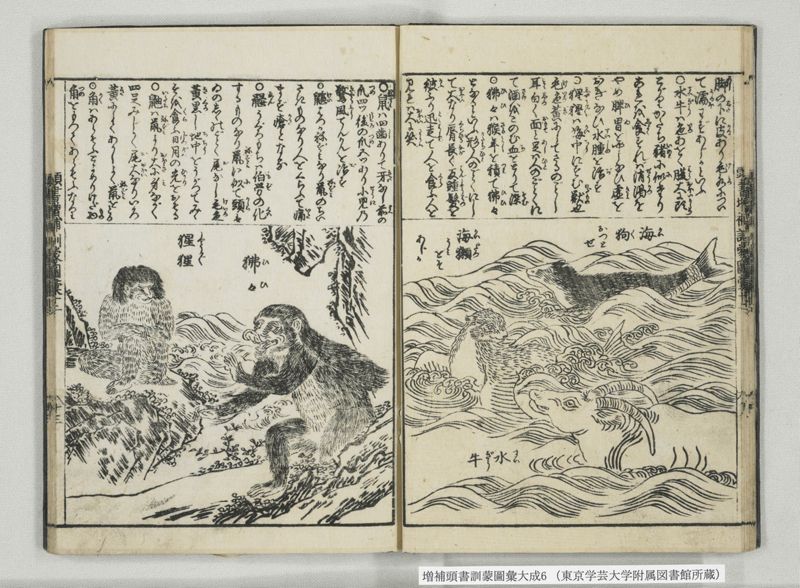
翻刻
【上段】
脚(あし)の下(した)に皮(かわ)あり毛水(けみず)につい
て濡(うるほ)わずあじかといふ
○水牛(すいぎう)は色(いろ)あをく腹大(はらおほい)に頭(かしら)
とがりかたち豬(いのこ)に似(に)たり
これを食(しよく)すれば消渇(せうかつ)を
やめ脾胃(ひゐ)をやしなひ虚(きよ)を
おぎなひ水腫(すいしゆ)を治(ぢ)す
○猩猩(しやう〴〵)は海中(かいちう)にすむ獣(けだもの)也
毛色黄(けいろき)にしてさるのごとし
耳白(みゝしろ)く面(おもて)と足(あし)は人(ひと)のごとくに
て酒(さけ)をこのむ血(ち)をとりて染(そむ)
○狒々(ひひ)は猴年(さるとし)を積(つみ)て狒々(ひひ)
となるといふ形人(かたちひと)のごとくにし
て大(おほい)なり脣長(くちひるなが)く反踵髪(はんしやうばつ)を
被(かふ)ふり迅走(とくはしり)て人を食(くら)ふ人を
見れは大(おほい)に笑(わらふ)
○鼠(ねすみ)は四 歯(し)ありて牙(きば)なし前(まへ)の
爪(つめ)四ツ後(うしろ)の爪(つめ)五ツあり小児(せうに)の
驚風(きやうふう)てんかんを治(ぢ)す
○鼷(けい)はつかねずみなり鼠(ねずみ)のちい
さきものなり人をくらふて痛(いた)
まず瘡(かさ)となる
○鼹(ゑん)うぐろもちは伯労(もず)の化(くは)
するものなり鼠(ねずみ)に似(に)て頭(かしら)は
ゐのしゝのごとく尾(お)なし毛色(けいろ)
黄黒(きくろ)し池中(ちちう)をうがつてみゝ
すを食(くら)ふ日月(じつげつ)の光(ひかり)をおそる
○鼬(いたち)は鼠(ねずみ)より大(おほき)に身(み)ながく
四足みじかく尾大(おおほい)なりいろ
黄(き)にしてあかしよく鼠(ねずみ)をとる
○角(かく)はあらそふとよめりけだ物(もの)
角(つの)をもつてあらそふなり
【下段】
海狗(かいく)
おつとせ
海獺(かいだつ)
うみをそ
あじか
水牛(すいぎう)
狒々(ひひ)
猩猩(しやう〴〵)
現代語訳
【上段】
脚の下に皮があり、毛は水について
も濡れない。アザラシという。
○水牛は色が青く腹が大きく、頭が
とがって形は猪に似ている。
これを食べると消渇を
止め、脾胃を養い、虚を
補い、水腫を治す。
○猩猩は海中に住む獣である。
毛色は黄色で猿のようである。
耳は白く、顔と足は人のようで
酒を好む。血を取って染める。
○狒々は猿が年を重ねて狒々
になるという。形は人のようで
大きい。唇が長く反踵髪を
被っており、素早く走って人を食う。人を
見ると大いに笑う。
○鼠は四つの歯があって牙がない。前の
爪は四つ、後ろの爪は五つある。小児の
驚風(ひきつけ)や癲癇を治す。
○鼷は二十日鼠である。鼠の小
さいものである。人を噛んでも痛
まず、瘡となる。
○鼹(もぐら)は百舌鳥が変化
したものである。鼠に似て頭は
猪のようで尾がない。毛色は
黄黒い。池の中を掘って蚯蚓
を食う。日月の光を恐れる。
○鼬は鼠より大きく身が長く、
四足は短く尾は大きい。色は
黄色で赤い。よく鼠を捕る。
○角は争うと読める。獣が
角を持って争うからである。
【下段】
海狗(カイク)
おっとせい
海獺(カイダツ)
うみうそ
あざらし
水牛(スイギュウ)
狒々(ヒヒ)
猩猩(ショウジョウ)
英語訳
[Upper section]
There is skin under its legs, and its fur does not
get wet even when touched by water. This is called a seal.
○The water buffalo is blue in color with a large belly and a
pointed head, resembling a wild boar in shape.
When eaten, it stops excessive thirst,
nourishes the spleen and stomach, supplements
deficiency, and treats edema.
○The orangutan is a beast that lives in the sea.
Its fur is yellow like a monkey.
Its ears are white, and its face and feet are like humans.
It likes alcohol. Its blood is taken for dyeing.
○The baboon is said to become a baboon
when a monkey ages. Its form is like a human
but large. It has long lips and wears
reverse-heel hair, runs swiftly and eats people. When it
sees people, it laughs greatly.
○The rat has four teeth but no fangs. It has four
claws in front and five claws behind. It treats
convulsions and epilepsy in children.
○The kei is a field mouse. It is a small
type of rat. Even when it bites people, it doesn't
hurt but causes sores.
○The mole is said to be a transformation
of a shrike. It resembles a rat but has a head like
a wild boar and no tail. Its fur color is
yellow-black. It digs in ponds and
eats earthworms. It fears the light of sun and moon.
○The weasel is larger than a rat with a long body.
Its four legs are short and its tail is large. Its color is
yellow and red. It catches rats well.
○"Kaku" (horn) can be read as "to fight." This is because beasts
fight using their horns.
[Lower section]
Sea dog (kaiku)
ottosei (fur seal)
Sea otter (kaidatsu)
umiuso
azarashi (seal)
Water buffalo (suigyū)
Baboon (hihi)
Orangutan (shōjō)