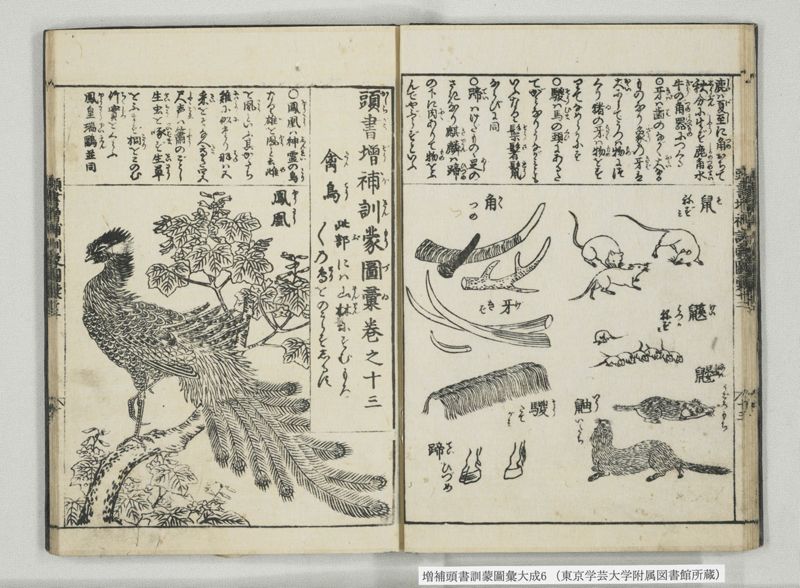
翻刻
【右丁】
【上段】
鹿(しか)は夏至(げし)に角(つの)おちて
秋分(しうぶん)に生(しやう)ず鹿角(しかのつの)水(すい)
牛(ぎう)の角(つの)器(うつはもの)につくる
○牙(きば)は歯(は)のながく大(おゝい)なる
ものなり象(ざう)の牙(きば)は
大(おゝい)にしてうつは物(もの)につ
くり猪(ゐ)の牙(きは)は物(もの)をす
りてなめらかにす
○騣(そう)は馬(むま)の頸(くひ)にあるた
てがみなりうながみとも
いふなり鬃(そう)鬐(さ)鬛(れう)
ならびに同
○蹄(てい)はけだものゝ足(あし)の
さきなり麒麟(きりん)は蹄(ひづめ)
の下に肉(にく)ありて物(もの)をふ
んでやぶらずといふ
【下段】
鼠(そ)
ねずみ
鼷(けい)
はつかねずみ
鼹(ゑん) うごろもち
鼬(いう) いたち
角(かく)
つの
牙(げ)
きば
騣(そう)
たてがみ
蹄(てい) ひづめ
【左丁】
頭書(かしらがき)増補(ぞうほ)訓蒙(きんもう)図彙(づゐ)巻之十三
禽鳥(きんてう)
此 部(ぶ)には山林(さんりん)にすむもろ
〳〵の鳥(とり)をのこらすしるす
【上段】
○鳳凰(ほうわう)は神霊(しんれい)の鳥(とり)
なり雄(お)を鳳(ほう)と云 雌(め)
を凰(わう)といふ其かたち
鶏(にはとり)に似(に)たり羽(はね)は五
采(さい)をそなへ高(たか)さ四五
尺(しやく)声(こゑ)は簫(しやう)のごとし
生虫(せいちう)を啄(ついばま)ず生草(せいさう)
をふまず桐(きり)をこのむ
竹実(ちくじつ)をくらふ
鳳皇(ほうわう)瑞鶠(ずいえん)並同
【下段】
鳳凰(ほうわう)
現代語訳
【右丁】
【上段】
鹿は夏至に角が落ちて
秋分に生える。鹿の角や水
牛の角を器物に作る。
○牙は歯が長く大きい
ものである。象の牙は
大きくて器物に
作り、猪の牙は物を
磨いて滑らかにする。
○騣は馬の首にある立て
髪である。うながみとも
言う。鬃・鬐・鬛
並びに同じ。
○蹄は獣の足の
先である。麒麟は蹄
の下に肉があって物を
踏んでも破らないという。
【下段】
鼠(ソ)
ねずみ
鼷(ケイ)
はつかねずみ
鼹(エン)うごろもち
鼬(イウ)いたち
角(カク)
つの
牙(ゲ)
きば
騣(ソウ)
たてがみ
蹄(テイ)ひづめ
【左丁】
頭書増補訓蒙図彙巻之十三
禽鳥(キンチョウ)
この部には山林に住む様々
な鳥を残らず記す。
【上段】
○鳳凰は神霊の鳥
である。雄を鳳と言い、雌
を凰という。その形は
鶏に似ている。羽は五
彩を備え、高さは四、五
尺、声は笙のようである。
生き物を啄まず、生草
を踏まず、桐を好み、
竹の実を食べる。
鳳皇・瑞鶠並びに同じ。
【下段】
鳳凰(ホウオウ)
英語訳
[Right page]
[Upper section]
Deer shed their antlers at the summer solstice and
grow new ones at the autumn equinox. Deer antlers and water
buffalo horns are made into vessels.
○Fangs are teeth that are long and large.
Elephant tusks are
large and made into vessels,
while boar tusks are used to
polish things smooth.
○Sō refers to the mane
on a horse's neck. It is also
called "unagami." Sōng, ki, and ryō
are all the same.
○Hooves are the tips
of beasts' feet. The qilin is said to have
flesh under its hooves so that it
does not break things when it steps on them.
[Lower section]
Rat (so)
nezumi
Field mouse (kei)
hatsuka-nezumi
Mole (en) - ugoromochi
Weasel (iu) - itachi
Horn (kaku)
tsuno
Fang (ge)
kiba
Mane (sō)
tategami
Hoof (tei) - hizume
[Left page]
Zōho Kashiragaki Kinmō Zui, Volume 13
Birds (kinchō)
This section records without omission all the various
birds that live in mountains and forests.
[Upper section]
○The phoenix is a divine bird.
The male is called hō, and the female
is called ō. Its form
resembles a chicken. Its feathers display five
colors, its height is four to five
shaku, and its voice is like a shō flute.
It does not peck living creatures, does not
step on living grass, prefers paulownia trees,
and eats bamboo seeds.
Hōō and zuien are the same.
[Lower section]
Phoenix (hōō)