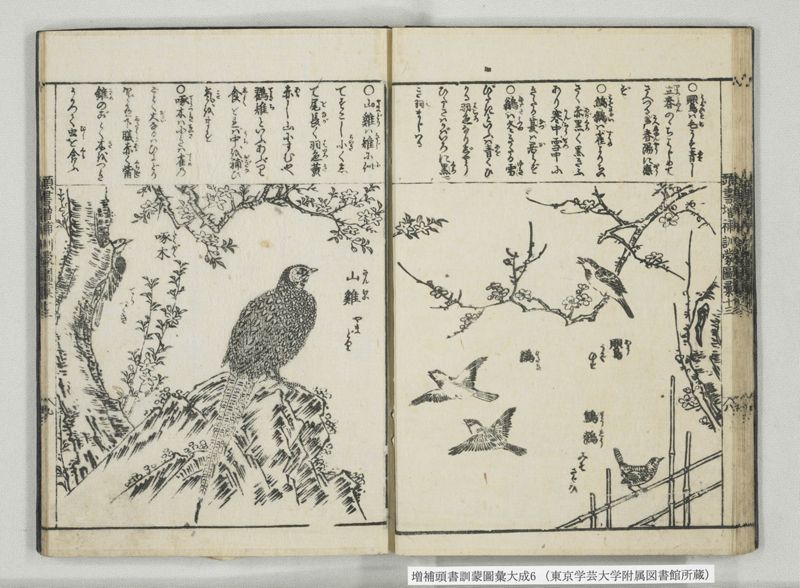
翻刻
【上段】
○鸎(うぐひす)は毛(け)うす青(あを)し
立春(りつしゆん)のゝちはじめて
さへつる声(こへ)春陽(しゆんやう)に応(おう)
ず
○鷦鷯(みそさゞい)は雀(すゝめ)よりちい
さく赤黒(あかくろ)く黒きふ
あり寒中(かんちう)雪(せつ)中に
きたる夏(なつ)は居(お)らず
○鶲(ひたき)は冬(ふゆ)きたる雪(ゆき)
びたきといふは青(あを)くひ
かる羽色(はいろ)なりじやう
ひたきはかばいろに黒(くろ)
き羽(は)まじる
○山鶏(やまどり)は雉(きじ)に似(に)
てすこし小(ちいさ)くし
て尾長(をなが)く羽色(はいろ)黄(き)
赤(あか)し山にすむ也
鸐雉(てきち)といふあぶり
食(しよく)すれば中(うち)を補(おぎな)ひ
気(き)をます
○啄木(てらつゝき)は小(ちいさ)きは雀(すゝめ)の
ごとく大(おゝい)なるはひよどり
ほど有 下腹赤(したはらあか)く觜(くちばし)
錐(きり)のごとく木(き)をつゝき
うかつて虫(むし)を食(くら)ふ
【下段】
鸎(あう)
うぐひす
鷦鷯(せうれう) みそさゞひ
鶲(ひたき)
山鶏(さんけい) やまどり
啄木(たくぼく)
てらつゝき
現代語訳
【上段】
○ウグイス(鶯)は羽毛が薄青色である。
立春の後に初めて
さえずる声は春の陽気に応じる
ものである。
○ミソサザイ(鷦鷯)はスズメより小
さく赤黒くて黒い斑
がある。寒中・雪中に
やってくる。夏はいない。
○ヒタキ(鶲)は冬にやってくる。雪
ヒタキというのは青く光
る羽色である。ジョウ
ヒタキは樺色に黒い
羽が混じる。
○ヤマドリ(山鶏)はキジに似
ているが少し小さく
して尾が長く、羽色は黄
赤い。山に住む。
テキチ(鸐雉)というものを焼いて
食べれば体の中を補い
気力を増す。
○テラツツキ(啄木)は小さいものはスズメの
ようで、大きいものはヒヨドリ
ほどある。下腹は赤く、くちばしは
キリのようで、木をつついて
穴を開けて虫を食べる。
【下段】
ウグイス
ミソサザイ
ヒタキ
ヤマドリ
テラツツキ
英語訳
[Upper section]
○The Uguisu (Japanese bush warbler) has light blue plumage.
After Risshun (beginning of spring), it begins
to sing, its voice responding to the spring
sunshine.
○The Misosazai (winter wren) is smaller than
a sparrow, reddish-black with black
spots. It comes during the cold season and snowy weather.
It is not present in summer.
○The Hitaki (flycatcher) comes in winter. The Yuki-
hitaki (snow flycatcher) has blue, gleaming
plumage. The Jou-
hitaki has birch-colored feathers mixed with black
ones.
○The Yamadori (copper pheasant) resembles
a pheasant but is slightly smaller
with a long tail and yellow-
red plumage. It lives in the mountains.
When the Tekichi (a type of pheasant) is roasted and
eaten, it nourishes the body
and increases vitality.
○The Teratsutuki (woodpecker): the small ones are like
sparrows, while the large ones are about the size
of a bulbul. The lower belly is red, the beak is
like an awl, and it pecks wood to
bore holes and eat insects.
[Lower section]
Uguisu (Japanese bush warbler)
Misosazai (winter wren)
Hitaki (flycatcher)
Yamadori (copper pheasant)
Teratsutuki (woodpecker)