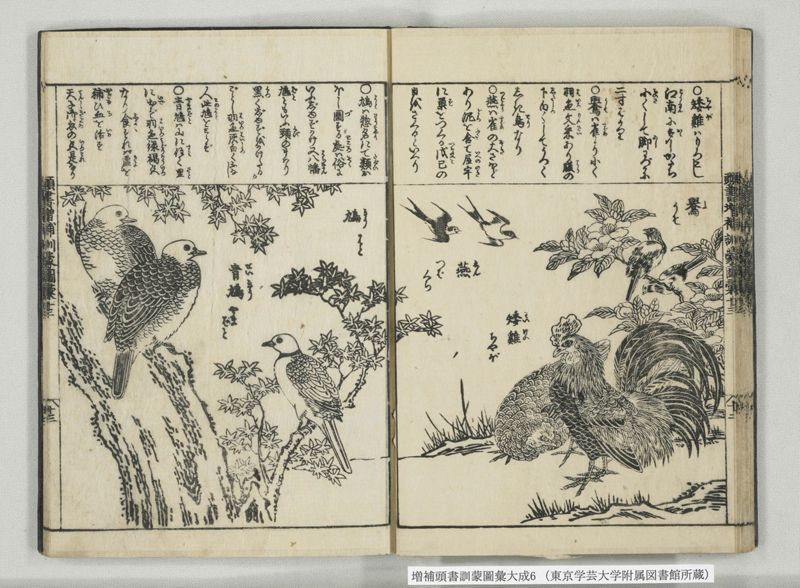
翻刻
【上段】
○矮鶏(ちやぼ)はもろこし
江南(こうなん)に多(おゝ)しかたち
小(ちいさ)くして脚(あし)わづかに
二寸ばかり
○鷽(うそ)は雀(すゞめ)より小く
羽色(はいろ)文采(もんさい)あり腹(はら)の
下白(したしろ)くしてうつく
しき鳥(とり)なり
○燕(つばくら)は雀(すゞめ)の大(おゝき)さほど
あり泥(どろ)を含(ふくみ)て屋宇(いへののき)
に巣(す)をつくる戊巳(つちのへみ)の
日をさくるといへり
○鳩(はと)は惣名(さうみやう)にて類(たぐひ)お
ほし図(づ)する処(ところ)は俗(そく)に
いふじゆずかけ又 八幡(はちまん)
鳩(ばと)ともいふ頸(くび)のまはり
黒(くろ)くじゆずをかけたるか
ごとし羽色(はいろ)灰白(はいしろ)くふなし
人 此鳩(このはと)をとらず
○青鳩(やまばと)は山に住(すみ)て里(さと)
に出(いで)ず羽色(はいろ)緑(みどり)褐色(かういろ)
なり食(しよく)すれば虚(きよ)を
補(おぎな)ひ血(ち)を活(いか)す
天子(てんし)御衣(ぎよゐ)の色(いろ)是(これ)なり
【下段】
鷽(よ)
うそ
矮鶏(わいけい)
ちやぼ
燕(ゑん)
つばくら
鳩(きう) はと
青鳩(せいきう) やまばと
現代語訳
【上段】
○矮鶏(チャボ)は中国の
江南地方に多い。体が
小さく脚がわずかに
二寸ほどしかない。
○鷽(ウソ)は雀より小さく、
羽の色に美しい模様がある。腹の
下が白くて美しい
鳥である。
○燕(ツバメ)は雀ほどの
大きさで、泥を口に含んで家の軒
に巣を作る。戊巳(つちのえみ)の
日を避けるといわれている。
○鳩(ハト)は総称で種類が
多い。図に描いているのは俗に
いう数珠掛け、また八幡
鳩ともいう。首の周りが
黒く数珠をかけたような
模様である。羽色は灰白色で船梨
人はこの鳩を捕らない。
○青鳩(ヤマバト)は山に住んで里
に出てこない。羽色は緑褐色
である。食べれば体の虚弱を
補い血行を良くする。
天子の御衣の色がこれである。
【下段】
鷽(ヨ)
ウソ
矮鶏(ワイケイ)
チャボ
燕(エン)
ツバメ
鳩(キュウ) ハト
青鳩(セイキュウ) ヤマバト
英語訳
[Upper section]
○The Waikei (bantam chicken) is abundant in the
Jiangnan region of China. Its body is
small and its legs are only
about two inches long.
○The Uso (bullfinch) is smaller than a sparrow,
with beautiful patterns in its feather colors. Its belly is
white underneath, making it a beautiful
bird.
○The Tsubame (swallow) is about the size
of a sparrow. It holds mud in its mouth to build nests under the eaves
of houses. It is said to avoid
the day of Tsuchinoe-mi.
○Hato (dove/pigeon) is a general term with many
varieties. What is illustrated here is commonly
called Juzukake, also known as Hachiman
dove. The area around its neck is
black, resembling wearing
prayer beads. Its feather color is grayish-white, and the Funashi
people do not catch this dove.
○The Seikyu (green dove/wood pigeon) lives in the mountains and does not
come out to villages. Its feather color is greenish-brown.
When eaten, it supplements
bodily weakness and invigorates the blood.
This is the color of the Emperor's robes.
[Lower section]
Yo
Uso
Waikei
Chabo
En
Tsubakura
Kyu - Hato
Seikyu - Yamabato