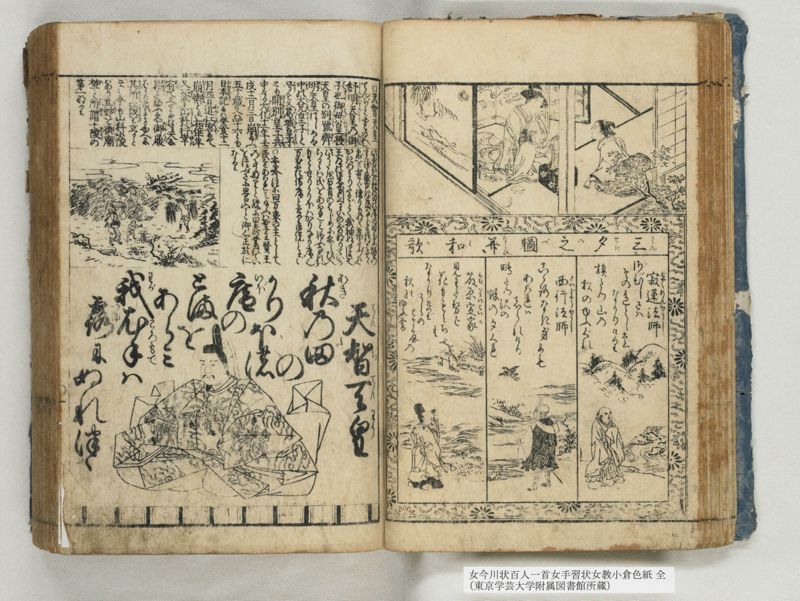
翻刻
【右丁】
【囲みの頭部に右から横書き】
三夕之図(さんせきのづ)并(ならび) ̄ニ和歌(わか)
寂蓮法師(じやくれんほうし)
さびしさは
その色としも
なかりけり
槙たつ山の
秋のゆふぐれ
【縦線あり】
西行法師
こゝろなき身にも
あはれは
しられける
鴫たつ沢の
秋の夕くれ
【縦線あり】
藤原定家(ふぢはらのていか)
見わたせば
花ももみち
も
なかりけり
うらの
とまやの
秋のゆふ暮
【左丁 上段】
○天智天皇
てんぢとにこるへし
舒明天皇(じよめいてんわう)の御(おん)
子(こ)也(なり)御 母(はゝ)は皇極(くはうきよく)
天皇の別号(へつごう)斉(さい)
明(めい)天皇はしめは
中(なか)の大兄皇子(をゝゑのわうじ)と
号(こう)す又 葛城皇子(かつらきのわうじ)
とも開別(ひらきわけ)皇子 共(とも)
申ける大化(だいくは)十二年壬
戌十二月三日 崩(ほうじ)給ふ
五十歳又四十六とも
日本記(にほんき)【紀の誤】には癸亥十二
月廿一日 近江宮(あふみのみや)にて
崩御(ほうぎよ)と云 在位(さいい)十年
また一 説(せつ)には山科(やましな)へ行幸(みゆき)
有(あり)てかへり給はず天に
昇(のぼり)たまふにや御履(おんくつ)
ばかりとゞまるゆへに
其(その)所(ところ)に陵(みさゝき)を立ると
云々今も山科に陵
はあり其野(そのゝ)を御 廟(べう)
埜(の)と所謂(いはゆる)十 陵(れう)の
第一なり
【同 中段】
此哥の心は秋の田の庵の時分に秋の
すゑに成ゆきとまなども朽はてゝ
露をふせぐ便りもなく露たぶ〳〵と
おきあまりたるごとく我袖ぬるよし也
王道の御しゆつくわいの哥なりていか
此うたを百首のはじめにゑらひ入
らるゝは民をあはれみ給ふなれは
もとゝせりかりほはかりなる庵也
万葉に借菴と書り御説と云々
○季吟注に曰万乗の主として
民をあはれみ給ふは聖主賢王
の事なりと殊に田夫の業のてい
をつぶさに思召入こと御心正於仁
なり
【同 下段】
天智天皇(てんぢてんわう)
秋(あき)の田(た)
の
かりほの
庵(いほ)の
とまを
あらみ
我(わが)衣手(ころもで)は
露(つゆ)にぬれつゝ
現代語訳
【右丁】
【囲み枠の上部に横書きで】
三夕の図並びに和歌
寂蓮法師
寂しさは
その色としても
なかりけり
槙立つ山の
秋の夕暮れ
西行法師
心なき身にも
哀れは
知られけり
鴫立つ沢の
秋の夕暮れ
藤原定家
見渡せば
花も紅葉も
なかりけり
浦の
苫屋の
秋の夕暮れ
【左丁 上段】
○天智天皇
天智天皇について
舒明天皇の御子である。御母は皇極天皇、別号は斉明天皇。初めは中大兄皇子と号し、また葛城皇子、開別皇子とも申した。大化12年壬戌12月3日に崩御された。50歳(また46歳とも)。日本紀には癸亥12月21日、近江宮にて崩御とある。在位10年。
また一説には山科へ行幸されて帰られず、天に昇られたため、御履のみが残るので、その所に陵を立てるという。今も山科に陵がある。その野を御廟野というのは十陵の第一である。
【同 中段】
この歌の心は、秋の田の庵の時分、秋の末になって、苫なども朽ち果てて、露を防ぐ手立てもなく、露がたっぷりと置き余るように我が袖が濡れるという意味である。王道の御趣向の歌であり、定家がこの歌を百首の始めに選び入れたのは、民を哀れみ給うからである。もともと仮の庵である。万葉には「借庵」と書いてある。御説という。
○季吟注に曰く、万乗の主として民を哀れみ給うのは聖主賢王のことである。特に田夫の業の様子を詳しく思し召し入れることは、御心が仁に正しいことである。
【同 下段】
天智天皇
秋の田の
仮庵の
庵の
苫を
荒み
我が衣手は
露に濡れつつ
<translation_en>
【Right Page】
【Horizontally written at the top of the bordered frame】
Illustration of the Three Evenings with Waka Poems
Priest Jakuren
The loneliness
does not have
that particular color
At the autumn evening
of the mountain where cypress trees stand
Priest Saigyō
Even to a heart
without feeling, pathos
can be known
At the autumn evening
of the marsh where snipes take flight
Fujiwara no Teika
Looking out,
there are neither
cherry blossoms nor autumn leaves
At the autumn evening
of the thatched hut
by the bay
【Left Page - Upper Section】
○Emperor Tenji
About Emperor Tenji
He was the son of Emperor Jomei. His mother was Empress Kōgyoku, also known by the alternate name Empress Saimei. Initially he was called Prince Naka-no-Ōe, and also Prince Katsuragi and Prince Hirakiwake. He passed away on the 3rd day of the 12th month of Taika 12 (672 CE), year of the Water Dog. He was 50 years old (some say 46). The Nihon-ki records that he died on the 21st day of the 12th month of the year of the Water Boar at Ōmi Palace. His reign lasted 10 years.
Another theory states that he went on an imperial journey to Yamashina and never returned, ascending to heaven, leaving only his shoes behind, so a mausoleum was built at that location. Even now there is a mausoleum in Yamashina. That field is called the Imperial Mausoleum Field and is the first of the ten imperial tombs.
【Same Page - Middle Section】
The meaning of this poem is about the time of the hut in the autumn fields, when autumn is ending, the thatch has rotted away, there is no way to ward off the dew, and one's sleeves become wet as if the dew were falling abundantly. This is a poem of royal sentiment, and Teika selected this poem to begin his hundred poems because the emperor showed compassion for his people. Originally it refers to a temporary hut. In the Man'yōshū it is written as "borrowed hut." This is the imperial explanation.
○Kigyo's commentary states: For the ruler of ten thousand chariots to show compassion for his people is the mark of a sage ruler and wise king. Especially to contemplate in detail the conditions of the farmers' work shows that his heart is righteous in benevolence.
【Same Page - Lower Section】
Emperor Tenji
The autumn fields'
temporary hut's
thatch roof
being rough,
my sleeves
are constantly wet with dew