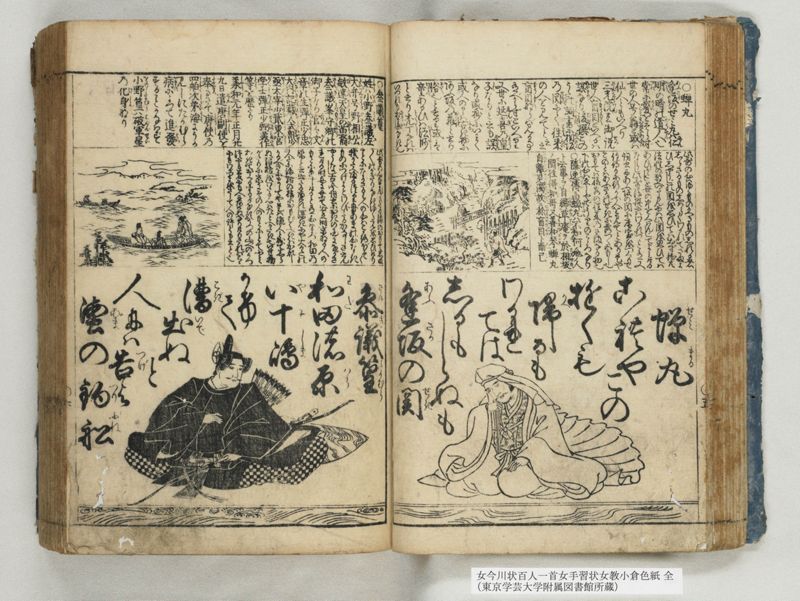
翻刻
【右丁 上段】
○蝉丸
逢坂(あふさか)のせみ丸は仁(にん)
明(めう)も時の道人(どうにん)也
常(つね)に髪(かみ)をそらず
世の人 号(こうす)翁(おきな)と或(あるひ)は
仙人ともいへり
三光院(さんくわういん)の御 説(せつ)
世人 盲目(もうもく)といへるは
誤(あやまり)なり後撰(ごせん)この
うたの詞書(ことはかき)に相坂(あふさか)
の関(せき)にて往来(わうらい)
の人を見てと云云
盲目(もうもく)ならば見る事
有べからずといへり
又世に延喜(ゑんぎ)の皇(わう)
子(じ)なりと云も誤(あやまり)
なり或抄にいわく
或人の申は古(ふる)き物に
あふ坂の翁(おきな)と書り
俗(ぞく)也と云り或は
童(わらべ)あるひは法師(ほうし)
と云り禿丁(とくてう)なれば
いづれも相違(さうい)なき也
【同 中段】
此哥の心はゆくものかへるものしれる者
しらさるものしはらくわかれてさまよ
ひしやうじの関を思ひては出ず然共
法性の都へいたらんには此関を思ひては
あひがたしと世の中をくはんじてよみける
なりし此哥後撰にはわかれつゝと有又
詞書にあふ坂の関に庵室をつくりて
住侍るに行かふ人を見てとあり是や
このとはあふさかのせきに落つく五もし也
おもては旅客の往来のさまなる物也
下の心はゑしやでうりのこゝろなり
○隠逸伝(インイツテン)ニ曰 蝉丸(セミマル)ハ不_レ知_二何ノ地ノ人
ト云事ヲ_一自 締(ムスヒ)_二草庵ヲ於 相坂(アフサカ)
ノ関(セキニ)_一往得和哥又 善(よくス)_二和琴(ワゴンヲ)_一蝉丸
自(ミツカラ)離(ハナル)_二見濁(▢▢▢▢)_一故(ユヘ)ニ称(セウスル)盲目(モウモク)ト而已(ノミ)
【同 下段】
蝉丸
これやこの
ゆくも
帰(かへ)るも
わかれ
ては
しるも
しらぬも
逢坂(あふさか)の関(せき)
【左丁 上段】
○参議篁
姓(しやう)は小野(をの)参議(さんぎ)左(さ)
大弁(だいべん)号(ごうす)野相公(やさうこうと)
敏達天皇(びたつてんわう)の苗裔(びやうゑい)
参議(さんぎ)峯守卿(みねもりきやう)の
御子なり官(くわん)は文(ふん)
章(しやう)の生(せう)弾正少忠(たんしやうせうちう)
大内記(たいないき)蔵人(くらんど)式部少(しきぶのせう)
丞(ぜう)太宰少弐(だざいせうに)東宮(とうぐう)
学士(がくし)弾正少弼(たんじやうせうひつ)美作(みまさか)
等(とう)を歴(へ)たり
承和(しやうわ)元年正月廿
九日 遣唐使(けんとうし)を
奉(たてまつ)るさて唐使(とうし)の
四舶(しはく)次第(しだい)海(うみ)にうか
みしにたかむら
病(やまひ)によつて進発(しんはつ)
することかなはず
小野篁(をのゝたかむら)は破軍星(はぐんせい)
の化身(けしん)なり
【同 中段】
此哥の心はまん〳〵たる海のおもてしま
〳〵のかぎりなきゆくえを思ひけり
ことになかさるゝ人の心はこゝろぼそく
我かたへ帰るつり舟あまの心なき
ものにつげよとわびたるかなしさ云ん
やうなし古今詞書におきの国にながさ
れける時舟に乗て出立時京なる人の
もとに遣しけると有心はまづ和田の
原と云出たるあはれ深きにや大かたの
人だに海路の旅におもむくべきはかなし
かるべきにましてや是は流人と成てしら
ぬ浪路をわたる心はたとへかたき也いせ物
がたりに京にその人のもとにとてふみ
かきておしへるするがなるうつの山べのうつ
つにも夢にも人にあはぬなりけりさればこゝ
にもわがつまをさして人の許とも云と也
【同 下段】
参議篁(さんぎたかむら)
和田(わだ)の原(はら)
八十島(やそしま)
かけ
て
漕(こぎ)
出(いで)ぬ
と
人には
告(つげ)よ
■(あま)【海+虫】の釣船(つりぶね)
現代語訳
【右丁 上段】
○蝉丸
逢坂の蝉丸は仁明天皇の時代の道人(修行者)である。
常に髪を剃らず、世の人は翁と号し、あるいは仙人とも言った。
三光院殿の御説では、世間の人が盲目と言うのは間違いである。『後撰集』のこの歌の詞書に「相坂の関にて往来の人を見て」とある。
盲目であれば見ることはできないはずであると言っている。
また世間で延喜帝の皇子であると言うのも間違いである。ある抄物によれば、
ある人が申すには、古い文献に逢坂の翁と書いてあり、俗人であると言っている。ある時は童子、あるいは法師と言っている。髪を剃らない者であれば、いずれも矛盾はない。
【同 中段】
この歌の心は、行く者帰る者、知っている者知らない者、しばらく別れてさまよう者たちが逢坂の関を思っては通り過ぎていく。しかし法性の都(悟りの世界)に至ろうとするならば、この関を思っては会い難いと、世の中を観じて詠んだものである。この歌は『後撰集』では「別れつつ」とある。また詞書に「逢坂の関に庵室を作って住んでいるが、行き交う人を見て」とある。「これやこの」とは逢坂の関に掛かる五文字の序詞である。
表面は旅客の往来の様子を詠んだものである。
裏の心は会者定離(出会った者は必ず別れる)の心である。
○『隠逸伝』に曰く「蝉丸はどこの地の人か知れない。自ら相坂の関に草庵を結び、和歌を得意とし、また和琴を善くした。蝉丸は自ら俗世を離れたため、盲目と称するのみ」
【同 下段】
蝉丸
これやこの
行くも
帰るも
別れ
ては
知るも
知らぬも
逢坂の関
【左丁 上段】
○参議篁
姓は小野、参議左大弁、号は野相公。
敏達天皇の末裔で、参議峯守卿の御子である。官職は文章生、弾正少忠、大内記、蔵人、式部少丞、太宰少弐、東宮学士、弾正少弼、美作守等を歴任した。
承和元年正月二十九日、遣唐使を命じられた。そして唐使の四隻の船が順次海に浮かんだが、篁は病気によって出発することができなかった。
小野篁は破軍星の化身である。
【同 中段】
この歌の心は、広々とした海の面に島々の限りない行く末を思ったのである。特に流罪になった人の心は心細く、わが方へ帰る釣り舟よ、海人の心ない者に告げよと、わびしい悲しさは言いようがない。『古今集』の詞書に「隠岐の国に流された時、舟に乗って出立する時、京にいる人のもとに遣わした」とある。心はまず「和田の原」と詠み出したのがあわれ深いのであろうか。普通の人でさえ海路の旅に赴くのは頼りないものであるのに、ましてやこれは流人となって知らない波路を渡る心は例えようがない。『伊勢物語』に「京にその人のもとにとて文書きて教える」として「駿河なる宇津の山辺の現にも夢にも人に逢わぬなりけり」とあるから、ここでも「わが妻」を指して「人」とも言うのである。
【同 下段】
参議篁
和田の原
八十島
掛けて
漕ぎ
出でぬ
と
人には
告げよ
海人の釣り舟
英語訳
【Right Page - Upper Section】
○Semimaru
Semimaru of Ōsaka was a religious practitioner during Emperor Ninmyō's time.
He never shaved his hair, and people called him "the old man" or sometimes "immortal sage."
According to Lord Sankōin's explanation, it is incorrect for people to say he was blind. The headnote to this poem in the "Gosen Wakashū" states "seeing travelers at Ōsaka Barrier."
If he were blind, he could not have seen anything.
It is also incorrect to say he was a prince of Emperor Daigo. According to certain commentaries,
someone stated that in old documents he is written as "the old man of Ōsaka" and was a layman. Sometimes called a child, sometimes a monk. Since he was one who did not shave his hair, there is no contradiction in any of these.
【Same Page - Middle Section】
The meaning of this poem is about those who go and return, those who know and don't know, those who part and wander temporarily, all passing through Ōsaka Barrier. However, if one seeks to reach the capital of enlightenment, thinking of this barrier makes meeting difficult—he composed this contemplating the world. This poem appears as "parting constantly" in the Gosenshū. The headnote states "living in a hermitage at Ōsaka Barrier, seeing travelers pass by." "Koreya kono" is a five-syllable preface (jo) leading to Ōsaka Barrier.
On the surface, it depicts travelers coming and going.
The deeper meaning expresses the Buddhist concept that all who meet must part.
○The "Inyitsu-den" states: "Semimaru's birthplace is unknown. He built a grass hut at Ōsaka Barrier, was skilled in waka poetry and the wagon (Japanese zither). Because Semimaru separated himself from the mundane world, he was merely called blind."
【Same Page - Lower Section】
Semimaru
This is the place—
those who go
and those who return,
parting
here—
those who know
and those who don't—
Ōsaka Barrier
【Left Page - Upper Section】
○Counselor Takamura
His family name was Ono, he held the positions of Counselor and Senior Secretary of the Left, and was called Yasōkō.
He was a descendant of Emperor Bidatsu and the son of Counselor Minemori. His official posts included Scholar of Literature, Junior Assistant in the Bureau of Inspection, Senior Palace Record Keeper, Chamberlain, Junior Assistant Minister of Ceremonial, Junior Assistant Governor-General of Dazaifu, Tutor to the Crown Prince, Junior Assistant Director of the Bureau of Inspection, and Governor of Mimasaka.
On the twenty-ninth day of the first month of Jōwa 1 (834), he was appointed as an envoy to Tang China. When the four ships of the Tang mission successively floated on the sea, Takamura could not depart due to illness.
Ono no Takamura was an incarnation of the Hagun star (Mars as an inauspicious star).
【Same Page - Middle Section】
The meaning of this poem is thinking of the vast sea surface and the endless destinations of countless islands. Especially the heart of one sent into exile is lonely—tell the fishing boat returning toward me, tell those heartless fishermen of my sorrow that cannot be expressed. The headnote in the Kokinshū states "sent to someone in the capital when boarding a ship to depart after being exiled to Oki Province." The heart first expressed as "Wada no hara" is deeply moving. Even ordinary people would find a sea journey unreliable, but much more so for one who has become an exile crossing unknown wave-paths—the feeling is beyond comparison. In the "Tales of Ise," writing a letter "to that person in the capital," it teaches: "At Utsu mountain pass in Suruga, neither in reality nor in dreams do I meet that person." Therefore, here too, referring to "my wife," he also says "person."
【Same Page - Lower Section】
Counselor Takamura
On Wada Bay
crossing eighty islands
I row
out—
tell this
to people,
fishing boat of the sea folk