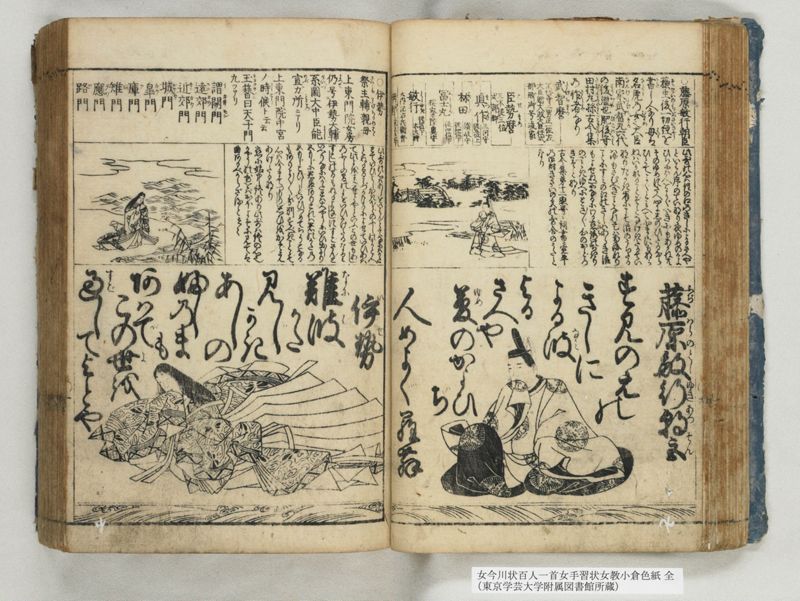
翻刻
【右丁 上段】
○藤原敏行朝臣
蘇生後(そせいのゝち)一切経(いつさいきやう)を
書(かき)し人なり母(はゝ)は
名虎(なとら)の女(むすめ)也大臣
南家(なんけ)武智丸(たけちまる)六代
の後胤(こういん)也 肥後守(ひこのかみ)
田村丸(たむらまるの)孫(まご)古今集(こきんしう)
の作者(さくしや)なり
武智麿(たけちまる)
《割書:不比等ノ一男正一位左|大臣贈大政大臣任式|部卿御号式家》
巨勢麿(こせまろ)
《割書:三木従三位|式部卿》
真作(まつくり)《割書:三河守|従五位上》
林田(はやしだ)《割書:讃岐守|従四位下》
富士丸(ふじまる)《割書:従四位下》
《割書:按察陸奥守》
敏行(としゆき)《割書:従四位下| 右大将》
《割書:大内記右兵衛督|二行目》
伊衡(これひら)《割書:三木正五位下》
【同 中段】
此哥の心は住の江のきしによるさへや
といはん序のていなり夜ゆめのかよ
ひちには人をよぐへきにもあかね共
そのゆめにさへ心にしのびたるなら
ひとてよぐとみへて心まゝにもなら
ねはいかなることぞとなげきたるてい
なりたかき峯にこそ浪のうちたる
はゆもさむべきことなれ是は南海なり
ことにすみの江のきしはあらき浪
もよせぬ所なるにわか恋路(こひち)のちきり
のごときゆへにとき〴〵心のおどろ
きぞとなり
古今集第十二恋哥に詞書に寛平
の御時きさいの宮の哥合のうたと
なり
【同 下段】
藤原敏行朝臣(ふぢはらのとしゆきあつそん)【注】
すみのえの
きしに
よる波(なみ)
よる
さへや
夢(ゆめ)のかよひ
ぢ
人めよぐらむ
【注「臣」とあるところ「宮」に見える】
【左丁 上段】
○伊勢
祭主(さいしゆ)輔親(すけちかの)母(はゝ)
上東門院女房
仍(よつて)号_二伊勢大輔_一
系図(けいづ)大中臣 能(よし)
宣(のぶ)ガ所(ところ)ニアリ
上東門院中宮
ノ時候(しこう)ト云々
玉簪(キヨクサンニ)曰天子門
九ツアリ
謂開門(イカヰモン)
遠郊(エンカウ)門
近郊(キンカウ)門
城(ジヤウ)門
皐(カウ)門
庫(ク)門
雉(シ)門
応(ヲウ)門
路(ロ)門
【同 中段】
此哥の心はあしをいはんとてなにはかた
とていひみじかきほどのふしのまと人
とぬる間わづかなるによせていひあは
て此よをすごせとやといふこの世もあし
のふしの間のよをいひかけたるなり
すこしの間もぬるよなしにすごさんと
いへりなにはかたとは大やうにいひ出したり
五もじに君臣ありこれは君のかたの
五もじこひしといひつめてちうとなる
もありよく〳〵分別すべきことぞ
心は今まてつもりし思ひをかぞえ
あげたるなり
恋に始中終あり此哥は終の心也
かやうの哥をばおほよそに見ては
曲あるべからざると云々
【同 下段】
伊勢(いせ)
難波(なには)
かた
見じ
かき
あしの
ふしのま
も
あはで
この世(よ)を
過(すご)してよとや
現代語訳
【右丁 上段】
○藤原敏行朝臣
蘇生した後に一切経を書写した人である。母は名虎の娘である。大臣南家武智麿の六代後の子孫である。肥後守田村麿の孫で、『古今集』の歌人である。
武智麿
《割書:不比等の長男、正一位左大臣、贈大政大臣、式部卿を任じ、御号は式家》
巨勢麿
《割書:正三位、式部卿》
真作《割書:三河守、従五位上》
林田《割書:讃岐守、従四位下》
富士麿《割書:従四位下》
《割書:按察使、陸奥守》
敏行《割書:従四位下、右大将》
《割書:大内記、右兵衛督、二行目》
伊衡《割書:正五位下》
【同 中段】
この歌の心は「住の江の岸に寄る」「さへや」と言おうとする序詞の体である。夜の夢の通い路には人を避けるべきなのに、それでも飽き足らず、その夢にさえ心に忍んでいる習いで、人を避けると見えて思うようにもならないのはどういうことかと嘆いている体である。高い峰にこそ波が打ち寄せるのも当然のことである。これは南海である。特に住の江の岸は荒波も寄せない所なのに、我が恋路の契りのようなゆえに、時々心が驚くということである。
『古今集』第十二恋歌に詞書として「寛平の御時、后の宮の歌合の歌」となっている。
【同 下段】
藤原敏行朝臣
住の江の
岸に
寄る波
夜る
さえや
夢の通い
路
人目避ぐらん
【左丁 上段】
○伊勢
祭主輔親の母。上東門院の女房。よって伊勢大輔と号する。系図は大中臣能宣の所にある。上東門院が中宮の時の候人という云々。
『玉簪』に曰く「天子の門は九つある」
謂わゆる開門
遠郊門
近郊門
城門
皐門
庫門
雉門
応門
路門
【同 中段】
この歌の心は「あし」を言おうとして「難波潟」と言い、「短き程の節の間」と人と寝る間のわずかな時間に寄せて言い、「合わでこの世を過ごせというのか」という。この世も葦の節の間の世を言いかけたのである。少しの間も寝る夜なしに過ごそうと言っている。「難波潟」とは大体的に言い出したものである。五文字に君臣がある。これは君の方の五文字。「恋し」と言い詰めて「中」となるのもあり、よくよく分別すべきことである。心は今まで積もった思いを数え上げたのである。
恋には始・中・終がある。この歌は終の心である。このような歌を大よそに見てはいけないという云々。
【同 下段】
伊勢
難波
潟
短き
垣
葦の
節の間
も
合わで
この世を
過ごしてよとや
英語訳
【Right Page - Upper Section】
○Fujiwara no Toshiyuki Ason
A person who copied the complete Buddhist scriptures after his revival. His mother was the daughter of Nadora. He was a descendant six generations after Minister Takechi-maro of the Southern Fujiwara branch. Grandson of Higo Governor Tamura-maro, he was a poet of the Kokinshū.
Takechi-maro
《Side note: Eldest son of Fuhito, Senior First Rank Left Minister, posthumously granted Grand Minister of State, appointed Minister of Ceremonial, imperial designation Shiki family》
Kose-maro
《Side note: Senior Third Rank, Minister of Ceremonial》
Matsukuri《Side note: Mikawa Governor, Senior Fifth Rank Upper》
Hayashida《Side note: Sanuki Governor, Junior Fourth Rank Lower》
Fuji-maro《Side note: Junior Fourth Rank Lower》
《Side note: Provincial Inspector, Mutsu Governor》
Toshiyuki《Side note: Junior Fourth Rank Lower, Right General》
《Side note: Senior Secretary, Right Military Guard Commander, second line》
Korehira《Side note: Senior Fifth Rank Lower》
【Same Page - Middle Section】
The meaning of this poem uses "yoru nami yoru sae ya" (waves approaching the shore, even at night) as an introductory passage. In the path of nightly dreams, one should avoid people, yet even in those dreams, following the habit of harboring secret feelings in one's heart, though appearing to avoid people, things don't go as wished - this expresses the form of lamenting "what is this situation?" It would be natural for waves to strike even high peaks. This refers to the southern sea. Particularly, the shores of Suminoe are places where rough waves don't approach, yet due to the nature of my love's pledge, my heart is startled from time to time.
In Kokinshū Volume 12, Love Poems, the headnote states it was "a poem from the poetry contest at the Empress's palace during the Kanpyō era."
【Same Page - Lower Section】
Fujiwara no Toshiyuki Ason
At Suminoe's
shore
approaching waves
even at night
might
the dream's pathway
avoid people's eyes?
【Left Page - Upper Section】
○Ise
Mother of Ritual Master Sukechika. A court lady of the Jōtōmon'in. Therefore called Ise no Taifu. The genealogy is in Ōnakatomi no Yoshinobu's section. She was a court attendant when Jōtōmon'in was Empress, etc.
In "Gyokushin" it says "The Emperor has nine gates":
Namely: Opening Gate
Outer Suburban Gate
Inner Suburban Gate
Castle Gate
Gao Gate
Treasury Gate
Pheasant Gate
Response Gate
Road Gate
【Same Page - Middle Section】
The meaning of this poem: intending to speak of "reeds," it says "Naniwa Bay," and referring to the brief time of "sleeping with a person for just a short interval between nodes," it asks "must we spend this world without meeting?" This world also refers to a world as brief as the interval between reed nodes. It says we should spend our time without even a night's sleep. "Naniwa Bay" is spoken in general terms. There are lord and subject in five characters. These are the five characters on the lord's side. There are also cases where saying "koishi" (beloved) in concentrated form becomes "chū" (middle) - this should be carefully distinguished. The heart counts up all the feelings accumulated until now.
In love there are beginning, middle, and end. This poem expresses the heart of the end. Such poems should not be viewed superficially, etc.
【Same Page - Lower Section】
Ise
Naniwa
Bay's
short
fence
of reeds'
node intervals
even
without meeting
spend this world
should we?