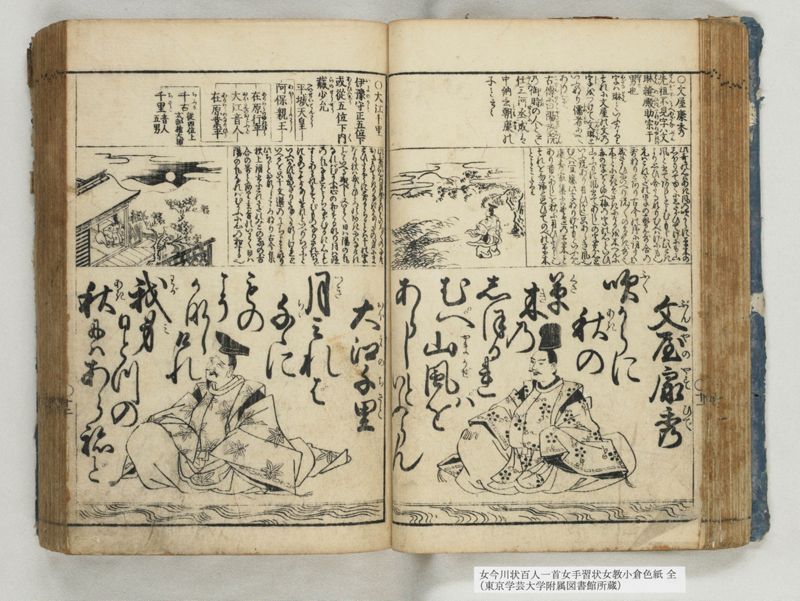
翻刻
【右丁 上段】
○文屋康秀
先祖(せんぞ)不(ず)_レ見(みへ)字(あざな)は文(ぶん)
琳(りん)縫殿助宗于(ぬひのすけむねゆきの)
男(むすこ)也
字(あざな)は琳(りん)といふなり
それに文屋の文の
字(じ)をつけて文琳(ぶんりん)と
いふなり儒者(じゆしや)にて
ありしぞ
古伝(こでん)に曰(いはく)陽成院(やうせいいん)
の御 時(とき)の人と《割書:云々》
任(にんず)_二 三河 丞(ぜうに)_一成は
中納言 朝康(ともやす)の
子と《割書:云々》
【同 中段】
此哥の心はあき風の吹からに草木の
しほりはてゆくにしたがひてげにも山
風と書てあらしとよむもじは此とき
より思ひ合たるなりむべはげにも也
元はこれさだの御子の家見哥合の
哥なりとあり古今の序に詞たくみ
成さかひにいへり説〳〵の多き哥也
木ごとに花ぞさきにけるを木へんに
毎の字をゝくゆへ梅の字の心といひ
山かふりに風書てあらしの字の心と
いふ説あり用ひがたし只あらき風也
むべは宜応此字なりげにもといふ心也
康秀家集には野辺の草木と
あり昔はあらしを秋に用ひたると也
それを勿論と思ひてのべの草木
とよみたり
【同 下段】
文屋康秀(ぶんやのやすひで)
吹(ふく)からに
秋(あき)の
草(くさ)
木(き)
の
しほるれ
ば
むべ
山風(やまかぜ)を
あらしと
いふらん
【左丁 上段】
○大江千里
伊予守(いよのかみ)正五位下
或(あるひは)従(じう)五位下 内(く)
蔵少允(らのせうぜう)
平城天皇(へいせいてんわう)
阿保親王(あほうしんわう)
在原行平(ありわらのゆきひら)
大江音人(おほえのおとふど)
在原業平(ありわらのなりひら)
千古(ちふる)《割書:従四位上|式部権大輔》
千里(ちさと)《割書:音人|五男》
【同 中段】
此哥の心は月をみればいろ〳〵の事共
おもわれてかぎりなきかなしさの身にま
とひたるやうに思はるゝちゞとは千の字
なり秋は我みひとつのあきにはなけれ
どゝいへる成べし又いわく日は陽の気
なればむかふに心の和するなり月は陰
の気なればうちながむるに心も
すみあわれもすゝむものなりさればちゞ
にものこそかなしけれといへりちゞにと
いふはかずもかぎりもなくかなしけれと
いへるを只千文選のかたちよみなり
此ちゞとおなじこゝろなり古今集
秋上詞書にこれさだのみこの家の哥
合の哥とあり其旨のいわく日は
陽の気なればむかふに心の和する也
【同 下段】
大江千里(おほえのちさと)
月(つき)みれば
千(ち)ゝ(ゞ)に
もの
こそ
かなしけれ
我身(わがみ)
ひとつの
秋(あき)にはあらねど
現代語訳
【右丁 上段】
○文屋康秀
先祖は不明。字は文琳。縫殿助宗于の息子である。
字は琳というのである。それに文屋の「文」の字をつけて「文琳」というのである。儒者であった。
古伝に曰く「陽成院の御時の人」という。三河丞に任ぜられた。成は中納言朝康の子という。
【同 中段】
この歌の意味は、秋風が吹くにつれて草木がしおれ果てていくのに従って、なるほど「山」に「風」と書いて「嵐」と読む文字は、この時から思い合わされたのである。「むべ」は「なるほど」という意味である。
元はこれは貞の御子の家歌合の歌であったとある。『古今集』の序に「言葉巧みな境界にいる」と評されている。諸説の多い歌である。
「木ごとに花ぞ咲きにける」を、木偏に「毎」の字を置くゆえ「梅」の字の意味といい、「山」冠に「風」と書いて「嵐」の字の意味という説があるが、用いがたい。ただ荒い風である。
「むべ」は「宜」「応」この字である。「なるほど」という意味である。
康秀家集には「野辺の草木」とある。昔は「嵐」を秋に用いたということである。それを当然と思って「野辺の草木」と詠んだのである。
【同 下段】
文屋康秀
吹くからに
秋の
草
木
の
しおるれば
なるほど
山風を
嵐と
言うらん
【左丁 上段】
○大江千里
伊予守 正五位下
あるいは従五位下 内蔵少允
平城天皇
阿保親王
在原行平
大江音人
在原業平
千古(従四位上・式部権大輔)
千里(音人の五男)
【同 中段】
この歌の意味は、月を見ればいろいろな事どもが思われて、限りない悲しさが身にまといついているように思われる。「ちぢ」とは「千」の字である。秋は我が身ひとつの秋ではないけれどと言っているのであろう。
また言うには、日は陽の気であるから向かうに心が和するのである。月は陰の気であるから眺めているうちに心も澄み、哀れの情も進むものである。だから「ちぢにものこそ悲しけれ」と言っている。「ちぢに」というのは数も限りもなく悲しいということを言ったもので、ただ『文選』の形を詠んだのである。この「ちぢ」と同じ心である。
『古今集』秋上の詞書に「これ貞の御子の家の歌合の歌」とある。その趣旨に言うには、日は陽の気であるから向かうに心が和するのである。
【同 下段】
大江千里
月見れば
千々に
もの
こそ
悲しけれ
我が身
ひとつの
秋にはあらねど
英語訳
【Right Page - Upper Section】
○Bunya no Yasuhide
His ancestry is unknown. His courtesy name was Bunrin. He was the son of Nuinodosuke Muneyuki.
His courtesy name was Rin. By adding the character "bun" (literary) from Bunya to this, it became "Bunrin." He was a Confucian scholar.
Ancient records state he was "a person from Emperor Yōzei's time." He was appointed to the position of Mikawa-no-jō. Nari was the son of Middle Counselor Tomoyasu.
【Same Page - Middle Section】
The meaning of this poem: As the autumn wind blows, the plants and trees wither away completely, and indeed, the character "arashi" (storm) written with "mountain" and "wind" has been associated since this time. "Mube" means "indeed" or "truly."
Originally this was a poem from Prince Korezada's house poetry competition. It is praised in the preface to the Kokinshū as being "skillfully worded at the boundary." This is a poem with many interpretations.
There is a theory that "ki-goto ni hana zo saki ni keru" uses the tree radical with the character "mai" (every) to suggest the meaning of "ume" (plum), and "mountain" crown with "wind" to suggest the meaning of "arashi" (storm), but this is difficult to accept. It is simply a rough wind.
"Mube" corresponds to the characters meaning "appropriate" or "fitting." It means "indeed."
In Yasuhide's personal collection, it appears as "nobe no kusaki" (plants of the fields). In ancient times, "arashi" was used for autumn. Considering this natural, he composed it as "plants of the fields."
【Same Page - Lower Section】
Bunya no Yasuhide
Fuku kara ni
aki no
kusa
ki
no
shiorureba
mube
yamakaze wo
arashi to
iuran
【Left Page - Upper Section】
○Ōe no Chisato
Governor of Iyo, Junior Fifth Rank Upper Grade
Or Junior Fifth Rank Lower Grade, Minor Assistant of the Palace Storehouse
Emperor Heizei
Prince Abo
Ariwara no Yukihira
Ōe no Otondo
Ariwara no Narihira
Chifuru (Junior Fourth Rank Upper Grade, Assistant Director of the Ministry of Ceremonial)
Chisato (Fifth son of Otondo)
【Same Page - Middle Section】
The meaning of this poem: When I look at the moon, various things come to mind, and it seems as if limitless sadness clings to my being. "Chiji" uses the character for "thousand." Though autumn is not just my own personal autumn, he says.
It is also said that since the sun has yang energy, the heart harmonizes when facing it. Since the moon has yin energy, as one gazes at it, the heart becomes clear and feelings of pathos advance. Therefore he says "chiji ni mono koso kanashikere." "Chiji ni" means countless and limitless sadness, simply composing in the style of the Bunsen (Selections of Refined Literature). This has the same heart as "chiji."
In the headnote to the autumn section of the Kokinshū, it states this was "a poem from Prince Korezada's house poetry competition." The purport states that since the sun has yang energy, the heart harmonizes when facing it.
【Same Page - Lower Section】
Ōe no Chisato
Tsuki mireba
chiji ni
mono
koso
kanashikere
waga mi
hitotsu no
aki ni wa aranedo