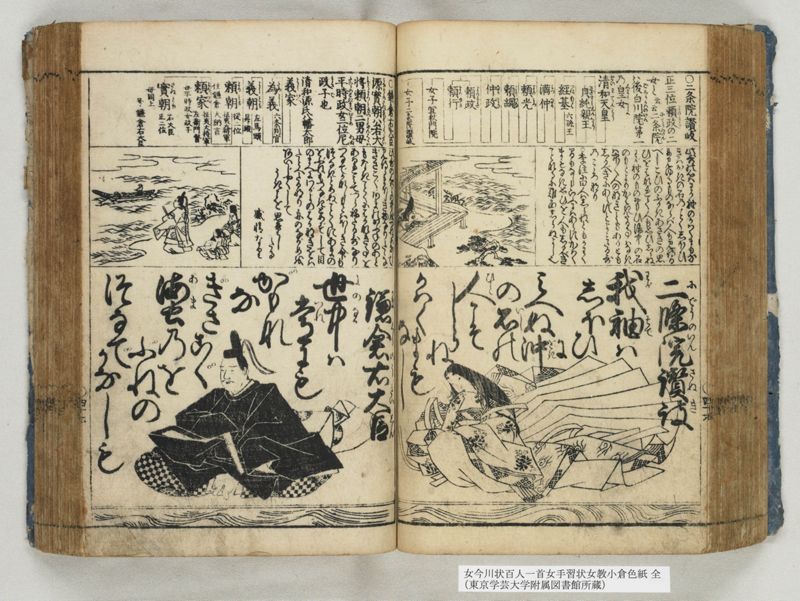
翻刻
【右丁 上段】
二条院讃岐
正三位 頼政(よりまさ)の二
女と云云 二条院(にてうのいん)
は後白川院(ごしらかはのいん)第一
の皇女(くわうしよ)
清和天皇(せいわてんわう)
貞純親王(さだすみしんわう)
経基(つねもと)《割書:六孫王》
満仲(みつなか)
頼光(よりみつ)
頼綱(よりつな)
仲政(なかまさ)
頼政(よりまさ)
頼行(よりゆき)
女子宜秋門院
女子二条院讃岐
【同 中段】
此哥の心はわか袖のかはくまもな
きはおきの石のことくしほひ
に見ゆるものならば人も見侍る
べしこひのふかきあさきの思
ひをはなれて人も思ひしらぬ
わが袖のものおもひ海中の石
のもとよりかはきたる事はなき
は中〳〵人のなきともありとも
しるべきにあらずとよみたる哥
のこゝろなり
○季注に曰人はしらねともかわく
間もなしといふにはあらすかはく
まもなき思ひを人もしるべき
ことなるに難面【つれなく】しらぬよし也
【同 下段】
二条院讃岐(にでうのいんさぬき)
我袖(わがそで)は
しほひ
に
みへぬ沖(をき)
の石(いし)の
人(ひと)こそ
しら
ね
かはくまも
なし
【左丁 上段】
○鎌倉右大臣
源実朝公(みなもとのさねともこう)右大(うだい)
将(しやう)頼朝(よりともの)二男(しなん)母(はゝは)
平時政(たいらのときまさ)女(むすめ)二位 尼(あま)
政子(まさご)也
清和源氏八幡太郎
義家(よしいへ)
為義(ためよし)《割書:六条判官》
義朝(よしとも)《割書:左馬頭|昇殿》
頼朝(よりとも)《割書:従二位|征夷大将軍》
《割書:住鎌倉 大納言》
頼家(よりいへ)《割書:征夷大将軍|左衛門督》
《割書:母平時政女政子》
実朝(さねとも)《割書:右大臣|正二位》
《割書:母同上| 号鎌倉右大臣》
【同 中段】
此哥の心はよの中をつねになして
見侍りまほしき物なりたゝな
ぎさこぐあまのおぶねのあと
もなきことくにはかなき事を
あはれみてつらねたる哥なり
つなでかなしもとはほしき命も
つなぎとめぬことくにあまの
をぶねもつなぎとめずして目
のまへにわがよのはかなきをは
たとへたるなり舟のながめを
あいじやくして
うきことを思量し
たる
感情なり
【同 下段】
鎌倉右大臣(かまくらのうだいじん)
世中(よのなか)は
常(つね)にも
がもな
な
ぎさこぐ
海士(あま)のを
ぶねの
つなで
かなしも
現代語訳
【右丁 上段】
二条院讃岐
正三位頼政の次女と言われている。二条院は後白河院の第一皇女である。
清和天皇
貞純親王
経基(六孫王)
満仲
頼光
頼綱
仲政
頼政
頼行
娘 宜秋門院
娘 二条院讃岐
【同 中段】
この歌の心は、私の袖が乾く間もないのは、沖の石のように潮に濡れて見えるものであれば、人も見ることができるでしょう。恋の深い浅いの思いを離れて、人も思い知らない私の袖の物思い。海中の石が元より乾いたことがないのは、なかなか人が泣いているとも泣いていないとも知るべきものではないと詠んだ歌の心である。
○季吟の注に言う。「人は知らないが乾く間もない」ということではなく、「乾く間もない思いを人も知るべきことであるのに、つれなく知らない」ということである。
【同 下段】
二条院讃岐
我が袖は
潮干に
見えぬ沖
の石の
人こそ
知ら
ね
乾く間も
なし
【左丁 上段】
○鎌倉右大臣
源実朝公。右大将頼朝の次男。母は平時政の娘、二位尼政子である。
清和源氏八幡太郎
義家
為義(六条判官)
義朝(左馬頭、昇殿)
頼朝(従二位、征夷大将軍)
(鎌倉に住む、大納言)
頼家(征夷大将軍、左衛門督)
(母は平時政の娘政子)
実朝(右大臣、正二位)
(母は同上、鎌倉右大臣と号す)
【同 中段】
この歌の心は、世の中を常にあってほしいと思って見たいものである。ただ、渚を漕ぐ海人の小舟の跡もないようにはかないことを哀れんで連ねた歌である。綱で悲しいことも、欲しい命も繋ぎ止められないように、海人の小舟も繋ぎ止めずして、目の前に我が世のはかなさを譬えたのである。舟の眺めを愛惜して、浮き世のことを思量したる感情である。
【同 下段】
鎌倉右大臣
世の中は
常にも
がもな
渚漕ぐ
海人の小
舟の
綱手
悲しも
英語訳
【Right Page, Upper Section】
Nijōin no Sanuki
Said to be the second daughter of Shosammi Yorimasa. Nijōin was the first imperial daughter of Emperor Go-Shirakawa.
Emperor Seiwa
Prince Sadasumi
Tsunemoto (Rokuson'ō)
Mitsu-naka
Yorimitsu
Yoritsuna
Nakamasa
Yorimasa
Yoriyuki
Daughter Gishūmon'in
Daughter Nijōin no Sanuki
【Same, Middle Section】
The heart of this poem is that my sleeves never have time to dry, like rocks in the offing that appear soaked by the tide—if this were visible, people would see it too. Apart from the deep or shallow thoughts of love, the melancholy of my sleeves that people do not understand. The rocks in the sea have never been dry from the beginning—it is quite impossible for people to know whether one is crying or not. This is the heart of the poem.
○Kigin's commentary says: It does not mean "people do not know but there is no time to dry," but rather "though people should know of thoughts that have no time to dry, they coldly remain unaware."
【Same, Lower Section】
Nijōin no Sanuki
My sleeves are
like rocks in the offing
unseen
at low tide—
though people
may not
know,
they never have
time to dry
【Left Page, Upper Section】
○Kamakura Udaijin
Lord Minamoto no Sanetomo. Second son of Udaishō Yoritomo. His mother was the daughter of Taira no Tokimasa, Nun of Second Court Rank Masako.
Seiwa Genji, Hachimantarō
Yoshiie
Tameyoshi (Rokujō Hangan)
Yoshitomo (Samanotō, permitted to ascend to court)
Yoritomo (Junior Second Rank, Sei-i Taishōgun)
(Resided in Kamakura, Dainagon)
Yoriie (Sei-i Taishōgun, Saemonnokami)
(Mother: Masako, daughter of Taira no Tokimasa)
Sanetomo (Udaijin, Senior Second Rank)
(Mother: same as above, titled Kamakura Udaijin)
【Same, Middle Section】
The heart of this poem is about wanting the world to remain constant, something one would always wish to see. It is a poem that laments the transience, like the fishing boats of the shore that leave no trace. Just as one cannot tie down sorrowful things or the life one desires with ropes, the fishermen's small boats cannot be moored, and this represents the transience of our world before our eyes. It is an emotion that cherishes the sight of boats and contemplates the sorrows of the floating world.
【Same, Lower Section】
Kamakura Udaijin
Would that the world
could always
remain—
how sad the ropes
of fishermen's boats
rowing
along the shore