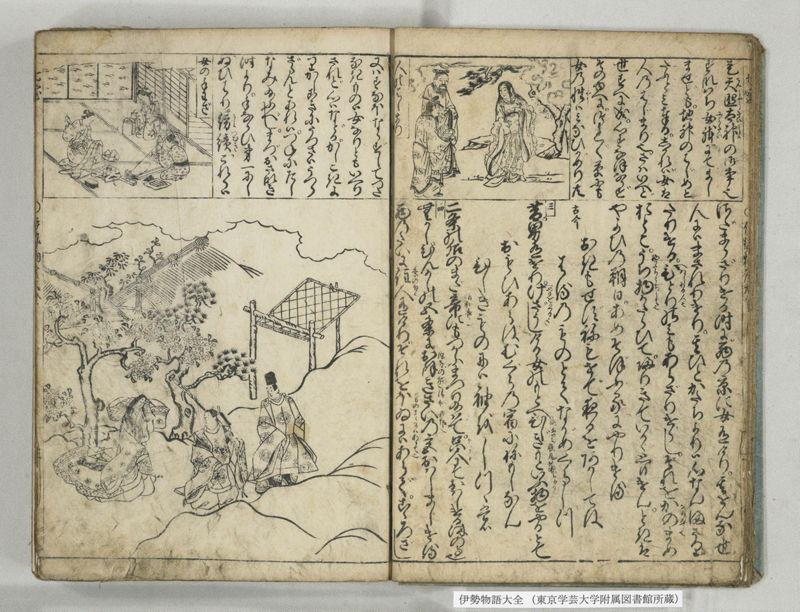
翻刻
【右丁・上段】
是/天照太神(てんしやうたいしん)の御事也
すなはち女体(によたい)にてまし
ませども。地神のはじめと
たふとみ奉る。しかれば女は
人のはじまり也。さはいへど
世すへに成。心すなほならず
そのゆへに。つれ〲草にも
女の性(しやう)はみなひがめり共
人のはしまり
【右丁・下段】
さだまらざりける時に。西の京に女有けり。其をんな世
人にはまされりけり。其ひとかたちよりは心なんまさり
たりける。ひとり((ぬしある人也)のみもあらざりけらし。それを《振り仮名:かの|なり平也》まめ
おとこ。《振り仮名:うち物かた|物かたりうちして也》らひて。帰りきていかゝ思ひけん。ときは
やよひの朔日。あめそぼふるにやりける
《送り仮名:古今》 おきもせずねもせで夜るをあかしては
はるのものとてながめくらしつ
《箱:三》
昔。男有けり。《振り仮名:けざうし|思ひをかくる也》ける女のもとへ《振り仮名:ひじきも|海草也鹿尾藻トカク》といふ物をやるとて
おもひあらばむぐらの宿にねもしなん
ひしきものには袖をしつゝも
二条の后のまだ帝(清和帝也)にもつかふまつり給はで。只人(タヽフト)にておはしける時の事也
《箱:四》
むかし。ひんがしの五条に《振り仮名:おほきさいの|染殿の后也清和母后也》宮おはしましける
西のたいに住人(二条の后也)有けり。それを《振り仮名:ほゐにはあ|思ひのまゝにはあらて也》らで。こゝろざし
【左丁・上段】
又はすなほならずしてつた
なきものは女なりともいへり
されど心はなどか。かしこきよ
りかしこきにうつさはうつら
ざらんとあれは。つねにたし
なみ給ふべし。まづおさなき
時より。手ならひ第一にし
ぬひはり。紡績(うみつむき)。これらは
女の手わざ
現代語訳
【右丁・上段】
これは天照大神(てんしょうだいじん)のことである。すなわち女性の御姿でいらっしゃるけれども、地神(ちじん)の始まりとして尊み奉る。そうであるから、女は人の始まりである。とはいえ、世も末になると、心が素直でなくなる。そのゆえに、『徒然草』にも「女の性(さが)はみな曲がっている」とも——
人の始まり(※挿絵の見出し)
---
【右丁・下段】
(前頁より続き)まだ定まらなかった時、西の京に女がいた。その女は世間の人よりも優れていた。その人は、容貌よりも心の方がさらに優れていた。ひとりの男の妻というわけでもなかったらしい(※主のある人、つまりすでに夫のある人ということである)。それを彼(※業平のことである)という誠実な男が、語り合って(※物語を語り合ったということである)、帰ってきてどう思ったのであろうか。時は三月一日、雨がしとしと降る中に送った歌——
【古今集より】
起きもせず寝もせで夜をあかしては
春のものとてながめ暮らしつ
(箱:三)
昔、男がいた。思いを寄せていた(※思いをかける、という意味である)女のもとへ、「ひじきも」(※海草のことで、鹿尾藻ともいう)というものを送るとて——
思ひあらばむぐらの宿に寝もしなん
ひじきものには袖を敷きつつも
二条の后が、まだ帝(清和天皇のことである)にお仕え申し上げておらず、ただ普通の高貴な方(※「只人」とは身分の高い普通の方という意味)でいらっしゃった時のことである。
(箱:四)
昔、東の五条に大后の宮(※染殿の后のことで、清和天皇の母后である)がいらっしゃった。その西の対(たい)に住む人(※二条の后のことである)がいた。それを、意のままにはならず(※思いのままにはならなかったということ)、慕う心を——
---
【左丁・上段】
また、素直でなく、つたなきものは女であるともいわれている。されど、心はどうして、賢い者からさらに賢い者へと移し変えれば、移らないということがあろうか(※賢く向上できないはずはない)。それゆえ、常に心がけ励みなさるべきである。まず幼い時から、手習い(書道)を第一とし、縫い針仕事、紡績(糸を紡ぐこと)——これらは——
女の手わざ(※挿絵の見出し)
英語訳
**[Right folio, upper section]**
This refers to the matter of Amaterasu Ōmikami (the Great Divinity of Heaven-Illumination). Although she manifests in female form, she is revered as the progenitor of the earthly deities (chijin). For this reason, woman is the origin of humankind. That said, as the world declines into its latter age, hearts become less honest and upright. It is for this reason that even the *Tsurezuregusa* states that "the nature of women is, in all cases, crooked"—
*(Illustration heading:)* The Beginning of Humankind
---
**[Right folio, lower section]**
*(Continued from the previous page)* — not yet settled, there was a woman in the western quarter of the capital. This woman surpassed the people of the world. In her case, her heart surpassed even her appearance. It seems she was not exclusively one man's wife *(note: meaning she was a woman who already had a master/husband)*. A sincere and devoted man *(note: referring to Narihira)* spent time conversing with her *(note: meaning they talked together at length)*, and upon returning home, what did he think? It was the first day of the third month; he sent this poem in the gentle rain:
**[Cited from the Kokinshū:]**
> *Oki mo sezu / ne mo sede yoru wo / akashite wa*
> *Haru no mono tote / nagame kurashitsu*
*(Neither rising nor sleeping, I passed the night through,*
*and as befits the spring, I spent the day lost in longing gaze.)*
---
**[Section 3]**
Long ago, there was a man. Wishing to send to a woman he was secretly devoted to *(note: meaning to place one's thoughts upon someone)* a thing called "hijiki-mo" *(note: a type of seaweed, also written as "鹿尾藻," hijiki)*, he sent this poem:
> *Omoi araba / mugura no yado ni / ne mo shinan*
> *Hijiki mono ni wa / sode wo shikitsutsu mo*
*(If you truly feel for me, I would lie down to sleep even in a weed-choked dwelling,*
*spreading out my sleeve as a mat of hijiki seaweed.)*
This concerns the time when the Nijō Consort had not yet entered the service of the Emperor *(note: the Emperor Seiwa)* and was still living as a private noble lady *(note: "tadabito" here denotes a person of high rank living outside imperial service)*.
---
**[Section 4]**
Long ago, at the Eastern Fifth Avenue (Higashi no Gojō), there resided the Empress Dowager *(note: this refers to the Somedono Consort, the mother of Emperor Seiwa)*. In the western wing of that residence lived a woman *(note: referring to the Nijō Consort)*. Unable to approach her as he wished *(note: meaning things did not go as he desired)*, with a heart full of yearning—
---
**[Left folio, upper section]**
Furthermore, it is also said that those who are not straightforward and are lacking in virtue are women. Yet, why should the heart be unable to be moved from wisdom to greater wisdom? *(note: meaning there is no reason one cannot improve and become more accomplished.)* Therefore, you should always strive and apply yourself diligently. First, from a young age, the practice of calligraphy (hand-copying) should be foremost, followed by needlework and sewing, spinning and weaving — these are —
*(Illustration heading:)* The Crafts of Women