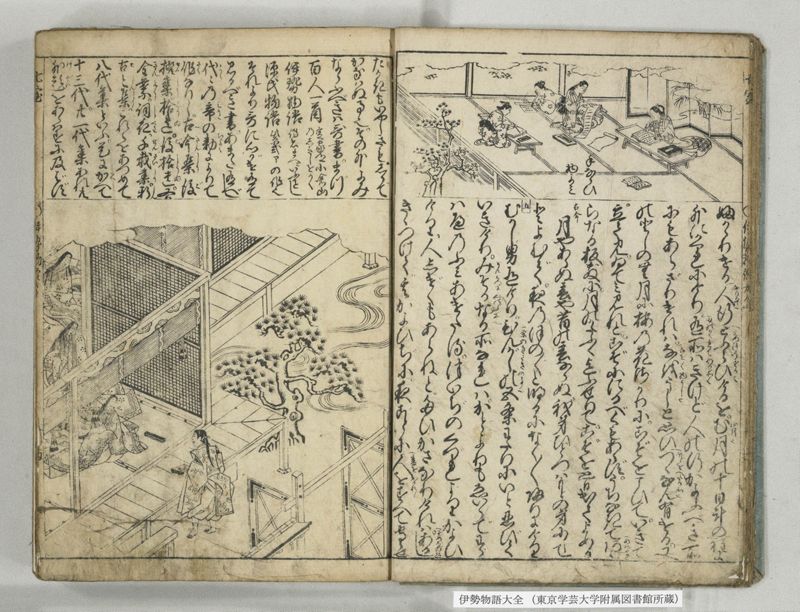
翻刻
【右丁・上段】
手ならひ
物よみ
【右丁・下段】
ふかゝりける人(なり平也)行《振り仮名:とふらひ|みつつうする也》けるを。《振り仮名:む月|正月也》の十日計の程に
外にかくれにけり《振り仮名:有所はきけど|女のかくれてある所也》人の行かよふべき所
にもあらざりけれは。《振り仮名:なをうし|(なを〳〵物うし也》と思ひ《振り仮名:つゝなん|(ほどをへたる心也》有ける。又
のとしのむ月に梅の花ざかりに。こぞをこひて。いきて
。立て見。ゐてみ見れと。こぞににるべくもあらず。うちなきて《振り仮名:あば|あれたる也》
らなる板敷に。月のかたふく迄ふせりて。こぞを思ひ出てよめる
《送り仮名:古今》
月やあらぬ春や昔の春ならぬ我身ひとつはもとの身にして
とよむで。夜のほの〴〵と明るになく〳〵帰りにけり
《箱:五》
むかし男有けり。《振り仮名:ひんがしの|二条のきさきの事也》五条わたりにいと忍びて
いきけり。《振り仮名:みそかなる|をんみつにしのふ所也》所なれは。かどよりもゑいらでわら
はべのふみあけたる。ついぢのくづれよりかよひ
けり。人しげくもあらねと。たひかさなりけれは。《振り仮名:あるし|(そめ殿の后也)》
きゝつけて。其かよひぢに。夜ごとに《振り仮名:人をす|番をおかれし》へて守らせ
【左丁・上段】
たかきもいやしきも。しらで
かなはぬ事也。その外よみ
ならふべきは哥書。まづ
百人一首《割書:定家郷小倉山|のしきしをかく》
伊勢物語 作者まへにいふことし
源氏物語 紫式部の作也
それより歌に心がけ有て
見るべき書。あまた有べし
代々(よゝ)の帝(みかと)の勅(ちよく)によりて
作(さく)なりし。古今集(こきんしう)後(ご)
撰集(せんしう)。拾遺(しうゐ)。後拾遺(ごしうゐ)。又は
金葉(きんえう)。詞花(しくわ)。千載集(せんざいしう)。新(しん)
《振り仮名:古今集|こきんしう》。これらをあつめて
八代集といふ。是に加(くは)へて
十三代。廿一代集あれ共
外題(げだい)をあらはすに及ばず
現代語訳
【右丁・上段】
手習い(書道)
物読み(読書)
---
【右丁・下段】
(前頁より続き)深く思い入っていた人(※業平のことである)が、訪ね続けていた(※見ながら親しんでいたということ)のを、正月十日ごろに、(女が)よそへ身を隠してしまった。女が隠れひそんでいる場所は聞いていたが、人が通い訪れることのできるような所でもなかったので、「ますます気が重く、つらいことだ」(※「なをうし」とは、なおなおと物憂い、の意味である)と思いながら(※日々を経てきた心情である)日を過ごしていた。そして、また翌年の正月、梅の花の盛りに、去年(の女のこと)を恋しく思い、(かつてその女のいた場所に)行って、立って眺め、座って眺め、見渡してみたが、去年に似ているようなところが少しもない。(男は)声を立てて泣きながら、荒れ果てた(※「あばら」とは荒れたということである)板敷きの上に、月が傾くまで横になって、去年のことを思い出して詠んだ歌——
【古今集より】
月やあらぬ 春や昔の春ならぬ
わが身ひとつは もとの身にして
と詠んで、夜がほのぼのと明けてくる中、泣く泣く帰っていったのであった。
---
(箱:五)
昔、男がいた。東の五条あたり(※二条の后のことである)に、たいそうひそかに通っていた。人目を忍ぶ場所(※密かに忍び込む所ということである)であったから、門からは入れずに、子どもたちが踏み破った築地塀(ついじのへい)の崩れた所から通っていた。人が多くいるわけでもなかったが、通う回数が重なったので、(その家の)主(※染殿の后のことである)がそれを聞きつけて、その通い路に、夜ごとに番人を置いて見張らせ——
---
【左丁・上段】
(書道・読書は)身分の高い者も低い者も、知らずにはすまない(身につけずにはいられない)ことである。それ以外に読み習うべきものは歌書(うたしょ)である。まず——
・百人一首(※藤原定家卿が小倉山の色紙に書き記したものである)
・伊勢物語(※作者については前に述べた通りである)
・源氏物語(※紫式部の作である)
それより、和歌に心がけのある方が見るべき書物は、数多くあることだろう。代々の帝(みかど)の勅(ちょく)によって作られた歌集として、古今集(こきんしゅう)・後撰集(ごせんしゅう)・拾遺集(しゅういしゅう)・後拾遺集(ごしゅういしゅう)、また金葉集(きんようしゅう)・詞花集(しかしゅう)・千載集(せんざいしゅう)・新古今集(しんこきんしゅう)——これらをまとめて「八代集(はちだいしゅう)」という。これに加えて、十三代集、二十一代集などもあるが、ここでは外題(書名)を列挙するまでには及ばない。
英語訳
**[Right folio, upper section]**
- Calligraphy practice (hand-copying)
- Reading texts
---
**[Right folio, lower section]**
*(Continued from the previous page)* — The man *(note: referring to Narihira)* had been visiting and attending upon *(note: meaning he had been growing familiar with her through repeated visits)* a woman to whom he was deeply devoted, but around the tenth day of the First Month, she concealed herself away elsewhere. He had heard tell of where the woman was hiding *(note: meaning the place where the woman had hidden herself)*, but it was not a place where one could easily come and go. So he passed the days feeling ever more despondent and heavy-hearted *(note: "nawoushi" means feeling increasingly weary and burdened, time having accumulated)*.
Then, in the First Month of the following year, at the height of the plum blossoms, longing for the previous year, he went to the place. He stood and gazed; he sat and gazed — yet nothing resembled how it had been the year before. Weeping aloud, he lay down upon the dilapidated *(note: "abara" means ruined or fallen into disrepair)* floorboards until the moon tilted in the sky, and recalling the previous year, he composed this poem:
**[Cited from the Kokinshū:]**
> *Tsuki ya aranu / haru ya mukashi no / haru naranu*
> *Waga mi hitotsu wa / moto no mi ni shite*
*(Is the moon no longer the same moon? Is this spring no longer the spring of old?*
*My own body alone remains as it always was.)*
Having composed this poem, as the night gently brightened toward dawn, he returned home, weeping all the while.
---
**[Section 5]**
Long ago, there was a man. He was making very secret visits to the vicinity of the Eastern Fifth Avenue *(note: this refers to the Nijō Consort)*. As it was a place for furtive rendezvous *(note: meaning a place for slipping in secretly and discreetly)*, he could not enter through the main gate; instead, he passed through a crumbled gap in the earthen wall that the servant children had broken through by trampling. The place was not particularly crowded with people, yet as his visits accumulated in number, the mistress of the house *(note: referring to the Somedono Consort)* got wind of it. Along that secret passageway, every night she posted people *(note: meaning guards were placed on watch)* to keep watch—
---
**[Left folio, upper section]**
*(Calligraphy and reading)* are things that neither high nor low in station can do without knowing. Beyond these, the texts one ought to read and study are poetry anthologies (*utasho*). First among them:
- **Hyakunin Isshu** *(note: compiled by Lord Fujiwara no Teika, written on shikishi cards at Mount Ogura)*
- **Ise Monogatari** *(note: regarding its author, as stated earlier in this text)*
- **Genji Monogatari** *(note: composed by Murasaki Shikibu)*
Beyond these, there must be a great many works for those who are earnest about poetry to consult. As for the imperial anthologies (*chokusen wakashū*) compiled by the command of successive emperors, they are: the *Kokinshū*, *Gosenshū*, *Shūishū*, *Goshūishū*, and further the *Kin'yōshū*, *Shikashū*, *Senzaishū*, and *Shin Kokinshū* — these together are called the "Eight Imperial Anthologies" (*Hachidaishū*). In addition to these, there are also collections known as the Thirteen Imperial Anthologies and the Twenty-one Imperial Anthologies, but it is not necessary here to set forth all their titles.