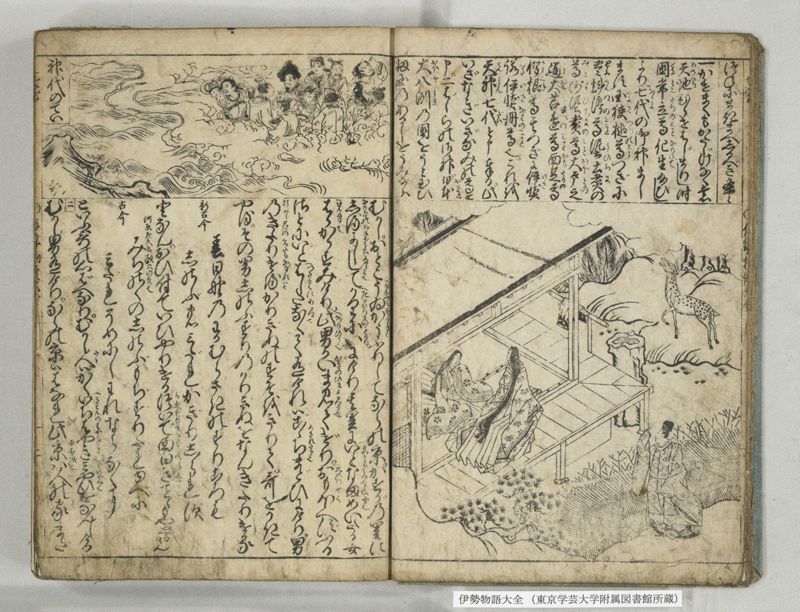
翻刻
【右丁・上段】
つねにまきまへしるべき条々
一かけまくもかたじけなくも
天地(あめつち)ひらけはじまりし時
国常立尊(くにとこたちのみこと)化生(なりいで)給ひし
より。七代(なゝよ)の御神まし
ます国狭槌尊(くにさつちのみこと)つぎに
豊斟渟尊(とよくんぬのみこと)埿土煮(うひちに)の
尊((みこと)沙埿煮尊(さひちにのみこと)大戸之(おほとの)
通(じ)大苫辺尊(おほとまべのみこと)面足(おもたるの)尊
惶根(かしこね)尊其つぎに伊弉(いさ)
諾(なき)伊弉冊尊(いさなみのみこと)也。これを
天神(てんしん)七/代(だい)と申奉る。此
いざなぎいざなみの尊と
申。二ばしらの御神。日本(やまと)
大八洲(おほやしま)の国をうみ玉ひ
扨国のあるじをうみ給ふ
【左丁・上段】
神代のてい
【左丁・下段】
むかし。おとこ うゐかう((けんふくする事也)ふりしてならの京。かすがの里に。
しるよしして(なり平のちきやう所有しと也)かりにい((たかかりにいきけり)にけり。其里に。いとなまめ((もつともうつくしい女也)いたる女
はらか((兄弟也)らすみけり。此男((なりひら也)《振り仮名:かいま見て|かきのひまより見る也》げり。おもほへ((思ひの外也)ずふる
さとにいと 《振り仮名:はしたなく|(つきなくにあ□ぬや》#1て有けれは。こゝちま(あきれたる也)どひにけり。男
のきたりける(折ふし花のえたもなけれは也)かりぎぬのすそをきりて。哥をかきて
やる。その男しのぶずりのかりぎぬをなんきたりける
《送り仮名:新古今》春日野のわかむらさきのすりころも
しのぶのみだれかぎりしられず
となん。おひ付ていひやりける《振り仮名:ついで面白きこと|取あへす古哥なれ共返しとする也》ゝもや思ひけん
《送り仮名:古今》みちのく(河原左大臣融公の哥也)のしのぶもぢすりたれゆへに
みだれそめにしわれならなくに
といふ哥の心ばへなり。むかし人(ウト)はかく《振り仮名:いちはやきみやひ|きてんのはやき□也といふ心也》をなんしける
《箱:二》
むかし。男有けり。ならの京ははなれ。《振り仮名:此京は| 平安城也》人の家まだ
現代語訳
## 【右丁・上段】
### 常に心に留めておくべき事柄
一、恐れ多くも申し上げれば、天地(あめつち)が開け始まった時、国常立尊(くにとこたちのみこと)がお生まれになってより、七代の御神がおられる。国狭槌尊(くにさつちのみこと)、次に豊斟渟尊(とよくんぬのみこと)、埿土煮尊(うひちにのみこと)、沙埿煮尊(さひちにのみこと)、大戸之道尊(おほとのじのみこと)・大苫辺尊(おほとまべのみこと)、面足尊(おもたるのみこと)、惶根尊(かしこねのみこと)、その次に伊弉諾尊(いざなぎのみこと)・伊弉冉尊(いざなみのみこと)がおられる。これを「天神七代」と申し上げる。この伊弉諾・伊弉冉の尊と申し上げる二柱の御神が、日本大八洲(おほやしま)の国をお産みになり、そうして国の主をお産みになった。
---
## 【左丁・上段】
### 神代の体(てい)〔神代のありさま〕
---
## 【左丁・下段】
### 〔伊勢物語・第一段〕
昔、男が元服して、奈良の京・春日の里に、(業平が知行所を)所有していたので、狩りに行った。その里に、たいそう優美な女が兄弟と住んでいた。この男(業平)が垣間見た〔垣根の隙間から見ること〕。思いがけず(古い奈良の)里に、たいそう場違いで〔ひどく不釣り合いに〕あったので、心が乱れてしまった。男が(来た折に)着ていた狩衣の裾を切って、歌を書いて贈った。その男は、しのぶずりの狩衣を着ていたのである。
〔新古今集〕
春日野の若紫のすり衣(ころも)
しのぶの乱れ 限り知られず
と、(彼女に)追いかけるように言い送った〔とっさのことで古歌ではあるが、返歌とする〕のも、(相手は)同じように思ったのであろうか。
〔古今集〕
陸奥のしのぶもぢずり 誰ゆゑに
乱れそめにし われならなくに
〔河原左大臣・源融の歌である〕
というこの歌の心(趣旨・精神)から来ているのである。昔の人は〔ウト(疎い人)〕このように「いちはやきみやび〔機転の早いこと、という意味〕」をしたのである。
---
### 〔第二段の書き出し〕
昔、男があった。奈良の京(みやこ)を離れ、〔この京は平安城である〕人の家がまだ(続く)…
英語訳
## [Right Folio, Upper Section]
### Matters to Always Keep in Mind
First: With the utmost reverence, when Heaven and Earth first began to open and take shape, the deity Kuninotokotachi no Mikoto came into being, and from that moment, the Seven Generations of Divine Deities existed: Kuninosatsuchi no Mikoto, then Toyokumnu no Mikoto, Uhijini no Mikoto, Suhijini no Mikoto, Ohotonoji no Mikoto and Ohotomabe no Mikoto, Omotaru no Mikoto, Kashikone no Mikoto, and then Izanagi no Mikoto and Izanami no Mikoto. These are reverently referred to as the "Seven Generations of Heavenly Deities" (Tenjin Shichidai). It is these two deities, Izanagi and Izanami, who gave birth to the great land of Yamato—the great eight islands of Japan—and thereafter gave birth to the lords of the land.
---
## [Left Folio, Upper Section]
### The Aspect of the Age of the Gods *(Kamiyo no tei)*
---
## [Left Folio, Lower Section]
### [*Ise Monogatari*, Section One]
Long ago, a man performed his coming-of-age ceremony (genpuku) and went hunting in Kasuga village in the old capital of Nara, at a place over which he held proprietary rights *(that is, Narihira had a domain there)*. In that village, a remarkably beautiful woman *(a most exceptionally beautiful woman)* lived together with her siblings *(siblings)*. This man *(that is, Narihira)* caught a glimpse of her *(to glimpse through a gap in the fence)*. Unexpectedly finding, in this old village, something so utterly out of place *(strikingly incongruous and unexpected)*, his heart fell into confusion *(a state of bewilderment)*. He cut the hem of the hunting cloak *(kariginu)* he had worn when he arrived *(there being no branch of flowers to offer at the time)*, wrote a poem upon it, and sent it to her. The man had been wearing a kariginu dyed in the *shinobu* rubbing-print pattern.
*(From the New Kokinshu)*
> The dye-printed robe of young purple / from the fields of Kasuga—
> the disarray of *shinobu* (longing) / knows no limit, has no end.
This he sent after her in pursuit *(though it was taken on the spur of the moment from an old poem, it serves as a returning verse)*—and perhaps she felt the same way in return.
*(From the Kokinshu)*
> The *shinobu* pattern-print of Michinoku—for whose sake
> did this disordered longing of mine first begin?
> *(This is a poem by the Minister of the Left of the Riverbank, Lord Minamoto no Tōru)*
This is the spirit and sentiment from which that poem derives. People of old *(those unacquainted with such things)* thus practiced what is called *ichihayaki miyabi* — *swiftness of elegant sensibility* *(meaning: the quickness of refined wit)*.
---
### [Opening of Section Two]
Long ago, there was a man. He departed from the old capital of Nara *(this capital refers to the city of Heian)*, and at someone's house, not yet… *(continues on the following page)*