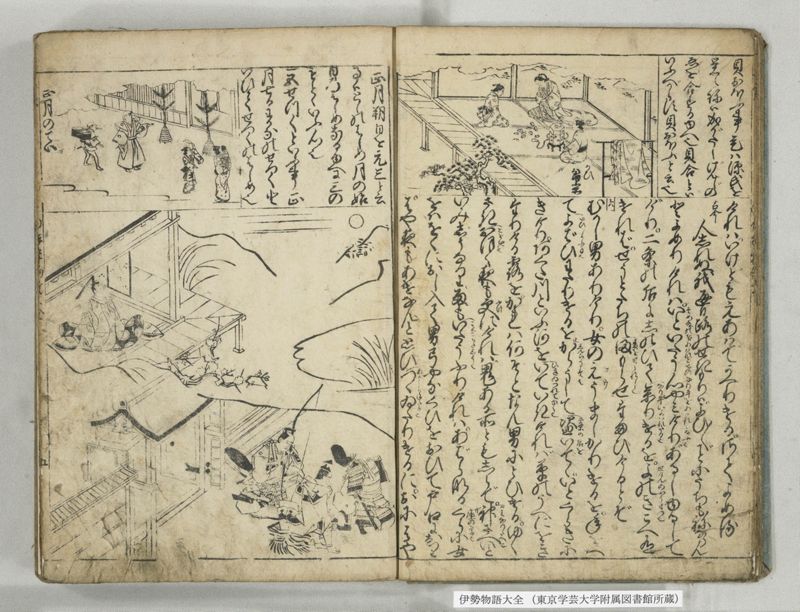
翻刻
【右丁・上段】
貝おほふ事是は源氏を
覚えねは成がたしげんじの
ゑを合するゆへ也貝合とは
いふべからす貝おほふと云也
かひ
おほふ所
【右丁・下段】
けれは。いけどもえあはでかへりける。さてよめる
《送り仮名:古今》人しれぬ我通ひ路のせきもりは。よひ〳〵ごとにうちもねならん
とよめりけれは。《振り仮名:いといたう心やみけり。|そめ殿の后あはれと思ひなり平をあはれ給ふ也》あるしゆるして
げり。二条の后にしのひて《振り仮名:参りける|(なり平かよはれたる也》を。《振り仮名:よのきこへ|せけんのふうぜつ也》有
ければ。せうとたちの《振り仮名:まもらせ|(番をせられし也》たまひけるとぞ
《箱:六》
むかし男ありけり。女のえ(ヨ)う(ウ)まじかりけるを。年をへ
て《振り仮名:よばひ|(いひかよふ事也》わたりけるを。《振り仮名:からう|(しんらうして也》して《振り仮名:盗いで|(二条の后を》ゝ。いとくらきに
きけり。あくた川といふ河を《振り仮名:いていき|(ひきゐつれてゆく也》ければ草のうへにをき
たりける露を。かれは何ぞとなん男にとひける。ゆく
さき《振り仮名:おほく|(とをき也》夜も更(ふけ)にけれは。鬼ある所ともしらで。《振り仮名:神さへ|(かみなりさへ也》いと
いみじうなり。雨も《振り仮名:いたう|(はなはたしう也》ふりけれは。あばらなる《振り仮名:くらに|座#1の字也》女
をはをくにおし入て。男弓やなくひをおひて戸口におり
。はや夜もあけなんと思ひ《振り仮名:つゝゐた|(あかしかねたる也》りけるに。おにはや
【左丁・上段】
正月朔日を元三と云
事はとしのはしめ月の始
日のはしめなるゆへに三の
もとゝいふ心也
五せつくといふ事正
月七日わかなのせつくと
いひてせつくのはしめ也
正月のてい
現代語訳
【右丁・上段】
貝覆い(かいおおい)という遊びについて。これは源氏物語を知らなければできないものである。なぜなら、源氏絵(げんじえ)を合わせる遊びであるからだ。「貝合(かいあわせ)」とは言うべきではなく、「貝覆い」と言うのが正しい。
(絵:貝覆いをする場所の図)
---
【右丁・下段】
(前頁より続き)——それで(男は)生きて通っていたけれども、(女に)会うこともできずに帰ったのであった。そこで(男が)詠んだ歌——
【古今集より】
人知れぬ わが通ひ路の 関守は
よひよひごとに うちも寝ならん
と詠んだところ、(染殿の后は)たいそうひどく心を痛められた(※染殿の后が哀れとお思いになり、業平をいとしくお思いになったのである)。(そこで)主人(后)はお許しになった。二条の后に(業平が)ひそかに参上していた(※業平が通っていたのである)ことが、世間に噂(※世間の風説ということである)として広まったので、(后の)兄上たちが(邸を)見張らせ(※番をさせられたのである)なさったということだ。
---
【箱:六】
昔、男がいた。(その男が)どうしても手に入れることができなかった女を、長年にわたって求婚し(※「よばひ」とは言い交わすことである)続けていたが、苦労して(※「からうして」とは苦労してということである)ついに盗み出し(※二条の后を盗み出したのである)、たいそう暗い夜に連れて行った。芥川(あくたがわ)という川を渡って行く(※引き連れて連れて行くのである)と、草の上に置いてあった露を、「あれは何ですか」と女が男に尋ねた。行く先は遠く(※「おほく」とは遠いということである)、夜もすっかり更けてしまったので、(そこが)鬼のいる所とも知らずに、雷まで(※雷さえもということである)たいそうひどく鳴り、雨もひどく(※「いたう」とははなはだしくということである)降ったので、(男は)荒れ果てた蔵(※「くら」は蔵の字である)に女を奥へ押し入れ、男は弓と矢入れ(やなぐい)を背負って戸口に座った。「早く夜も明けてほしい」と思いながら(※夜明けを待ちかねているのである)座っていたところ、鬼がたちまち——
---
【左丁・上段】
正月朔日(ついたち)を「元三(がんさん)」と言うのは、年の始め・月の始め・日の始めであるから、「三つの元(もと)」という意味である。
五節句(ごせっく)ということについて——正月七日を「若菜の節句(わかなのせっく)」といい、これが節句の最初である。
(絵:正月の様子の図)
英語訳
**[Right folio, upper section]**
On the game of *Kai-ōi* ("Shell Covering"): this game cannot be played without knowledge of *The Tale of Genji*, because it is a game of matching pictures depicting scenes from Genji. It should not be called *kai-awase* ("shell matching") — the correct term is *kai-ōi* ("shell covering").
*(Illustration: a depiction of the place where kai-ōi is played)*
---
**[Right folio, lower section]**
*(Continued from the previous page)* — And so, though the man lived and kept coming to the place, he was unable to meet with her and returned home each time. He then composed this poem:
**[Cited from the Kokinshū:]**
> *Hito shirenu / waga kayoiji no / sekimori wa*
> *yoiyoi goto ni / uchi mo ne naramu*
*(The guardian of my secret passageway —*
*the one none but I know —*
*must surely fall asleep each and every night.)*
Upon the composition of this poem, *(note: the Somedono Consort was deeply moved, and came to feel tenderness and affection for Narihira)* the mistress relented and permitted him entry. However, as the news of his secret visits to the Nijō Consort *(note: meaning Narihira had been making his visits to her)* spread as rumor throughout the world *(note: "yono kikoe" means the talk and gossip of society)*, her elder brothers had the residence placed under guard *(note: meaning they had watchmen posted)*.
---
**[Section 6]**
Long ago, there was a man. There was a woman he absolutely could not obtain; for many years he had continued to court her *(note: "yobai" means to call out and communicate one's feelings to a woman repeatedly)*. With great difficulty *(note: "karōshite" means having gone to considerable trouble)*, he at last stole her away *(note: it was the Nijō Consort whom he stole away)*, and set off through the pitch darkness of night. As they made their way along the river called the Akutagawa *(note: meaning he was leading her along with him)*, the woman asked the man, "What is that?" pointing to the dewdrops that lay upon the grass. The way ahead was long *(note: "ōku" means far and distant)*, and the night had grown deeply late. Not knowing that it was a place where demons dwelled, even the thunder *(note: meaning thunder above all else)* roared terribly, and the rain fell in torrents *(note: "itau" means severely, to an extreme degree)*. The man pushed the woman deep into a ruined, dilapidated storehouse *(note: the character used here is the one for "storehouse," kura)*, and he himself, taking up his bow and quiver (*yanagui*), sat at the doorway. Waiting and wishing that the night would quickly give way to dawn *(note: meaning he could hardly bear the wait for daybreak)*, he sat there — when all at once, the demon—
---
**[Left folio, upper section]**
The reason that the first day of the First Month is called *Ganzan* ("Three Origins") is that it marks the beginning of the year, the beginning of the month, and the beginning of the day — thus it is called the "origin of three beginnings."
On the matter of the Five Seasonal Festivals (*Gosekku*): the seventh day of the First Month is called the "Young Herb Festival" (*Wakana no Sekku*), and this is the first of the seasonal festivals.
*(Illustration: a depiction of a New Year's scene)*