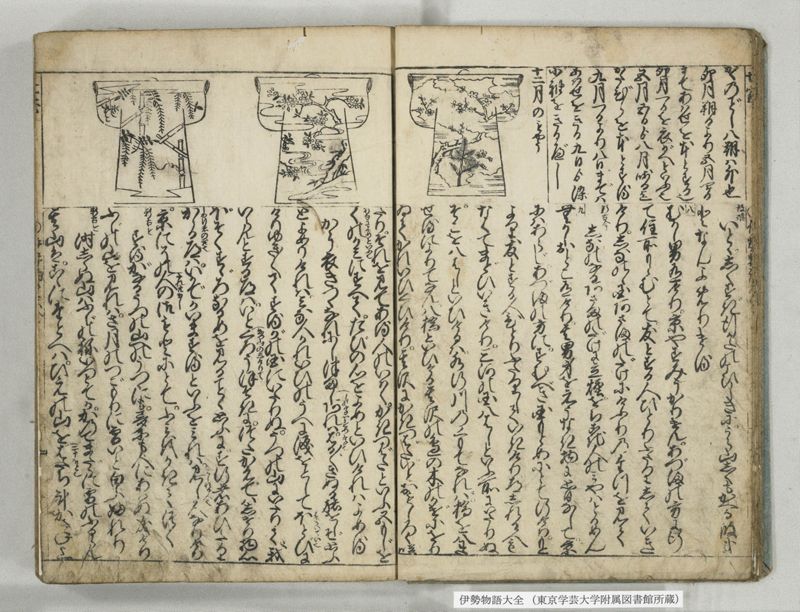
翻刻
【右丁・上段】
かくのごとし八朔は外也
卯月朔日より五月四日
まてあはせを本とする也
卯月一日を衣がへといふ也
五月五日より八月晦日迄
かたびらを本とする
九月一日より八日までは
あはせをきる九日より染
小袖をきるべし
十二月のもやう
【右丁・下段】
《送り仮名:後撰》いとゞしくすぎ行かたのこひしきに。うら山しくもかへる波哉
となんよめりける
《箱:八》
むかし男有けり。京やすみうかりけん。あづまの方に行
て住所もとむとて。友とする人ひとりふたりしていき
けり。しなのゝ国あさまのだけにけふりのたつを見て
《送り仮名:新古今》しなのなるあさまのだけに立煙。をちこち人のみやはとかめん
《箱:九》
むかしおとこ有けり。其男身をえうなき物に思ひなして。京
にはあらじ。あづまの方に。すむべき国もとめにとて行けり。もと
より友とする人ひとりふたりしていきけり。道しれる人も
なくてまどひいきけり。三河の国八はしといふ所にいたりぬ
。そこを八はしといひけるは。水行川のくもでなれば。橋を八わた
せるによりてなん。八橋といひける其沢の辺の木のかげにをり
ゐてかれいひくひけり。其沢にかきつばた。いとおもしろく咲
【左丁・下段】
たり。それを見てある人のいはく。かきつばたといふ五もじを
《振り仮名:くのかみに|折句によめといふ也》すへて。たびの心をよめといひけれはよめる
から衣きつゝなれにしつま《振り仮名:しあれは。はる|(しの字やすめ字也》〴〵きぬる旅をしぞ思ふ
とよめりけれは。みな人かれいひのうへに涙をとして《振り仮名:ほとび|はいかいてい也》に
けりゆき〳〵てするがの国にいたりぬ。うつの山にいたりて。我
いらんとする道は。いと《振り仮名:くろうほ|(なつ山のしけりて》そきに。つたかえではしげり物心
ぼそくすゞろなるめを見ることゝ思ふに。す行者あひたり
《振り仮名:かゝる道|しゆ行者の詞也》は。いかでかいまするといふをみれは。《振り仮名:見し人|みしれる人也》なりけり
。京にその《振り仮名:人の御|たれ共なし》もとにとて。ふみをかきてつく
《送り仮名:新古今》するがなるうつの山へのうつゝにも。夢にも人にあはぬ成けり
ふじの山を見れは。さ月のつごもりに雪いと白ふふれり
《送り仮名:新古今》時しらぬ山はふじのねいつとてか。かのこまだらに雪のふるらん
其山は。こゝにたとへは。ひえの山を。《振り仮名:はたち|(二十ほと也》計かさね上
現代語訳
【右丁・上段】
(以上のとおりである。八朔(はっさく、八月一日)は例外である。)
卯月(四月)の朔日(一日)から五月四日までは、袷(あわせ)を基本とする。
卯月一日を「衣替え」という。
五月五日から八月末日(晦日)までは、帷子(かたびら)を基本とする。
九月一日から八日までは袷を着る。九日からは染め小袖を着るべし。
十二月の模様(※衣服の模様についての記述)
---
【右丁・下段】
【後撰集より】
いとゞしくすぎ行かたのこひしきに うら山しくもかへる波哉
(「ますます過ぎ去った方(故郷・都)が恋しいのに、羨ましいことよ、帰っていく波よ」)
と詠んだのであった。
---
(箱:八)
昔、男があった。京に住んでいることが辛く思われたのであろうか、東の方へ行って住む所を求めようと、友人を一人・二人連れて出発した。信濃(しなの)の国、浅間岳(あさまのだけ)に煙が立つのを見て——
【新古今集より】
しなのなるあさまのだけに立煙 をちこち人のみやはとかめん
(「信濃にある浅間岳に立つ煙を、遠くの人も近くの人も、いったいとがめるだろうか(いや、とがめはすまい)」——私の恋心も、あの煙のように誰もとがめることはできまい、というたとえ)
---
(箱:九)
昔、男があった。その男は、自分自身を世に不要な者と思い定めて、「京にはいまい。東の方に、住むべき国を求めに行こう」と思い立って旅立った。以前から友人としている人を一人・二人連れて行った。道を知っている人もなく、迷いながら進んでいった。三河(みかわ)の国・八橋(やつはし)という所に到着した。そこを八橋というのは、水が流れる川が蜘蛛手(くもで)のように八方に分かれており、橋を八つ渡してあるところから、八橋と言ったのである。その沢のほとりの木の陰に降り立って、干し飯(かれいい)を食べた。その沢に、燕子花(かきつばた)が、たいそう美しく咲いていた。
---
【左丁・下段】
(続き)——それを見て、ある人が言うには、「『かきつばた』という五文字を(※折句として詠め、つまり各句の頭に置いて詠めということである)各句の頭に据えて、旅の心を詠め」と言ったので、(男が)詠んだ歌——
から衣 きつゝなれにし つましあれば はる〴〵きぬる 旅をしぞ思ふ
(※「し」の字は休め字(調子を整えるための助字)である)
(「唐衣を着慣れるように、慣れ親しんだ妻が(都に)いるので、はるばるやって来たこの旅のことを、しみじみと思う」)
と詠んだので、皆が(その歌に感動し)、干し飯の上に涙を落として(干し飯が)ふやけてしまった(※「ほとびにけり」とは、ふやけて柔らかくなったということである)。
旅を続けて駿河(するが)の国に着いた。宇津(うつ)の山に差し掛かって、自分がこれから入ろうとする道は、たいそう暗く茂っていて(※「くろうほそき」とは、夏山が茂っているということである)、蔦(つた)や楓(かえで)が生い茂り、心細くも、思いがけない(侘しい)境遇を味わうことよと思っていたところ、修行者(山伏)と出会った。「(※「かかる道は」以下は修行者の言葉である)こんな道を、どうしてお通りになるのですか」と(修行者が)言うのを見ると、(以前)知っていた人であった。京に(残している)ある人のもとへ、と思って手紙を書いて(修行者に)託した。
【新古今集より】
するがなるうつの山へのうつゝにも 夢にも人にあはぬ成けり
(「駿河にある宇津の山の(名の「うつ」のように)現(うつつ)にも、夢の中にも、あの人に逢うことができないのだった」)
富士の山を見ると、五月の末(つごもり)であるのに、雪がたいそう白く降っていた。
【新古今集より】
時しらぬ山はふじのねいつとてか かのこまだらに雪のふるらん
(「季節を知らない山は富士の峰よ、いつだからといって、斑(かのこ)模様に雪が降るのだろうか」)
その山は、ここ(都)に例えるならば、比叡(ひえ)の山を二十(はたち)ほど積み重ね上げた……(以下次頁へ続く)
英語訳
**[Right folio, upper section]**
*(The above applies as stated. The first day of the Eighth Month [Hassaku] is an exception.)*
From the first day of the Fourth Month (*Uzuki*) through the fourth day of the Fifth Month, lined garments (*awase*) are the standard.
The first day of the Fourth Month is called the "Changing of Robes" (*Koromogae*).
From the fifth day of the Fifth Month through the last day of the Eighth Month, unlined summer robes (*katabira*) are the standard.
From the first through the eighth day of the Ninth Month, lined robes are worn. From the ninth day onward, dyed *kosode* should be worn.
*Designs for the Twelfth Month* *(a note concerning textile patterns)*
---
**[Right folio, lower section]**
**[Cited from the *Gosen'shū*:]**
> *Itodo shiku / sugi yuku kata no / koishiki ni*
> *Urayamashiku mo / kaeru nami kana*
*(How I long, more and more, for the direction I have come from — and how I envy the waves, which return whence they came!)*
— and so the verse was composed.
---
**[Section 8]**
Long ago, there was a man. Perhaps finding life in the capital too difficult to bear, he set off eastward, taking one or two friends with him, to seek a place to settle. Upon seeing smoke rising from Mount Asama (*Asama no Take*) in Shinano Province, (he composed this poem):
**[Cited from the *Shin-Kokinshū*:]**
> *Shinano naru / Asama no take ni / tatsu kemuri*
> *Ochikochi hito no / miya wa togamen*
*(The smoke that rises from Mount Asama in Shinano — would those near and far really find fault with it? — No, just as no one condemns the smoke, neither can anyone censure my burning love.)*
---
**[Section 9]**
Long ago, there was a man. That man, having come to regard himself as utterly useless and superfluous in the world, resolved: "I shall not stay in the capital. I will go east and find a province in which to live." And so he set out. He took with him one or two friends he had long kept company with. There was no one who knew the road, and they wandered on their way. They arrived at a place in the Province of Mikawa called Yatsuhashi ("Eight Bridges"). The reason this place was called Yatsuhashi was that the river waters there branched out like a spider's legs in eight directions, and eight bridges had been laid across them — hence the name Eight Bridges. They dismounted in the shade of a tree by the marsh there and ate their dried provisions (*kareii*). In the marsh, irises (*kakitsubata*) were blooming in extraordinary beauty.
---
**[Left folio, lower section]**
*(Continued)* — Seeing this, one of the party spoke up: "Compose a poem with the word '*kakitsubata*' *(note: this means to compose an acrostic poem [*oriку*], placing each syllable of the word at the head of each successive verse-phrase)*," he said, "placing those five syllables at the head of each phrase, and expressing the heart of this journey." And so (the man) composed:
> *Karagoromo / kitsutsu narenishi / tsuma shi areba*
> *Harubaru kinuru / tabi wo shi zo omou*
*(note: The syllable "shi" is a kakari-musubi filler syllable used to regulate the rhythm)*
*("Because I have a wife in the capital, as familiar and dear to me as a well-worn Chinese robe, I think with deep feeling of this journey, which has carried me so far away.")*
When this was recited, all present let their tears fall upon their dried provisions, until the provisions were quite sodden *(note: "hotobini keri" means they became swollen and soft with moisture)*.
They continued on their way and arrived in Suruga Province. Coming to Mount Utsu, the path they were to take into it was exceedingly dark and overgrown *(note: "kurohosoki" means thickly overgrown as a mountain in summer)*, tangled with vines and maple branches, and as he was thinking what a lonely and unexpected misfortune it was to find himself in such a place, he encountered a wandering ascetic (*shugenja*). "*(note: "kakaru michi wa" and the following words are spoken by the ascetic)* How do you come to be travelling such a road?" the ascetic said. Looking at him, (the man) saw that it was someone he had known before. Wishing to send word to a certain person remaining in the capital, he wrote a letter and entrusted it to the ascetic.
**[Cited from the *Shin-Kokinshū*:]**
> *Suruga naru / Utsu no yamabe no / utsutsu ni mo*
> *Yume ni mo hito ni / awanu nari keri*
*("On the path beside Mount Utsu in Suruga — even in waking reality [utsutsu], even in my dreams, I cannot meet that person.")*
Looking upon Mount Fuji, he saw that though it was already the end of the Fifth Month, snow was falling brilliantly white upon it.
**[Cited from the *Shin-Kokinshū*:]**
> *Toki shiranu / yama wa Fuji no ne / itsu tote ka*
> *Kanoko madara ni / yuki no furu ran*
*("O Mount Fuji, peak that knows no seasons — on what occasion, for what reason, do you scatter snow in fawn-spotted patterns?")*
As for that mountain, if one were to compare it to something here in the capital, it would be as though Mount Hiei were stacked twenty-fold upon itself... *(continues on the following page)*