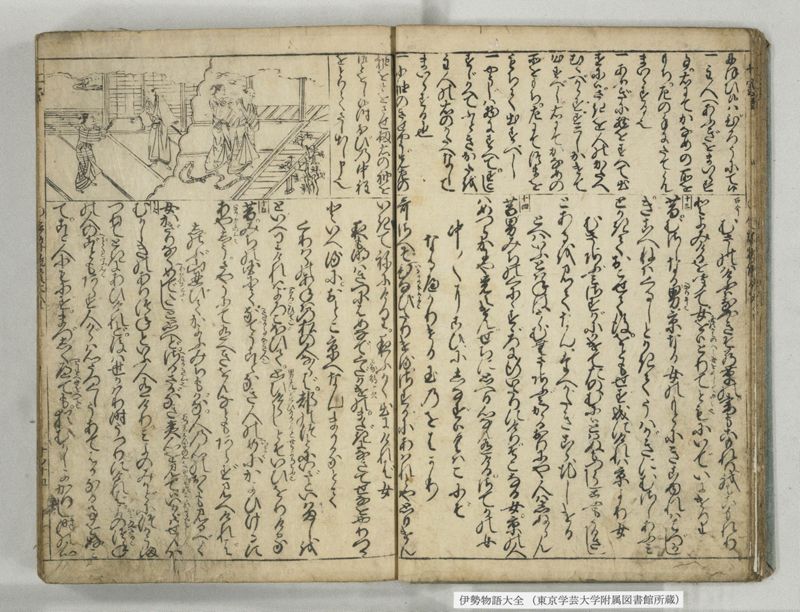
翻刻
【右丁上段】
にほひ候はびろうにて候
一 主人へあふぎをまいらす
事。右にてかなめの所を
もち。左の手にたて候て
まいらする也
一あふぎに物をすへて出
すには。さきを人のかたへ
むくべからず。すこしかけて
出すべし。右にてかなめの
所をもち。左にてつまを
もちて出すべし
一やうじは物にすへて。すこし
すじかへてふときかたを
主人の右のかたへなして
まいらする也
一小袖のきせやう。先左の
【右丁下段】
《送り仮名:古今》むさしのはけふはなやきそ若草の。妻もこもれり我もこもれり
とよみけるを聞て。《振り仮名:女をはとりてとも|国のかみの人々女をくしてゆく也》にいでいにけり
《箱:十三》
昔。むさしなる《振り仮名:男。|(なり平也》京なる女のもとにきこゆれははづかし
きこへねはくるしとかきてうはがきにむさしあぶみ
とかきておこせて後。をともせず成にけれは京より女
むさしあぶみさすがにかけてたのむにはとはぬもつらしとふもうるさし
とあるを見てなん。たへがたきこゝ地しける
とへはいふとはねはうらむむさしあぶみかゝるおりにや人はしぬらん
《箱:十四》
昔。男みちのくにゝすゞろに行いたりにけり。そこなる女。京の人
はめつらかにや覚えけん。せちに思へる心なん有ける。さてかの女
中〳〵にこひにしなずはくはこにぞ
なるへかりける玉のをはかり
哥さへぞ《振り仮名:ひなび|(いなかめきたる也》たりける。さすがにあはれとや思ひけん
【左丁上段】
袖をとをさせ扨右の袖を
御とをし候時おびの中程
をとりてさし出し申也
【左丁下段】
いきてねにけり。夜ふかく出にければ女
夜も明はきつにはめなで《振り仮名:くだかけ|家鶏ト書》の。まだきになきてせなをやりつる
といへるに。おとこ京へなんまかるとて
くりはらのあねはの松の人ならば。都のつとにいざといはましを
といへりけれは。《振り仮名:よろこ|(よろこひて也》ぼひて。《振り仮名:思ひけらしとそいひ|男われを思ひけるよと女かよろこふ也》をりける
《箱:十五》
昔。みちの国にて。《振り仮名:なでうこ|(させることなき人也》となき人の。《振り仮名:め|(つま也》にかよひけるに
《振り仮名:あやし|(なり平の心也》う。さやうにて有べきをんなともあらず見へければ
しのぶ山忍びてかよふみちもがな。人の心のおくも見るべく
女かぎりなく《振り仮名:めでた|(あはれに思ふ也》しと思へど。《振り仮名:さるさ|(わるき心也》がなき《振り仮名:夷心を|(あつまえひすの心也》《振り仮名:見てはいかゞはせ|(なり平のみられたらは也》んは
《箱:十六》
むかしきのありつねといふ人有けり。みよのみかどにつかうま
つりてときにあひけれど。後は世かはり時うつりにければ。《振り仮名:よのつね|おとろへたる也》
の人の《振り仮名:ごとも|(ごとくといふ心也》あらず人がらは心うつくしうあてはかなる事を好み
て。こと人にもにず。まづしく《振り仮名:へても。|(としをへ世をへて也》猶むかしよかりし時の心
現代語訳
【右丁上段】(宮仕えの心得・続き)
(前ページからの続き)香りが強すぎるのは無礼にあたります。
一、主人に扇を差し上げる際は、右手で要(かなめ)の部分を持ち、左手で扇を立てて差し上げるものである。
一、扇の上に物を載せて差し出すには、扇の先を相手の方へ向けてはならない。少し斜めに傾けて差し出すべきである。右手で要の部分を持ち、左手で端(つま)を持って差し出すべきである。
一、楊枝(ようじ)は物の上に載せて、少し斜めにして、太い方を主人の右の方へ向けて差し上げるものである。
一、小袖の着せ方は、まず左の……(次段へ続く)
---
【右丁下段】(伊勢物語 第十二段・続き)
(古今和歌集より)「武蔵野は今日はな焼きそ若草の 妻もこもれり我もこもれり」
と詠んだのを聞いて、(国司の)人々は女を(無事に)連れて出ていった。
【第十三段】
昔、武蔵にいる男が、京にいる女のもとへ便りを送るに、「返事をくれれば恥ずかしく、返事をくれなければつらい」と書いて、上書きに「武蔵鐙(むさしあぶみ)」と書いて送ってきた後、何の音沙汰もなくなってしまったので、京の女(が詠んだ)。
武蔵鐙、それにすがってあなたを頼りにしているのに、訪ねてこないのもつらく、訪ねてくるのも煩わしいとは。
とあるのを見て、(男は)耐えがたい心地がした(そして詠んだ)。
訪えば(あれこれ)言い、訪ねなければ恨む、武蔵鐙よ。このような折こそ、人は死ぬのであろうか。
【第十四段】
昔、ある男が陸奥(みちのく)の国へ、あてもなく行き着いた。そこにいる女は、京の人を珍しく思ったのだろうか、しきりに思い慕う心があった。そこで、その女(が詠んだ)。
なまじっか恋い死にせずにいるくらいなら、(蚕が糸を)繰る繰(く)る籠(かご)の中に入るべき、その玉の緒(命の糸)ほどのものよ。
(歌の詠みぶりも)いかにも田舎びていた。それでも(男は)あわれと思ったのであろうか……
---
【左丁上段】(宮仕えの心得・続き)
(前ページからの続き)袖を通させ、次に右の袖を(主人に)お通し申し上げる際には、帯の中ほどを取って差し出し申し上げるものである。
---
【左丁下段】(伊勢物語 第十四段・続き)
(男は女のもとに)行って一緒に寝た。夜の深いうちに(男が)出発したので、女(が詠んだ)。
夜が明けたら(男を引き留める鶏の鳴き声)気にも留めず、家鶏(にわとり)が早々に鳴いて、背な(愛しい人)を行かせてしまった。
と言ったところ、男は「京へ参ります」として(詠んだ)。
栗原の姉歯の松が人であったなら、都への土産として、「さあ一緒においで」と言えるものを。
と言ったので、(女は)喜んで、「(あの人は)私のことを思ってくれているのだ」と言い合っていた。
【第十五段】
昔、陸奥の国で、これといって取り立てるほどでもない(身分の低い)男が、ある女のもとへ通っていたのだが、(業平が)不思議に思うことには、(これほど辺鄙な土地に)そのような(素晴らしい)女がいるとは思われなかったので(詠んだ)。
信夫山(しのぶやま)を忍んでたどる道があればよいものを、あの人の心の奥まで見通せるように。
女は限りなく(この歌を)素晴らしいと思ったが、(相手の男の)悪い心根、東夷(あずまえびす)の野蛮な心を見てしまっては、どうしようもない……
【第十六段】
昔、紀有常(きのありつね)という人がいた。三代の帝(みかど)にお仕えして、時運に恵まれていたが、後に世の中が移り変わり、時勢が変わってしまったので、(もはや以前の栄光は)世間並みではなく(すっかり衰えてしまった)。しかし人柄は心が清らかで、高雅なことを好み、他の人とは違っていた。貧しく(長い年月を)過ごしても、なお昔の(栄えていた)時代の心……(次ページへ続く)
英語訳
【Right folio, upper section】 (Etiquette for those in service, continued)
(Continued from previous page) ...an overpowering fragrance is considered discourteous and improper.
One: When presenting a fan to one's master, hold the pivot (*kaname*) with the right hand, stand the fan upright with the left hand, and offer it in that manner.
One: When presenting something placed upon a fan, one must not point the tip of the fan toward the recipient. One should tilt it slightly and offer it thus. Hold the pivot with the right hand, and hold the edge (*tsuma*) with the left hand when presenting it.
One: When presenting a toothpick (*yōji*), place it on an object, tilt it slightly at an angle, and orient the thicker end toward the right side of the master before presenting it.
One: When helping one's master put on a *kosode* (short-sleeved garment), begin with the left... (continued in lower section)
---
【Right folio, lower section】 (Ise Monogatari, Section Twelve, continued)
(From the *Kokin Wakashū*)
*Musashino wa kyō wa na yaki so wakakusa no / tsuma mo komore ri ware mo komore ri*
(Do not set fire to the fields of Musashino today — just as the young grass hides within, my wife is hidden there, and I am hidden here too.)
Hearing this poem, the provincial governor's men led the woman safely away.
**Section Thirteen**
Long ago, a man in Musashi sent a message to a woman in the capital, writing: "If you reply, I feel embarrassed; if you do not reply, I suffer." On the outer wrapper he wrote "Musashi Stirrup" (*Musashi abumi*) and sent it off. After that, he fell entirely silent. So the woman in the capital composed:
*Musashi abumi, sasuga ni kakete tanomu ni wa / towanu mo tsurashi tou mo urusashi*
(Though I depend on you as one depends on the Musashi stirrup — when you do not visit, I am hurt; yet when you do visit, it is a burden.)
Seeing this poem, the man felt an unbearable anguish, and composed in reply:
*Toeba iu towanu ba uramu Musashi abumi / kakaru ori ni ya hito wa shinu ran*
(Visit and she speaks her complaints; stay away and she harbors resentment — O Musashi stirrup! Is it not at moments such as this that people die?)
**Section Fourteen**
Long ago, a man drifted aimlessly to the province of Michinoku. A woman there, finding a man from the capital a rare and marvelous thing, harbored deep feelings for him. And that woman composed:
*Nakanatani koi ni shinazu wa kuwako ni zo / naru beka rikeru tama no o bakari*
(Rather than linger on without dying of love, I would be as a silkworm wound round and round within a basket — the very thread of life itself.)
Even her poetry had a rustic, provincial air. And yet, the man must have found it touching, for...
---
【Left folio, upper section】 (Etiquette for those in service, continued)
(Continued from previous page) ...pass the sleeve through, and then when passing the right sleeve through for the master, take hold of the middle of the sash (*obi*) and present it forth in offering.
---
【Left folio, lower section】 (Ise Monogatari, Section Fourteen, continued)
(The man) went to the woman and spent the night with her. Since he departed in the deep of night, the woman composed:
*Yo mo akeba kitsuni wa menade kudakake no / madaki ni naite sena wo yari tsuru*
(Before dawn could break — before the cock-crow that might have kept him — the farmyard cockerel crowed too soon, and sent my beloved away.)
The man, saying he was returning to the capital, composed:
*Kurihara no Aneha no matsu no hito naraba / miyako no tsuto ni iza to iwa mashi wo*
(If the pine of Aneha in Kurihara were a person, I would say "Come, let me take you as a souvenir to the capital.")
Hearing this, the woman rejoiced, saying to one another that he must truly care for her.
**Section Fifteen**
Long ago, in the province of Michinoku, a man of no particular distinction was visiting a certain woman. (Narihira) found it astonishing, for the woman did not seem like one who ought to be in such a place, and so he composed:
*Shinobu yama shinobi te kayou michi mo gana / hito no kokoro no oku mo miru beku*
(Would that there were a path through Mount Shinobu — to travel it secretly, and see to the very depths of that person's heart.)
The woman thought the poem incomparably wonderful. Yet looking upon the coarse and savage heart of the eastern barbarian (*azuma ebisu*) who was her companion, what could be done?...
**Section Sixteen**
Long ago, there was a man named Ki no Aritsune. He served three successive emperors and was a man of his time. But afterward, as the world changed and the age shifted, he fell into decline — no longer as others of his standing had been (in the world). Yet his character remained refined: his heart was pure and beautiful, he was fond of elegant things, and he was unlike other people. Although he had lived through years of poverty, still, the heart of those former, better days... (continued on next page)