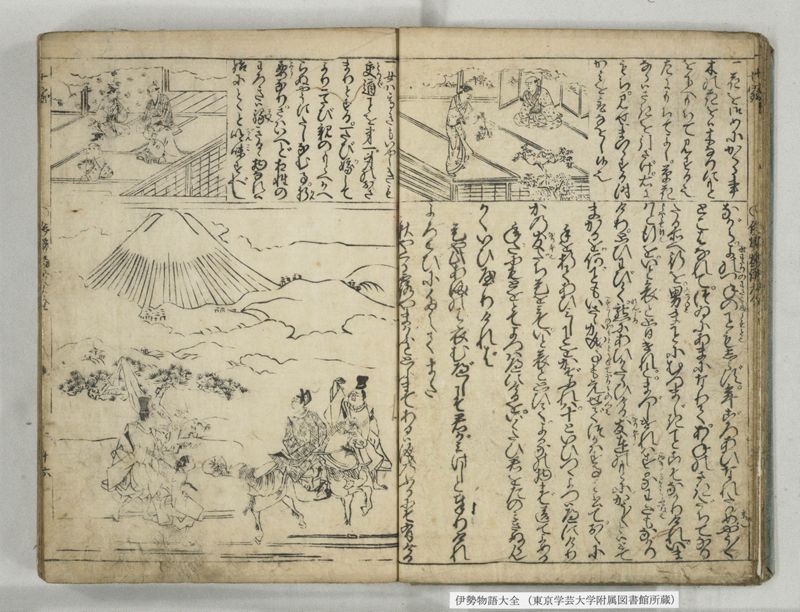
翻刻
【右丁・上段】
一花を御めにかくる事
木の花をは木なりにもと
を下へもちて見する也
左にもちてよし。草花
ならはさきを引さげ。右に
もち。見せまいらする時
かみを取なをし候也
【右丁・下段】
ながら。《振り仮名:よのつねのことも|(世わたりのわさもならすと也》しらず。年ごろあひなれたる《振り仮名:め。|(妻也 》やう〳〵
とこはなれて。つゐにあまになりて。あねのさきだちてなり
たる所へ行を。《振り仮名:男|有つね也》まことにむつまじきことこそなかりけれ。いま
《振り仮名:はと行|さらはとて行也》を。いと哀と思ひけれど。まづしけれは《振り仮名:するわざ|(物なともえわたせぬ也》もなかり
けり。思ひわびて。《振り仮名:懇|ねんごろ》にあひかたらひける。《振り仮名:友|(なり平也》達のもとにかう〳〵とはとて
まかるを。何ごとも《振り仮名:いさゝか成事もえせで|(すこしの物もえとらせてやるとの心也》つかはす事と書て。おくに
手を折てあひみしことをかぞふれは。十といひつゝよつはへにけり
かの《振り仮名:友だ|なり平也》ち是をみて。いと哀と思ひて。よるの物まで送てよめる
年だにもとをとてよつはへにけるを。いくたび君をたのみきぬらん
かくいひやりければ
是や此あまのは衣むべしこそ君がみけしと奉りけれ
よろこびにたえてまた
秋やくる露やまがふと思ふまであるは涙のふるにそ有ける
【左丁・上段】
一女は高きもいやしきも
交道(とつぐ)ことを第一。身のおさ
まりとする。一たび嫁(か)して
より二たび親のもとへかへ
らぬやうにたしなむ事。肝(かん)
要(よう)なり。さはいへど相性の
わろきは縁(えん)きるゝ物なれは
始にとくと吟味(ぎんみ)すべし
現代語訳
【右丁・上段】(宮仕えの心得)
一、花を(主人の)目にかけてお見せする際のこと。
木の花(木に咲く花)は、木に付いたままの状態で、根元を下にして持ち、お見せするものである。左手で持っても構わない。草花であれば、先端(花の部分)を引き下げるようにして右手で持ち、お見せ申し上げる際には、(自分の)髪を整え直すものである。
---
【右丁・下段】(伊勢物語 第十六段・続き)
(前ページより続き)……(昔の良き時代の心を保ちながら)も、世渡りのすべを知らず、長年連れ添ってきた妻も、次第に(男の)床を離れ、ついには尼になって、先に尼になった姉のいるところへ行った。(紀有常は)本当に親しく(妻と)睦まじく暮らしていたわけではなかったが、今こそ(妻が)去っていく(別れの)場面を、たいそうあわれと思ったけれど、貧しかったので、(餞別として)できることも何もなかった。
思い悩んで、懇意にしていた友人(在原業平)のところへ、「このような事情で(妻が)出家して去ります。何一つわずかなことも(餞別を)して差し上げることもできず(送り出します)」と書いて、その後に(歌を添えた)。
折り数えて逢ってきた年月をかぞえれば、十(年)と言いながら四つ(年)を重ねてきた。(つまり十四年)
その友人(業平)はこれを見て、たいそうあわれと思って、夜の食べ物まで(用意して)送り、詠んだ。
年でさえも十とて四つを重ねてきたのに、いったい何度あなたを頼りにしてきたことであろうか。
このように送ったところ(有常が返した)。
これこそまさに(天の羽衣のように)、あなたが(妻に)お召し物として差し上げてくださったものです。
(業平は)喜びに堪えられず、また(詠んだ)。
秋が来たのか、露(と涙)が紛れるかと思うほど、(あなたの感謝の言葉に)降り注ぐのは涙であったのだ。
---
【左丁・上段】(女性の心得)
一、女性は、身分の高い者も低い者も、嫁ぐことを第一のこととし、身の落ち着き(人生の安定)とするものである。一度嫁いだならば、二度と親元へ帰らないよう心がけることが肝要である。そうは言っても、相性の悪いものは縁が切れるものであるから、最初によくよく(相手を)吟味すべきである。
英語訳
【Right folio, upper section】 (Etiquette for those in service)
One: Concerning the matter of presenting flowers for the master's viewing.
For flowers on a branch (*ki no hana*, flowers of trees and shrubs), hold the stem end downward — just as it grows on the tree — and show them in that manner. It is also acceptable to hold them in the left hand. For herbaceous flowers (*kusabana*), droop the blossoming tip downward, hold them in the right hand, and when presenting them for viewing, take the opportunity to straighten and tidy one's own hair.
---
【Right folio, lower section】 (Ise Monogatari, Section Sixteen, continued)
(Continued from previous page) ...yet knowing nothing of how to make his way in the world, the wife with whom he had grown accustomed to living over many years gradually distanced herself from his bed, and at last took Buddhist vows, going to the place where her elder sister, who had taken the tonsure before her, resided. (Ki no Aritsune) had not truly enjoyed a deeply intimate relationship with her, yet at this very moment of her departure, he found it deeply moving (*aware*). However, as he was so poor, there was nothing whatsoever he could do (as a parting gift).
Grieving over this, he wrote to his close friend (Ariwara no Narihira), saying: "It is for such-and-such a reason that (my wife) is departing into religious life. I cannot do even the smallest thing to send her off properly." And at the end he attached a poem:
*Te wo orite ai mishi koto wo kazofu reba / to to iitsutsu yotsu wa e ni keri*
(Counting on my fingers the years we have met and been together — saying "ten," we have added four more years besides.)
His friend (Narihira), upon reading this, found it deeply moving, and sent provisions for the night along with a poem:
*Toshi dani mo tō tote yotsu wa e ni keru wo / ikutabi kimi wo tanomi ki nu ran*
(Even the years — saying "ten," four more have been added — yet how many times over have I depended upon you?)
When this was sent, (Aritsune replied):
*Kore ya kono ama no hagoromo mube shiko so / kimi ga mikes hi to tatematsurikere*
(This must be it — the heavenly feather robe: how fitting that it should be offered up as your lordship's own robe.)
Unable to contain his joy, (Narihira) composed once more:
*Aki ya kuru tsuyu ya magau to omou made / aru wa namida no furu ni zo ari keru*
(I wondered whether autumn had come, or whether (dew) mingled in confusion — but what was falling was none other than tears of joy.)
---
【Left folio, upper section】 (Precepts for women)
One: For women, whether of high or low station, marriage (*totsugu*) is to be regarded as the foremost matter — the foundation upon which one's life is settled. Once having married, it is of vital importance to conduct oneself in such a way that one never returns to one's parents' home a second time. That said, when the match is ill-suited in temperament, the bond will naturally be severed — and therefore, one must examine (the prospective match) very carefully from the very beginning.