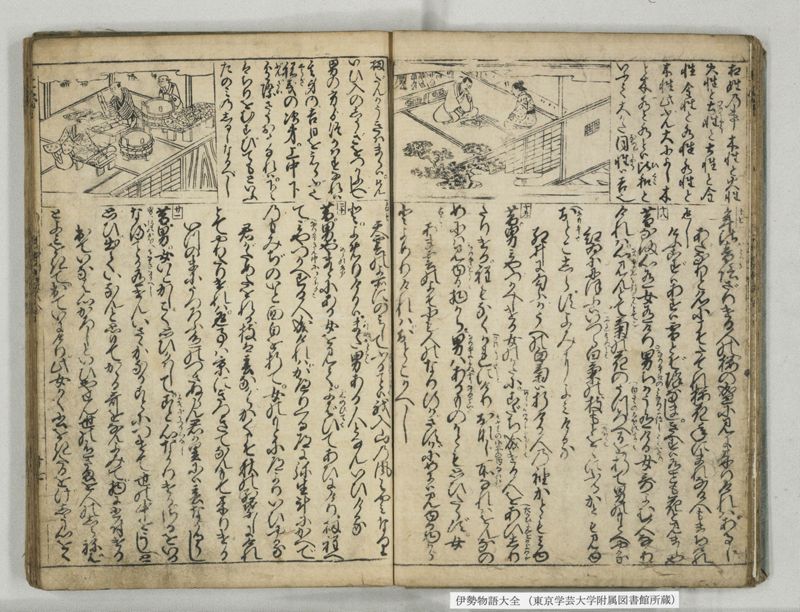
翻刻
【右丁・上段】
相姓乃事 木性と火性
火性と土性(つちしやう)と土性と金
性金性と水性水性と
木性此ぶん大によし木
と木水と水とは比和(ひくわ)と
いふて大かた同性(おなじしやう)は吉也
【右丁・下段】
《箱:十七》
年比/音信(おとづれ)ざりける人の。桜の盛に見に来りけれは。あるじ
あだなりと名にこそたてれ桜花年にまれなる人もまちけれ
返し
けふこずはあすは雪とぞ降なまし。きへすは有とも花と見ましや
《箱:十八》
昔なま心有女有けり。《振り仮名:男ちかう有ける女|なり平女のとなりに侍しとみへたり》歌よむ人なり
けれは。《振り仮名:心見んとて菊|なり平の心を引かんとて也》の花の《振り仮名:うつろへるを|(白きくのしほれたる也》折て男のもとへやる
紅ゐににほふは《振り仮名:いつら白|いつれしらぬと也》菊の枝も《振り仮名:とを|たはゝ也》ゝにふるかとも見ゆ
《振り仮名:おと|(なり平也》こしらずよみによみける
紅ゐに匂ふがうへの白菊は折ける人の袖かともみゆ
《箱:十九》
昔。男みやづかへしける女のかたに。《振り仮名:こだち成け|(めしつかはるゝ女ほう也》る人を《振り仮名:あひしり|(たかひに心をかよはす》
たりける。程もなく《振り仮名:かれに|かれ〲に成し也》けり《振り仮名:おなじ所な|そめ殿の御所の西なれは》れはをんなの
めには《振り仮名:見ゆる|(なり平をみ■也》物から。《振り仮名:男はあるも|(なり平はみぬやうなるてい也》のかとも思ひたらず。女
《送り仮名:古今》あま雲のよそにも人のなり行か。さすがにめには見ゆる物から
とよめりけれは。おとこかへし
【左丁・上段】
扨だんかうきはまらは。先
いひ入のしうぎをつかふべし
男の方よりつかはすなれは
其身の吉日をえらぶ也
祝義(しうぎ)の次第。上中下
分際(ぶんざい)さうおうなれは。下々
はちりをむすびてもといふ
たのみのしるしなるべし
【左丁・下段】
《送り仮名:古今》天雲のよ所にのみして《振り仮名:ふること|月日をふる也》は我入山の風はやみなり
と。よめりけるは。《振り仮名:また男|外のおとこ也》ある人となんいひける
《箱:二十》
昔。男。《振り仮名:やまと|ならの京》にある女を見て。《振り仮名:よばひ|しのひて也》てあひにけり。扨程へ
て《振り仮名:みやつかへする|(なり平きん中につかふる也》人成けれは。かへりくる道に弥生計にかへで
のもみぢのいと面白を折て。女のもとに道よりいひやる
君がためたをれる枝は春ながらかくこそ秋の紅葉しにけれ
とてやりたりけれは。返事は京にきつきてなんもて来りける
いつのまにうつろふ色のつきぬらん君か里には春なかるらし
《箱:廿一》
昔。男。女いとかしこく思ひかはして。《振り仮名:こと心な|(よそにうつる心なし》かりける。さるをいか
《振り仮名:なることか有け|男は何のおほへもなきなるへし》んいさゝかなることにつけて世の中をうしと
思ひ。出ていなんと思ひてかゝる哥をなんよみて。物に書付ける
出ていなば心かろしといひやせん世の有さまを人のしらねば
とよみをきて。出ていにけり。此女かく書をきたるをげしう心をく
現代語訳
【右丁・上段】(相性について)
相性のこと。木性と火性、火性と土性、土性と金性、金性と水性、水性と木性、これらの組み合わせは大いによい(相性である)。木と木、水と水のように同じ性同士は「比和(ひわ)」といって、おおむね同じ性質どうしは吉である。
---
【右丁・下段】(伊勢物語)
〔第十七段〕
長年音信のなかった人が、桜の盛りの頃に(花を)見にやってきたので、主人(あるじ)が(詠んだ)。
浮気者だと評判に立っている桜の花よ、年にまれな(めったに来ない)あなたのことも待っていたのだ。
返歌
今日来なければ、明日には雪のように(花びらが)降ってしまっていたことだろう。散らずにあったとしても、花と見られたであろうか(とうに散り果てていたものを)。
〔第十八段〕
昔、少々浮気心のある女がいた。(業平の近くに住んでいた女で、業平の隣に仕えていたと見える。)(その女は業平が)歌を詠む人であることを知っていたので、(業平の心を引こうとして)菊の花の色あせたもの(白菊のしおれたもの)を折って、男(業平)のもとへ送った。
紅に匂うのはどれが白菊の枝か、(白菊が紅に染まって)遠くからでも(まるで紅に)降り積もっているかとも見える。
男(業平)は知らないふりをして、さりげなく詠み返した。
紅に匂うその上にある白菊は、(あなたが)折った人の袖かとも見える。(紅に染まった袖が白菊に映えているようだ。)
〔第十九段〕
昔、男(業平)が、宮仕えしていた女のもとに(召し使われていた)女房を互いに心を通わせていた。ほどなくして(その仲は)互いに冷え切ってしまった。(業平と女房は)同じ(染殿御所の西の)場所にいたので、女の目には(業平の姿が)見えるけれど、男は(女のことを)まるでいないかのようにふるまっていた。女が(古今集の歌として)、
(あなたは)天雲のように遠い他人のようになってしまったのか。そうはいっても目には見えるものを。
と詠んだので、男が返した。
---
【左丁・上段】(縁談の手続き)
さて、縁談の話がまとまったならば、まず(相手方に)申し込みの祝儀を遣わすべきである。男の方から遣わすのであるから、その人(男)の吉日を選ぶのである。祝儀の次第(やり方)は、上・中・下それぞれの身分・分際に応じてすればよい。下々の者は、(取るに足りない)ちりを結んだだけであっても、それが「頼みのしるし」(誠意の証)となるものである。
---
【左丁・下段】(伊勢物語 第十九段・続き)
(古今集の歌として)「天雲の遠くにのみして(遠ざかりながら)、月日を経るのは、私が入った山の風が激しいからだ」と詠んだのは、(業平ではなく)別に男がいた(つまり他の男に心を移していたのだ)、と言ったのである。
〔第二十段〕
昔、男(業平)が、大和(奈良の都)にいる女を見て、密かに(しのんで)逢うようになった。さて、しばらくして(業平は)宮中に仕える身であったので、帰ってくる道で、弥生(三月)の頃に、紅葉した楓(かえで)が大変美しかったので、それを折って、女のもとへ道中から(歌を)遣わした。
あなたのために折り取った枝は、春であるのに、このように秋の紅葉のようになってしまった。
と(歌を)送ったところ、返事は(業平が)京に着いてから(使いの者が)持ってきたのだった。
いつの間に(あなたの心の)色は変わり尽きてしまったのか。あなたのいる里には春(の情け)がないのでしょうか。
〔第二十一段〕
昔、男と女がたいそう深く思い合っていて、よそに心を移すことのない(一途な)仲であった。それが、どういったことがあったのか(男には何の心当たりもないはずなのだが)、ほんのわずかなことをきっかけとして(女は)世の中をつらいと思い、(家を)出て去ってしまおうと思って、このような歌を詠んで、(部屋の)何かに書き付けた。
(私が)出て去ってしまったならば、心が軽い(薄情だ)と言うだろうか。この世のありさまを(あなたは)知らないのだから(どうせ分かるまい)。
と詠み置いて、出て去ってしまった。この女がこのように書き置いたのを、(男は)ひどく気に病んで……(次ページへ続く)
英語訳
【Right folio, upper section】 (On astrological compatibility)
Concerning astrological compatibility (*aishō*): Wood and Fire, Fire and Earth, Earth and Metal, Metal and Water, Water and Wood — these combinations are greatly auspicious. When Wood meets Wood, or Water meets Water, this is called *hiwa* (a state of mutual accord), and in general, matching elements of the same type are considered auspicious.
---
【Right folio, lower section】 (Ise Monogatari)
[Section Seventeen]
A person who had not sent word for many years came to view the cherry blossoms at their peak. The host composed:
*Ada nari to na ni koso tateri sakurabana / toshi ni mare naru hito mo machi kere*
(You cherry blossoms — known by reputation as fickle and fleeting — yet even you, it seems, were waiting for this person who comes so rarely in a year.)
Reply:
*Kyō kozuba asu wa yuki to zo furi namashi / kienu wa ari tomo hana to mi mashi ya*
(Had you not come today, by tomorrow it would surely have fallen like snow. And even had it not scattered — could you have seen it truly as blossoms?)
[Section Eighteen]
Long ago, there was a woman who was somewhat flirtatious in her heart. (She appears to have been a woman who served in attendance near Narihira, living in his neighbourhood.) Knowing that (Narihira) was a man who composed poetry, she (hoping to draw out Narihira's heart) broke off a faded chrysanthemum blossom (a wilted white chrysanthemum) and sent it to the man (Narihira).
*Kurenai ni niou wa izura shira-giku no / eda mo tawawa ni furu ka to mo miyu*
(Which of these is the white chrysanthemum branch, glowing as it does with crimson? It appears as though (the crimson) falls thickly, bending the branches low.)
The man (Narihira), feigning ignorance, composed in return with seeming nonchalance:
*Kurenai ni niou ga ue no shira-giku wa / orikeru hito no sode ka to mo miyu*
(The white chrysanthemum resting atop the crimson glow — it looks as though it might be the sleeve of the very person who broke it off.)
[Section Nineteen]
Long ago, a man (Narihira) had become mutually intimate in heart and spirit with a lady-in-waiting (*kodachi*) serving in the household of a woman in palace service. Before long, the two had grown entirely estranged. Since they were in the same place (the western quarters of the Somedono Palace), the woman could see the man before her eyes — yet the man conducted himself as though she were not there at all. The woman composed (in the manner of a *Kokinshū* poem):
*Ama-gumo no yoso ni mo hito no nari yuku ka / sasuga ni me ni wa mieru mono kara*
(Have you become, like a cloud in the sky, someone utterly distant and apart? And yet, despite everything, you are there before my very eyes.)
At which the man replied—
---
【Left folio, upper section】 (Procedures for a marriage proposal)
Now, once the discussion (of a marriage proposal) has reached its conclusion, one should first send a congratulatory gift (*shūgi*) as a formal offer. Since it is sent from the man's side, one must select an auspicious day according to the man's own (astrological) reckoning. The manner of the congratulatory gift should be appropriate to one's station — whether upper, middle, or lower. For those of the humblest rank, it is said that even a knot of dust will suffice — for it must serve as a token of one's sincerity and trust.
---
【Left folio, lower section】 (Ise Monogatari, Section Nineteen, continued)
(Composed in the manner of a *Kokinshū* poem): "Remaining only in the distant sky like a cloud, the passing of months and days is because the wind in the mountain I have entered blows so fiercely" — so he composed, yet it was said that there was in fact another man (that is, the woman had transferred her affections to someone else).
[Section Twenty]
Long ago, a man (Narihira) saw a woman who lived in Yamato (the old capital of Nara) and came to meet her secretly. After some time had passed, being a person in palace service, on his way back (from court duty), around the third month (*yayoi*), he broke off a branch of maple (*kaede*) whose leaves had turned in a remarkably beautiful manner and, from along the road, sent it to the woman with a poem:
*Kimi ga tame taoreru eda wa haru nagara / kaku koso aki no momiji shi ni kere*
(This branch I broke for your sake — though it is still spring, it has taken on the colours of autumn's crimson leaves.)
This was sent off, but the reply did not arrive until after (Narihira) had reached the capital, brought back by a messenger:
*Itsu no ma ni utsurou iro no tsuki nu ran / kimi ga sato ni wa haru nakaruran*
(When did its colour change and fade away entirely? Perhaps in the place where you dwell there is no spring at all.)
[Section Twenty-One]
Long ago, a man and a woman were deeply, mutually devoted to one another — a bond with no straying of the heart toward another. Yet somehow (the man could have had no idea of the reason), over some trivial matter, the woman came to find the world unbearable, and thinking she would leave and be gone, she composed this poem and wrote it upon something (in the room):
*Idete ina ba kokoro karoshi to ii ya sen / yo no ari sama wo hito no shiraneба*
(If I go away and leave, will they say my heart was light and fickle? Since you know nothing of the way things truly are in this world...)
Having composed and left these words, she departed. The man, finding that the woman had left this written behind, was deeply troubled in his heart… (continued on the next page)