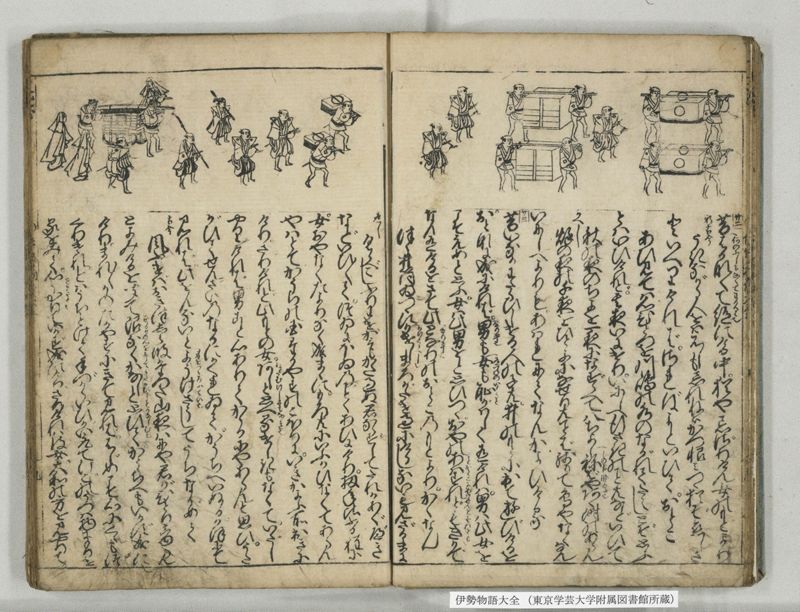
翻刻
【右丁上段 插絵】
【右丁・下段】
《箱:廿二》
昔《振り仮名:はかなくて絶|(何のふしもなくてわかるゝ也》にける中。猶や忘ざりけん女のもとより
《送り仮名:新古今》うきながら人をはえしも忘れねはかつ恨みつゝ猶ぞ恋しき
といへりければ。さればよといひて。おとこ
あひ見ては心ひとつを川島の水のながれてたえしとぞ思ふ
とはいひけれど。其夜いにけり。いにしへ行さきのこと共などいひて
秋の夜のちよを一夜になずらへて八ちよし《振り仮名:ねばやあ|(しのじ助字也》く時のあらん
《送り仮名:かへし》秋の夜の千夜をひとよになせり共ことば残りて鳥やなくなん
いにしへよりも。あはれにてなんかよひける
《箱:廿三》
昔いなかわたらひしける人の子共。井のもとに出て遊びけるを
。おとなに成にければ。《振り仮名:男も|(なり平也》《振り仮名:女も恥|(有つねのいもうと》がはしく有けれは。男は此女を
こそえめと思ふ。女は此男をと思ひつゝ。おやの《振り仮名:あはすれどもき|(ことおとこにあはせんとすれとも》かで
なん有けるを。さて此《振り仮名:となり|(なり平也》のおとこのもとより。かくなん
つゝ井筒ゐつゝに《振り仮名:かけしま|(かけくらへし也》ろがたけ過にけらしないも見ざるまに
【左丁上段 插絵】
【左丁・下段】
《送り仮名:返し》くらべこしふりわけがみもかた過ぬ君ならずしてたれかあぐべき
などいひ〳〵て。つゐにほゐのごとくあひにけり。扨年比ふる程に
。女おやなくたよりなく成まゝに。もろ共にいふかひなくてあらん
やはとてかうちの国たかやすのこほりに。いきかよふ所出きに
けり。さりけれど此もとの女。《振り仮名:あしと思へる|ねたむけしきもなき也》けしきもなくて。いだし
やりければ男こと心ありてかゝるにやあらんと思ひ。うた
がひてせんざいのなかにかくれゐて。かうちへいぬるかほにて
見れば。此をんないと《振り仮名:ようけさ|身をつくろふてい也》うしてうちながめて
《送り仮名:古今》風ふけばおきつしら波たつた山夜はにや君がひとりこゆらん
とよみけるを聞て《振り仮名:限なくかなしと思ひ|かゝる女の心をしらてうたかひしとかなしむ也》て。かうちへもいかず成に
けり。まれ〳〵かのたかやすにきて見れば。はじめこそ心にくゝもつ
くりけれ。今はうちとけて手づからいひがい取てけごのうつは物にもりけ
るをみて。心《振り仮名:うかり|見かきる也》ていかず成にけり。さりければ彼女。大和の方を見やりて
現代語訳
## 第二十二段
昔、はかなく終わってしまった仲であったが、それでもやはり忘れられなかったのだろうか、女のもとから(歌が届いた)。
「浮きながら(辛い思いに沈みながらも)、あなたをまったく忘れることができないでいて、一方では恨みながら、それでもやはり恋しく思っております」
と言ってきたので、「さてはそうであったか」と言って、男は、
「逢って見ては、一つ心を川島の流れのように絶えることはないと思っていますよ」
と言ったが、その夜(男は女のもとへ)行ってしまった。昔の、行く先々のことなどを語り合って、
「秋の夜の千年を一夜に例えて、八千夜も共に寝ないでいられる時があるだろうか(いや、そんなことはできない)」
(返し)「秋の夜の千夜を一夜になしたとしても、言葉が残って(もっと語り合いたいと思いながら)鳥が鳴いてしまうことだろう」
昔よりも、しみじみと情趣深く逢い続けたのであった。
---
## 第二十三段
昔、田舎を渡り歩いていた人の子どもたちが、井戸のほとりに出て遊んでいたが、大人になったので、男も女も(互いに)恥ずかしく思うようになった。男はこの女を得たいと思い、女はこの男をと思い続けていたが、親が(別の男と)引き合わせようとしても、気が向かないままでいた。そこで、この(女の)隣の男のもとから(歌を送った)。
「筒井筒、井筒に比べた(私の)背丈も過ぎてしまったようです、あなたに会わないうちに」
(返し)「比べ合ってきた振り分け髪も肩を過ぎてしまいました。あなたでなくて、誰が結い上げてくれましょう」
などと詠み交わして、ついに願い通りに結ばれたのであった。さて、長年を経るうちに、女の親が亡くなり、頼りとするものもなくなるにしたがって、(男は)二人でこのように甲斐なく暮らしていてよいものかと思って、河内国高安の郡に通う所(女)ができてしまった。そうではあったが、この元の女は、(男を)悪く思っている様子も嫉妬する気配もなく、(男を)送り出してやっていたので、男は(女に)別の心があってこのようにしているのではないかと思い、疑って、庭の植え込みの中に隠れていて、河内へ行くふりをして(様子を)見ると、この女はたいそう身を整えて、物思いにふけりながら、
「風が吹けば沖の白波が立つ、あの竜田山を、夜中にあなたが一人で越えていらっしゃるのだろうか」
と詠んでいるのを聞いて、(男は)この上なく愛しいと思って、河内へも行かなくなった。たまたま(男が)あの高安へ行って見ると、最初のうちこそ奥ゆかしく振る舞っていたが、今はすっかりくつろいで、自ら(手ずから)飯匙を取って、毛籠の器に(飯を)盛っているのを見て、(男は)嫌気が差して行かなくなってしまった。そういうわけで、あの(元の)女は大和の方を眺めやって——
英語訳
## Section 22
Long ago, their relationship had ended without any particular occasion, yet she apparently still could not forget him, for from the woman came a poem:
"Though I drift in sorrow, I cannot forget you at all — resenting you, yet still longing for you."
Upon receiving this, the man replied, thinking, "So that is how it is":
"When we meet, my heart, like the waters of the Kawashima River, I believe will never cease to flow."
But that very night, he went to her. They spoke of the old days and what had passed, and she composed:
"Comparing a thousand years of autumn nights to a single night — could there ever come a time when we might sleep eight thousand nights together?"
(Reply) "Even if a thousand autumn nights were made into one, words would remain unspoken, and the dawn bird would cry before we could say all."
And so they continued to meet, with even deeper feeling than in former times.
---
## Section 23
Long ago, there were children of a man who wandered the countryside. They used to play together at the well, but as they grew into adults, the boy and girl both became bashful with each other. The boy thought he would like to make this girl his own; the girl thought the same of the boy. Though their parents tried to match them with others, neither felt inclined. Then from the boy next door, a poem arrived:
"Like the tube-well's frame against which we once measured our heights — my stature has grown past it, it seems, while I have not seen you."
(Reply) "The hair we once compared, parted and hanging down, has now grown past my shoulders. Who but you should be the one to dress it up?"
And so, exchanging poems like these, they were at last united as they had hoped. As the years passed, the girl's parents died and she was left without support. Thinking it would not do for them to live in such poverty together, the man began frequenting a woman he had found in Takayas in Kawachi Province. Yet his original wife showed no sign of resentment or jealousy, and sent him off without complaint. Suspecting she must have feelings for someone else to be so unconcerned, the man hid in the garden shrubbery, pretended to leave for Kawachi, and watched. He saw his wife dress herself with great care and gaze pensively into the distance, composing:
"When the wind blows and white waves rise on the offing — over Tatsuta Mountain in the dead of night, are you crossing alone?"
Hearing this, the man was moved to the depths of his heart, and he stopped going to Kawachi altogether. On one of the rare occasions he did visit Takayas, he found that while at first the woman there had carried herself with elegant reserve, she had now let down her guard entirely and was scooping rice herself with a paddle into a rough wooden vessel. Seeing this, he was put off and stopped going there. And so, the original wife gazed out toward Yamato and —