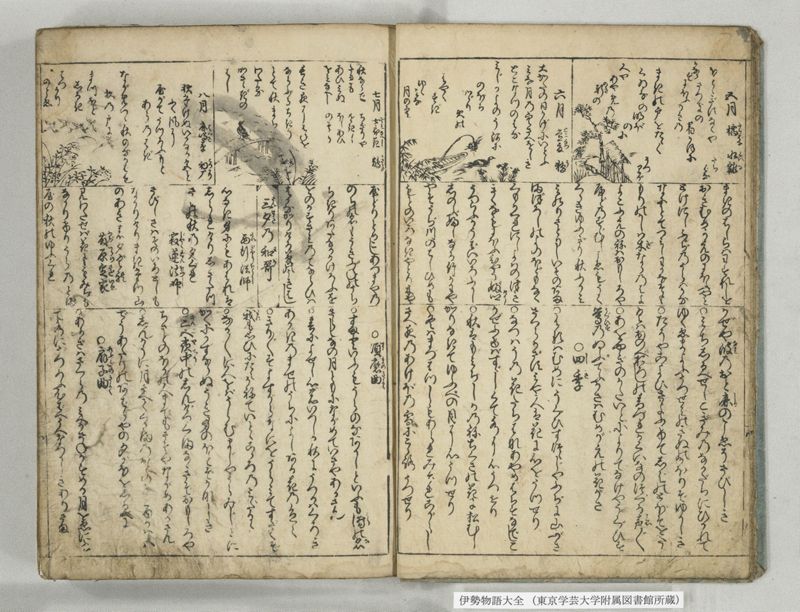
翻刻
【右丁・上段】
五月 橘(たちばな) 水鶏(くいな)
ほとゝぎすなくや たち
さつきの ばな
宿かほに
かならず
にほふのきの
まきの戸をたゝく
くゐなの うつ
明ぼ りが
人や のに
あやめの
軒(のき)の
六月 常夏(とこなつ) 鵜(う)
大かたの日かげにいとふ
みな月の空さへをしき
とこなつのはな
みじかよのう河に
のぼる
かゞり
火の
はやく
すぎ
ゆく
みな
月の空
【右丁・中段】
まきのはしらはわすれしを
おきむめかえのにほふやと
とけにしふぢのうらはかな
なにとてつみしわかなそも
もりのかしは木(ぎ)ならのはよ
よこふえのねはおもしろや
やどのすゞむしこゑもうく
くらきゆふぎり秋ふかみ
みのりさとりしいそのあま
まぼろしのよのほどもなく
くもかくれにしよはのつき
きくなもにほふひやうぶ卿(けう)
うつらふかうばいろふかし
しのぶふしなる竹かわや
やそうぢ川のはしひめも
もとのいろなきやとり木や
【右丁・下段】
かぜや波(なみ)のおと鹿(しか)のこゑそさびしき
○みちしるべせしこぎみのなかだちにひかれて
ゆくゑまよふうつせみのきぬのかほりぞゆかしき
○たそやこよひさよにふけてしばのとぼそをたゝ
くはおのへおろしの音づれかくはなのつづる声(こゑ)〴〵
○あをやぎのかたいとによりてなけやうぐひす
鶯(うぐひす)のぬふてふかさはむめがえの花がさ
○/四季(しき)
○はるはむめにうぐひすつゝじやふぢに山ぶき
さくらかざすみやこ人は花に心をうつせり
○なつはうの花たちはなあやめはちすなでしこ
かぜふけばすゞしくて水に心うつせり
○秋はもみぢしかのねちくさの花に松むし
かりなきてゆふべの月に心うつせり
○冬はまづはつしもあられみそれこがらし
さへ夜のあけぼの雪にこゝろうつせり
【左丁・上段】
七月 女郎花(をみなへし) 鵲(かさゝき)
秋ならで ちぎりや
たれも をきし
あひみぬ ほしあひ
をみなへし のそら
長き夜にはねを
ならぶるちきり
とて秋まち
わたる
かさゝぎの
はし
八月 鹿鳴草(はぎ)初雁(はつかり)
秋たけぬいかなる色と
ふく風に
やがてうつろふもと
あらのはぎ
ながめつゝ秋のなかばも
杉の戸に
まつほど
しるき
はつ
かり
のこゑ
【左丁・中段】
やどりとめこしあつまやの
のちの名もうきふねのうち
ちぎりあたなるかけろふを
をのかすさみのてならひは
はかなかりける夢のうきはし
三夕(さんせき)の和歌(わか)
西行法師(さいぎやうほうし)
心なき身にもあはれは
しられけりしきたつ
さはの秋の夕ぐれ
寂蓮法師(じやくれんほつし)
さびしさはそのいろとしも
なかりけりまきたつ山
のあきの夕ぐれ
藤原定家(ふじはらのさだいゑ)
見わたせば花もみぢも
なかりけりうらのとま
屋の秋のゆふくれ
【左丁・下段】
○須磨曲(すまのきよく)
○すまといふもうらのなあかしといふも浦(うら)の名(な)
さらしなの月ともにながめていさやあかさん
○春によせし心のいつしか秋にうつるはくろき
あかきのませのうちによしある花の色々
○きり〴〵すよすがらなにをうらみてすだくぞ
我(われ)も思ひにたえかねていとゝこゝろのみだるゝ
○なか〳〵に人をばうらむまじやうらみじとに
かくにかずならぬうき身のほとぞかなしき
○/三五夜中(さんごやちう)のしんげつくまなきぞおもしろや
ちさとのほかの人までもさそやながめあかさん
○しんかうに月さへてくるまのおとのきこゆかは八
でうあたりのあばらやの夕がほをしるべに
○扇子曲(あふぎのきよく)
○あふぎはさくらのみへがさねかすめる月をゑに書
て水にうつろふ心ばへうへなつかしきありさま
現代語訳
## 【右丁・上段】四季花鳥の歌(続き)
**五月 橘(たちばな)・水鶏(くいな)**
ほととぎすが鳴く、五月の宿に
かならず香る軒の橘よ
まきの戸を叩く
くいなの声——
明けぼのに、
あやめの軒で
**六月 常夏(なでしこ)・鵜(う)**
だいたいにおいて日差しを厭う
水無月の空さえも惜しまれる
常夏(なでしこ)の花よ
短い夜の宇治川に
上る篝火の
早く過ぎゆく
水無月の空よ
---
## 【右丁・中段】源氏名寄長歌(続き)
まきの柱は忘れじを(真木柱)
置き梅が枝の匂う宿(梅枝)
解けにし藤の裏葉かな(藤裏葉)
何とて摘みし若菜そも(若菜)
森の柏木ならの葉よ(柏木)
横笛の音はおもしろや(横笛)
宿の鈴虫、声も憂く(鈴虫)
暗き夕霧、秋深み(夕霧)
みのり、悟りし磯の海人(御法)
幻の世のほどもなく(幻)
雲隠れにし夜半の月(雲隠)
菊の名も匂う兵部卿(匂宮)
移ろう紅梅、色深し(紅梅)
忍ぶ伏し成る竹河や(竹河)
八十宇治川の橋姫も(橋姫)
もとの色なき宿り木や(宿り木)
---
## 【右丁・下段】
風や波の音、鹿の声ぞ寂しき
みちしるべをしてくれた小君の仲立ちに
引かれて行方迷う、空蝉の衣の香りぞゆかしき
「たそや、こよい更けて、しばの戸をたたくは
峰下ろしの音づれか、花のつづる声よ」
青柳の形糸によりてなけ、鶯よ
鶯の縫うという笠は、梅が枝の花笠
**四季(しき)の歌**
春は梅に鶯、つつじや藤に山吹、
桜をかざす都人は、花に心を移せり
夏は卯の花、橘、あやめ、蓮、撫子よ
風吹けば涼しくて、水に心を移せり
秋は紅葉、鹿の音、千草の花に松虫
雁鳴いて夕べの月に、心を移せり
冬はまず初霜、霰、みぞれ、木枯らし
冴える夜の曙、雪に心を移せり
---
## 【左丁・上段】四季花鳥の歌(続き)
**七月 女郎花(おみなえし)・鵲(かささぎ)**
秋ならでたれも逢いみぬ女郎花よ
契りや置きし星合いの空
長き夜に羽を並べる契りとて
秋待ちわたるかささぎの橋
**八月 鹿・萩・初雁(はつかり)**
秋たけぬ、いかなる色と吹く風に
やがてうつろうもとあらの萩よ
ながめつつ秋の半ばも
杉の戸に松ほどしるき
初雁の声
---
## 【左丁・中段】源氏名寄長歌(続き)
宿り止めこし東屋の(東屋)
後の名も憂き浮舟の中(浮舟)
契りあだなる蜉蝣を(蜻蛉)
おのが慰みの手習いは(手習)
はかなかりける夢の浮橋(夢浮橋)
---
**三夕(さんせき)の和歌**
**西行法師**
心なき身にも哀れは
知られけり 鴫立つ
沢の秋の夕暮れ
**寂蓮法師**
寂しさはその色としも
なかりけり 槇立つ山の
秋の夕暮れ
**藤原定家**
見渡せば花も紅葉も
なかりけり 浦のとま屋の
秋の夕暮れ
---
## 【左丁・下段】
**須磨の曲**
「須磨」というも浦の名、「明石」というも浦の名
更科の月と共にながめて、さあ明かさん
春に寄せし心がいつしか秋に移る
黒き、赤きの籬の内によしある花の色々
こおろぎよ、夜もすがら何を恨みて鳴き騒ぐぞ
我も思いに耐えかねて、いっそう心乱れる
なか√に人をば恨むまじ、恨みじとも
かくにかずならぬ浮き身のほどぞ悲しき
三五夜中の新月くまなきぞ面白や
千里の外の人までも、さぞながめ明かさん
深更に月冴えて、車の音の聞こゆかは
八条あたりのあばら屋の夕顔をしるべに
**扇子の曲**
扇は桜の見え重ね
霞める月を絵に描いて
水に映ろう心ばえ
上(うわ)なつかしきありさま
英語訳
## [Right Folio, Upper Section] — Songs of the Four Seasons: Flowers and Birds (continued)
**Fifth Month (May): Orange Blossoms (tachibana) & Water Rail (kuina)**
The hototogisu cries —
at the dwelling in the fifth month,
the orange blossoms at the eaves
never fail to perfume the air.
The water rail taps
at the cedar door —
in the pale light of dawn,
beneath the iris-hung eaves.
**Sixth Month (June): Wild Pink (tokonatsu/nadeshiko) & Cormorant (u)**
Even the sky of the water month (June),
which most would shun for its fierce sun,
is dear to me —
oh, the wild pink flowers!
On the short summer night,
the fishing fires rise
on the Uji River;
how quickly they pass —
the sky of the water month.
---
## [Right Folio, Middle Section] — Long Poem Linking the Names of the Genji Chapters (continued)
The cypress pillar I shall not forget (*Makibashira*)
The fragrant plum branch dwelling (*Umegae*)
The trailing wisteria, its undersides revealed (*Fujiuraba*)
Why did I pluck those young herbs? (*Wakana*)
Forest oak and Nara oak leaves (*Kashiwagi*)
The transverse flute's captivating sound (*Yokobue*)
The bell-cricket's cry at my lodging, sad and weary (*Suzumushi*)
Dark evening mist, deep in autumn (*Yūgiri*)
Teaching of the Law, insight of the fisher-woman of the shore (*Minori*)
The phantasmal world, fleeting as can be (*Maboroshi*)
The moon hidden behind clouds in the dead of night (*Kumogakure*)
The fragrance of chrysanthemums — Prince Hyōbukyō (*Niou Miya*)
The shifting crimson plum, deep in colour (*Kōbai*)
Remembrance upon the bamboo river (*Takekawa*)
The Bridge Princess of eighty Uji rivers (*Hashihime*)
The parasitic tree of no original colour (*Yadorigi*)
---
## [Right Folio, Lower Section]
How lonely — the sound of wind, waves, and the cry of a deer!
Led by the young lord Kogimi, who showed the way,
wandering, unsure where to go —
how alluring, the scent of Utsusemi's discarded robe!
"Who is there, tonight, late into the night,
tapping at the brushwood door?
Is it the sound of the ridge-wind coming down,
or the voice of flowers strung together?"
Like green willow threads twisted together, cry out, O warbler!
The hat that the warbler is said to sew
is a flower hat of plum branches.
**Songs of the Four Seasons**
In spring: plum blossoms and warblers, azaleas and wisteria, kerria roses,
the people of the capital adorning their hair with cherry blossoms — their hearts are captured by flowers.
In summer: deutzia, orange blossoms, iris, lotus, pink carnation —
when the wind blows, it is cool; their hearts are captured by the water.
In autumn: scarlet leaves, the cry of the deer, wildflowers and pine crickets,
wild geese crying at the evening moon — their hearts are captured by it all.
In winter: first frost, hail, sleet, and bitter winds,
the cold dawning sky, and snow — their hearts are captured by these things.
---
## [Left Folio, Upper Section] — Songs of the Four Seasons: Flowers and Birds (continued)
**Seventh Month (July): Maiden Flower (ominaeshi) & Magpie (kasasagi)**
None but in autumn can meet the maiden flower —
what vows were laid in the sky of the Star Festival?
Over the long autumn night, with wings side by side they pledge their love —
the magpie's bridge, awaited throughout the autumn.
**Eighth Month (August): Deer, Bush Clover (hagi) & First Wild Geese (hatsukari)**
Autumn is at its height — in what colours
does the wind blow, so that
the clumps of bush clover in the wild fields
begin immediately to fade?
Gazing on, through the midst of autumn,
at the cedar door — the voice of the first wild geese,
so clear in how long I have waited.
---
## [Left Folio, Middle Section] — Long Poem Linking the Genji Chapter Names (continued)
The traveller's shelter of the eastern cottage (*Azumaya*)
The floating boat whose later name is, too, unhappy (*Ukifune*)
The mayfly — a vow as fleeting as it (*Kagerō*)
One's own amusement in handwriting practice (*Tenarai*)
The dream's floating bridge, how transient it all was (*Yume no Ukihashi*)
---
**The Three Twilight Poems (Sanseki no waka)**
**Saigyō Hōshi (Priest Saigyō)**
Even in one such as I,
with no feeling left —
how moving it is:
snipe rising from the marsh
in the autumn dusk.
**Jakuren Hōshi (Priest Jakuren)**
Loneliness —
it is not something
of any particular colour;
cryptomeria rise on the mountain
in the autumn dusk.
**Fujiwara no Teika**
Looking out as far as I can —
neither blossoms nor scarlet leaves:
only a rush-thatched hut
on the bay
in the autumn dusk.
---
## [Left Folio, Lower Section]
**The Suma Melody**
"Suma" — that too is the name of a bay; "Akashi" — that too is the name of a bay.
Together gazing at the moon of Sarashina — come, let us spend the night in watching it!
The heart that was drawn to spring has, before one notices, shifted to autumn.
Within the fence of black and red — various beautiful flowers of noble bearing.
O cricket, what do you lament, crying out all through the night?
I too can barely endure my sorrows — my heart grows all the more disordered.
I shall not resent others for this — no, I shall not resent them —
yet how wretched, how sad, is the lot of one as insignificant as I.
How splendid — the new moon on the fifteenth night, unclouded!
Even people a thousand leagues away must surely be gazing and staying up through the night.
Deep in the night, the moon is clear, and the sound of a carriage can be heard —
the evening face (yūgao) of the crumbling house near the Eighth Avenue, as a guide.
**The Fan Melody**
The fan, layered with the sight of cherry blossoms,
with a misty moon painted upon it —
a heart that shifts and ripples in the water,
a figure that is somehow dear and moving.