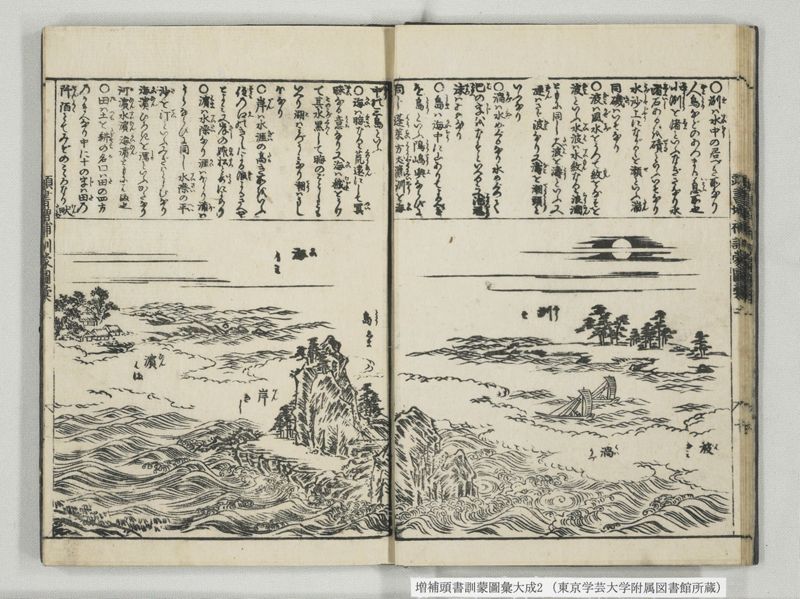
翻刻
【右丁上段】
○洲(す)は水中(すいちう)の居べき所なり
人(ひと)鳥(とり)などのあつまる息(いこふ)所也
小洲(しやうしう)を渚(しよ)といふなぎさなり水
渚(しよ)石(いし)あるを磧(せき)といふいそなり
水(みづ)沙上(しやじやう)にながるゝを瀬(せ)といふ湍(たん)
同 磯(き)はいそなり
○波(なみ)は風(かぜ)水(みづ)をうつて紋(もん)をなすを
波(なみ)といふ水波(すいは)は水紋(すいもん)なり浪瀾(らうらん)
ともに同し大波(たいは)を濤(とう)といふ又
漣(れん)はさゞ波(なみ)なり又 濤(なみ)を潮頭(てうとう)と
いふなり
○渦(うづ)は水(みづ)めぐるなり水めぐつて
巴(は)【左ルビ:ともへ】の字(じ)をなすといへり又 泡(はう)漚(をう)
沫(まつ)はあはなり
○島(しま)は海中(かいちう)に山ありてよるべき
を島(とう)といふ隝(とう)嶋(とう)嶼(よ)ならびに
同し蓬莱(はうらい)方丈(はうじやう)瀛洲(えいしう)を海(かい)
【左丁上段】
中(ちう)の三島といふ
○海(かい)は晦(くわい)なり荒遠(くはうゑん)にして冥(めい)
昧(まい)なる意(こゝろ)なり又 海(かい)は穢(けがれ)をうけ
て其水(そのみづ)黒(くろく)して晦のごとしとも
いへり湖(こ)はみづうみなり潮(てう)はうし
ほなり
○岸(がん)は水 涯(ぎは)の高(たか)き所をいふ
住(すみ)の江(え)のきしによる浪(なみ)よるさへや
とよみ又 岸(きし)の姫松(ひめまつ)と哥(うた)によめり
○浜(はま)は水際(すいさい)なり涯(かい)はほとり浦(ほ)は
うらならひに同し水際(すいさい)の平(へい)
沙(さ)を汀(てい)といふみぎはとよむなり
海浜(かいひん)ひろきを瀉(しや)といふかたなり
河浜(かひん)水浜(すいひん)海浜(かいひん)ともにはま也
○田(た)は土(つち)を耕(たがやす)の名(な)囗は田(た)の四方
のかまへなり中に十の字(じ)は田(た)の
阡陌(せんはく)とてみぞのこゝろなり畎(けん)【左ルビ:たみぞ】
【右丁下段挿絵】
波(は)
《割書:なみ|》
渦(くは)
《割書:うづ|》
洲(しう)
《割書:す|》
【左丁下段挿絵】
島(とう)《割書:しま|》
海(かい)
《割書:うみ|》
岸(がん)
《割書:き| し》
浜(ひん)
《割書:はま|》
現代語訳
【右丁上段】
○洲(す)は水中の住めるべき所である。人や鳥などが集まって休む所である。小洲を渚と言う。なぎさである。水際で石があるものを磧と言う。いそである。水が砂の上に流れるのを瀬と言う。湍も同じである。磯はいそである。
○波(なみ)は風が水を打って文様をなすのを波と言う。水波は水紋である。浪・瀾ともに同じである。大波を濤と言う。また漣はさざ波である。また濤を潮頭と言う。
○渦(うず)は水が回ることである。水が回って巴の字をなすと言われている。また泡・漚・沫は泡である。
○島(しま)は海中に山があって頼りにできるものを島と言う。隝・嶋・嶼いずれも同じである。蓬莱・方丈・瀛洲を海
【左丁上段】
中の三島と言う。
○海(かい)は晦である。荒涼として遠く、暗くて不明瞭である意味である。また海は穢れを受けて、その水が黒くて晦のようであるとも言われている。湖はみずうみである。潮は潮汐である。
○岸(がん)は水際の高い所を言う。「住の江の岸による波よるさえや」と詠み、また「岸の姫松」と歌に詠まれている。
○浜(はま)は水際である。涯はほとり、浦は「うら」と同じく水際である。水際の平らな砂地を汀と言う。「みぎわ」と読む。海浜で広いものを瀉と言う。「かた」である。河浜・水浜・海浜ともに浜である。
○田(た)は土を耕すことの名前である。囗は田の四方の構えである。中の十の字は田の阡陌といって溝の意味である。畎は田溝のことである。
英語訳
【Right page, upper section】
○Su (sandbar) is a habitable place in the water. It is a resting place where people and birds gather. Small sandbars are called sho (shore). This is nagisa. Water's edge with stones is called seki (rocky shore). This is iso. Water flowing over sand is called se (rapids). Tan is the same. Ki means rocky shore.
○Nami (waves) refers to wind striking water and creating patterns. Water waves are water patterns. Rō and ran are the same. Large waves are called tō. Ren refers to small ripples. Tō is also called chōtō (tidal bore).
○Uzu (whirlpool) is water circling. It is said that water circles and forms the shape of the character tomoe (spiral). Also, hō, ō, and matsu refer to foam/bubbles.
○Shima (island) refers to mountains in the sea that can be relied upon. Tō, tō, and yo are all the same. Hōrai, Hōjō, and Eishū are called the three islands of the
【Left page, upper section】
sea.
○Kai (sea) means "dark." It means desolate, distant, and obscure. Also, it is said that the sea receives impurities and its water becomes black like darkness. Ko is a lake. Chō refers to tides.
○Gan (shore) refers to high places at the water's edge. It is sung "nami yoru sae ya" (even waves that come to the shore of Suminoe), and also sung in poetry as "kishi no himematsu" (the princess pine of the shore).
○Hama (beach) is the water's edge. Gai means vicinity; ura is the same as "ura" meaning bay - both refer to water's edge. Flat sandy areas at water's edge are called tei. This is read as "migiwa." Wide coastal areas are called sha. This is "kata." Riverbanks, water shores, and seashores are all hama.
○Ta (rice field) is the name for cultivating soil. The enclosure represents the four sides of the field. The cross character in the middle represents the senpaku (field paths), meaning irrigation ditches. Ken refers to field ditches.