翻刻
【右丁上段】
畝(ほ)【左ルビ:うね】町(てう)【左ルビ:まち】畔(はん)【左ルビ:くろ】
○畔(はん)は田(た)の界(さかひ)なりぐろとも又は
あぜともよむなり又 塍(せう)【左ルビ:ぐろ】堘(せう)【左ルビ:あせ】同じ
周(しう)の国(くに)には耕(たがやす)ものは畔(くろ)を譲(ゆづる)と
いふなり
○溝(みぞ)は田間(でんかん)の水(みづ)なり溝(かう)は構(かう)なり
たてよこにまじへかまへたるなり
渠(きよ)同
○独梁(ひとつばし)は独木梁(どくぼくりやう)ともいふなり
又 狐橋(こきやう)【孤の誤ヵ】ともいふ丸木(まるき)ばし一本(いつほん)
橋(ばし)などいふ
○塚(つか)は平(たいらか)なるを墓(ぼ)といひ土(つち)を
封(はう)ずるを塚(ちよ[う])といふ又すぐれて
高(たか)きを墳(ふん)といふともにつかなり
塚(つか)のうへにしるしの木(き)をうゆる
事なり
○場(ちやう)は五穀(ごこく)をお□【さヵ】むる圃(はたけ)なり
【左丁上段】
土(つち)を築(きつく)を壇(だん)といふ地(ち)を除(はらふ)を
場(ちやう)といふ神(かみ)をまつる所なりと
あり農人(のうにん)の米穀(へいこく)をこなす所
を場(ぢやう)といふ又ほしばなどゝいふ
市場(いちば)売場(うりば)などいふ又 場(ば)とも
かくなり
○井(せい)は伯益(はくゑき)といふ人つくりはじ
め給ふなり鴆(ちん)は毒鳥(どくてう)なり羽(はね)井(ゐ)
の内(うち)におちて人その水(みづ)をのめば
死すよつて井(ゐ)のもとに桐(きり)を
うゆ鴆(ちん)は鳳凰(はうわう)を懼(をそる)鳳凰(はうわう)は梧(き)
桐(り)にすむものなれば鳳(はう)のゐ
んことを鴆(ちん)に懼(おそれ)しめん為(ため)也
○幹(かん)は井垣(せいゑん)なりとあり俗(ぞく)に
いけたゐづゝといふ井筒(ゐづゝ)と書(かく)
はあしく韓(いづゝ)のかたはらに竹(たけ)を
うゆべし鳳凰(はうわう)は竹(たけ)の実(み)をくら
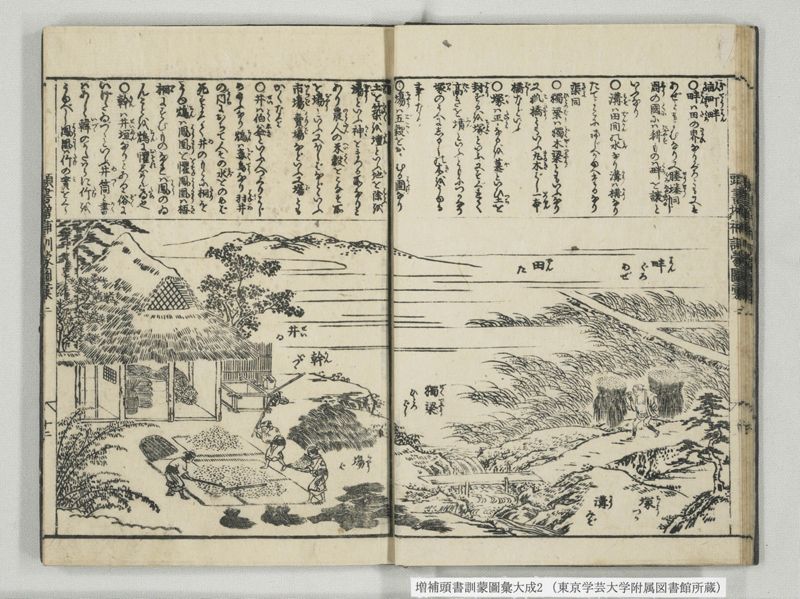
【右丁下段挿絵】
畔(はん)
《割書:ぐろ|あぜ》 塚(ちよう)
《割書:つか|》
溝(かう)
《割書:みぞ|》
田(でん)
《割書:た|》
独梁(どくりやう)
《割書:ひとつ| ばし》
【左丁下段挿絵】
場(ちやう)
《割書:ば|》
幹(かん)
《割書:い| づゝ》
井(せい)
《割書:ゐ|》
現代語訳
【右丁上段】
畝(うね)町(まち)畔(くろ)
○畔(はん)は田の境界である。「くろ」とも「あぜ」とも読む。また塍(くろ)、堘(あぜ)も同じである。周の国では耕作する者は畔を譲ると言う。
○溝(みぞ)は田の間の水路である。溝(こう)は構(こう)である。縦横に交えて構築したものである。渠(きょ)も同じ。
○独梁(ひとつばし)は独木梁(どくぼくりょう)とも言う。また孤橋(こきょう)とも言う。丸木橋、一本橋などと言う。
○塚(つか)は平らなものを墓(ぼ)と言い、土を盛るものを塚(ちょう)と言う。また特に高いものを墳(ふん)と言う。ともに塚である。塚の上に目印の木を植えることである。
○場(ちょう)は五穀を干す畑である。
【左丁上段】
土を築くものを壇(だん)と言い、地を払い清めるものを場(ちょう)と言う。神を祭る所であるとある。農民が米穀を加工する所を場(じょう)と言う。また「ほしば」などと言う。市場(いちば)、売場(うりば)などと言う。また「場(ば)」とも書く。
○井(せい)は伯益という人が作り始めた。鴆(ちん)は毒鳥である。羽が井戸の中に落ちて、人がその水を飲めば死ぬ。そのため井戸のそばに桐を植える。鴆は鳳凰を恐れる。鳳凰は梧桐に住むものなので、鳳凰がいることを鴆に恐れさせるためである。
○幹(かん)は井垣(せいえん)であるとある。俗に「いげたいづつ」と言う。井筒と書くのは良くない。韓(いづつ)のそばに竹を植えるべきである。鳳凰は竹の実を食べる
英語訳
【Right page, upper section】
Une (furrow), machi (town), kuro (ridge)
○Han (ridge) is the boundary of rice fields. It is read as "kuro" or "aze." Also, sho (kuro) and sho (ase) are the same. In the country of Zhou, it is said that those who cultivate yield the ridge.
○Mizo (ditch) is the waterway between rice fields. Ko (ditch) means ko (structure). It is constructed crossing lengthwise and widthwise. Kyo (canal) is the same.
○Hitotsuhashi (single-log bridge) is also called dokubokiryo (single-wood bridge). It is also called kokyo (solitary bridge). It is called maruki bridge (round-log bridge) or ippon bridge (single-log bridge).
○Tsuka (mound): flat ones are called bo (grave), and those with piled earth are called cho (mound). Particularly high ones are called fun (tumulus). All are tsuka. Trees are planted on top of mounds as markers.
○Ba (threshing ground) is a field for drying the five grains.
【Left page, upper section】
Building up earth is called dan (platform), and clearing ground is called cho (place). It is a place for worshipping gods. The place where farmers process rice and grains is called jo (place). It is also called "hoshiba" (drying place). There are ichiba (market) and uriba (sales place). It can also be written as "ba."
○Sei (well) was first created by a person called Hakueki. Chin is a poisonous bird. When its feathers fall into a well and people drink that water, they die. Therefore, paulownia trees are planted near wells. The chin fears the phoenix. Since phoenixes live in paulownia trees, this is to make the chin fear the presence of phoenixes.
○Kan refers to seien (well enclosure). Commonly called "igetaidzutsu." Writing it as "idzutsu" is incorrect. Bamboo should be planted beside the kan (well frame). Phoenixes eat bamboo seeds.