翻刻
【右丁上段】
○日(ひ)は陽(やう)の精(せい)なり空虚(くうきよ)にして
かたどりがたしよつて烏(からす)をもつて日
の形(かたち)とす陽鳥(やうてう)なればなり三 足(そく)と
するは陽数(やうすう)のこゝろなり
○月(つき)は陰(いん)の精(せい)なり空虚(くうきよ)にして
かたどりがたしよつて兔(うさぎ)をもつて月
の形(かたち)とす兔(うさぎ)は陰(いん)の獣(けだもの)なればなり
白兔(はくと)陰(いん)の色(いろ)なり
○北辰(ほくしん)は北極(ほくきよく)ともいふ天(てん)の枢(くろゝ)【注①】なり
一周(いつしう)天のめぐる事 此(この)北辰(ほくしん)を枢(くろゝ)か
なめとしてめぐるなり北(きた)に位(くらい)して
諸(もろ〳〵)の星(ほし)これにむかふ也 北辰(ほくしん)の座(ざ)に
七 星(せい)あり四 星(せい)あり
○列宿(れつしゆく)此星(このほし)天(てん)の東西南北(とうざいなんぼく)に位(くらい)
して四 方(はう)各(おの〳〵)七 星(せい)づゝなり合(あわせ)て二十
八 宿(しゆく)なり是(これ)を三十日にくばりて
毎日(まいにち)をつかさとるなり
【左丁上段】
○晦(くわい)毎月(まいけつ)大なれば三十日小な
れば二十九日を晦(くわい)といふ月 地下(ちか)に
かくれて光(ひかり)なしよつて晦(くわい)の字(じ)
をくらしとよむなり昏晦(こんくわい)暗晦(あんくわい)
のこゝろなり
○朔(さく)は蘇(そ)なりよみがへるとよむ月
は十五日より晦日(つもごり)【注②】までにかけつきて
又 朔日(ついたち)よりよみがへりてはじめて
明(めい)を生(しやう)ずるといふ義(ぎ)にて朔(さく)といふ
○弦(けん)は上十五日を上弦(しやうげん)といひ下十
五日を下弦(げげん)といふ上 弦(げん)は西(にし)の方
下弦(げげん)は東(ひがし)の方(はう)なり上 弦(げん)は七日
八日九日下 弦(げん)は廿二日廿三日廿四日
にあり月の光(ひかり)よこにあり
○望(ばう)は十五日の事なり十五日は
日月 東西(とうさい)にあひ望(のぞ)むゆへに望(ばう)
といふ又もち月ともいふなり日
【注① 「くろろ」は「くるる」の変化した語。】
【注② 「つもごり」は「つごもり」の変化した語。】
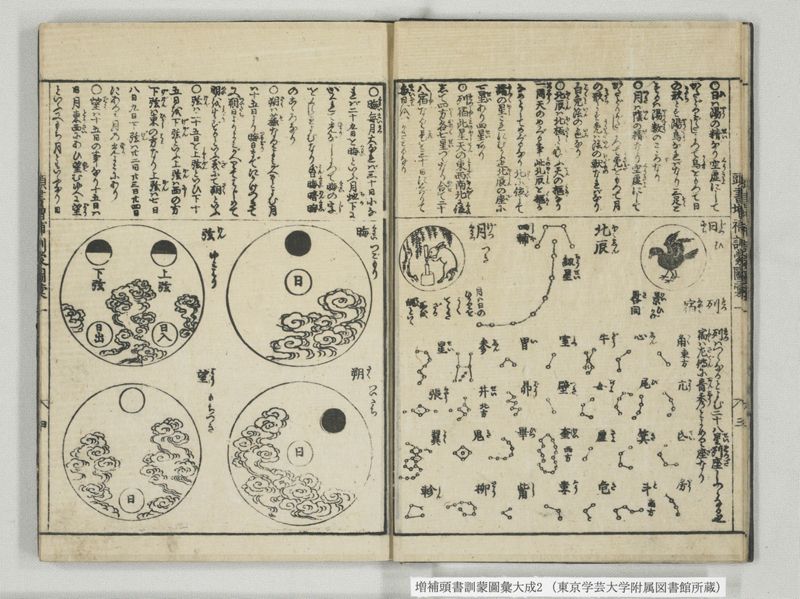
【右丁下段挿絵上部】
日(じつ)【左ルビ:にち】《割書:ひ|》
景(けい)《割書:ひ| かげ》
晷(き)《割書:同|》
北辰(ほくしん)
紉星(ちうせい)
四輔(しほ)
月(げつ)【左ルビ:くわつ】《割書:つき|》
月は日の
ひかりを
うく
てらさ
ざる
所を
魄(はく)といふ
【右丁下段挿絵下部】
列宿(れつしゆく)【横並び】
列(れつ)はつらなるとよむ二十八 星(せい)列座(れつざ)しつらなる也
宿(しゆく)は左伝(さでん)に音秀(おんしう)とよめり座(ざ)なり。
角(かく)《割書:東方|》 亢(かう) 氐(てい) 房(ばう)
心(しん) 尾(び) 箕(き) 斗(と)《割書:南方|》
牛(ぎう) 女(ぢよ) 虚(きよ) 危(き)
室(しつ) 壁(へき) 奎(けい)《割書:西方|》 婁(ろう)
胃(い) 昴(ばう) 畢(ひつ) 觜(し)
参(しん) 井(せい)《割書:北方|》 鬼(き) 柳(りう)
星(せい) 張(ちやう) 翼(よく) 軫(しん)
【左丁下段挿絵、日「太陽」と月が書かれていて月の満ち欠けの原理を示している】
晦(くわい)《割書:つごもり》 朔(さく)《割書:ついたち》
日 日
弦(けん)《割書:ゆみはり》 望(ばう)《割書:もちづき》
上弦 日入
下弦 日出 日
現代語訳
【右丁上段】
○太陽は陽の精気である。空虚で形を表しにくいので、烏(からす)を用いて太陽の形とする。陽鳥(太陽の鳥)だからである。三本足とするのは陽数(奇数)の意味である。
○月は陰の精気である。空虚で形を表しにくいので、兎を用いて月の形とする。兎は陰の獣だからである。白兎は陰の色である。
○北辰は北極ともいい、天の軸である。天が一周回ることは、この北辰を軸の要として回るのである。北に位置して、すべての星がこれに向かっている。北辰の座には七星があり、四星がある。
○列宿:この星は天の東西南北に位置して、四方それぞれに七星ずつある。合わせて二十八宿である。これを三十日に配分して毎日を司るのである。
【左丁上段】
○晦:毎月、大の月なら三十日、小の月なら二十九日を晦という。月が地下に隠れて光がないので、晦の字を「くらし」と読む。昏晦・暗晦の意味である。
○朔は「蘇」で、よみがえると読む。月は十五日から月末まで欠けていき、また一日(朔日)からよみがえって初めて明を生じるという意味で朔という。
○弦:上旬の十五日を上弦といい、下旬の十五日を下弦という。上弦は西の方、下弦は東の方である。上弦は七日・八日・九日、下弦は二十二日・二十三日・二十四日にある。月の光が横になる。
○望は十五日のことである。十五日は太陽と月が東西で向かい合うので望という。また満月ともいう。
【下段挿絵】
太陽・月・北辰・二十八宿の配置と、月の満ち欠けの周期(晦・朔・弦・望)を図示している。
英語訳
【Right page, upper section】
○The Sun is the essence of yang. Being ethereal and difficult to represent in form, a crow is used to symbolize the sun's shape, as it is a yang bird. The three legs represent the concept of yang numbers (odd numbers).
○The Moon is the essence of yin. Being ethereal and difficult to represent in form, a rabbit is used to symbolize the moon's shape, as the rabbit is a yin animal. The white rabbit represents the color of yin.
○Hokushin (North Star) is also called the North Pole and is the pivot of heaven. The complete rotation of heaven revolves around this North Star as its central axis. Located in the north, all stars face toward it. In the constellation of the North Star there are seven stars and four stars.
○Retsu-shuku (Lunar Mansions): These stars are positioned in the east, west, south, and north of heaven, with seven stars in each of the four directions. Together they make twenty-eight mansions. These are distributed over thirty days to govern each day.
【Left page, upper section】
○Kai (New Moon): Each month, if it's a long month it's the 30th day, if it's a short month it's the 29th day that is called kai. The moon is hidden underground with no light, so the character kai is read as "kurashi" (darkness). It means twilight darkness and deep darkness.
○Saku means "revival" and is read as "yomigaeru" (to be reborn). The moon wanes from the 15th day until the end of the month, then revives again from the 1st day (ついたち) and begins to generate light, hence it is called saku.
○Gen (Quarter): The 15th day of the first half is called jōgen (first quarter), and the 15th day of the second half is called gegen (last quarter). The first quarter is in the west, the last quarter is in the east. The first quarter occurs on the 7th, 8th, and 9th days, the last quarter on the 22nd, 23rd, and 24th days. The moon's light appears sideways.
○Bō refers to the 15th day. On the 15th day, the sun and moon face each other from east to west, hence it is called bō (望, to face/look at). It is also called mochizuki (full moon).
【Lower section illustrations】
Diagrams showing the positions of the sun, moon, North Star, and twenty-eight lunar mansions, as well as the lunar cycle phases (kai, saku, gen, bō).