翻刻
【右丁上段】
月 相対(あひたい)して月の光(ひかり)地(ち)の方(はう)に有
て天(てん)になし故(ゆへ)に満月(まんげつ)なり
○日蝕(につしよく)は日月 天(てん)に有て日(ひ)は上(かみ)
なり月は下(しも)なり朔日(ついたち)は日月の
会(くわい)なり日月 上下(しやうか)にありて道(みち)を
同(おなしう)して会(くわい)すれば地(ち)より見(み)るとき
は日は月のためにおほはる是(これ)を日蝕(につしよく)
といふなり
○月蝕(くはつしよく)は月はもと光(ひかり)なし日の
光(ひかり)を受(うけ)て明(あきらか)なるものなり日月
道(みち)を同(おなじう)して相(あひ)むかふ地(ち)は月にあた
るゆへに日の光(ひかり)地(ち)に遮(さへきつて)る【而ヵ】月蝕(ぐはつしよく)す
○星(ほし)は陽精(やうせい)なり陽精(やうせい)日(ひ)となる
日わかれて星(ほし)となる故(ゆへ)に日(ひ)生(しやうず)
とかきて星(ほし)とよむ
○斗(と)は北斗(ほくと)なり七 星(せい)有一二三四
を魁(くわい)とし五六七を杓(ひやう)とす揺光(ようくわう)は
【左丁上段】
破軍星(はぐんせい)なり輔星(ほせい)はそへぼし也
○参星(しんせい)は西方(さいはう)七 宿(しゆく)の一なり俗(ぞく)
に是(これ)をからすきぼしといふ也
星(ほし)の列座(れつざ)からすきに似(に)たり
○昴星(ばうせい)は西方(さいはう)の一 宿(しゆく)なり旄(はう)
頭星(とうせい)ともいふ俗(ぞく)にすばる星(ぼし)と
いふ是(これ)なり星(ほし)の列座(れつざ)間(あひ)せまく
してすばりたり
○牽牛(けんぎう)は星(ほし)の名(な)おたなばたなり
ひこぼしともいふ又 河鼓星(かこせい)とも
いふ七月七日 織女(しよくぢよ)牽牛(けんぎう)に嫁(か)す
と桂陽(けいやう)の武丁(ぶてい)といふ仙人(せんにん)がいひし
より七夕(たなはた)といふ事 始(はじま)れり
○織女(しよくぢよ)は星(ほし)の名(な)めたなばたなり
七月七夕 瓜菓(くは〳〵)を庭上(ていしやう)にそなへ五
色(しき)の糸(いと)を竿(さほ)に掛(かけ)て願(ねか)ふことをいのる
に三 年(ねん)の内(うち)に必(かならず)かなふと也 是(これ)を乞(きつ)
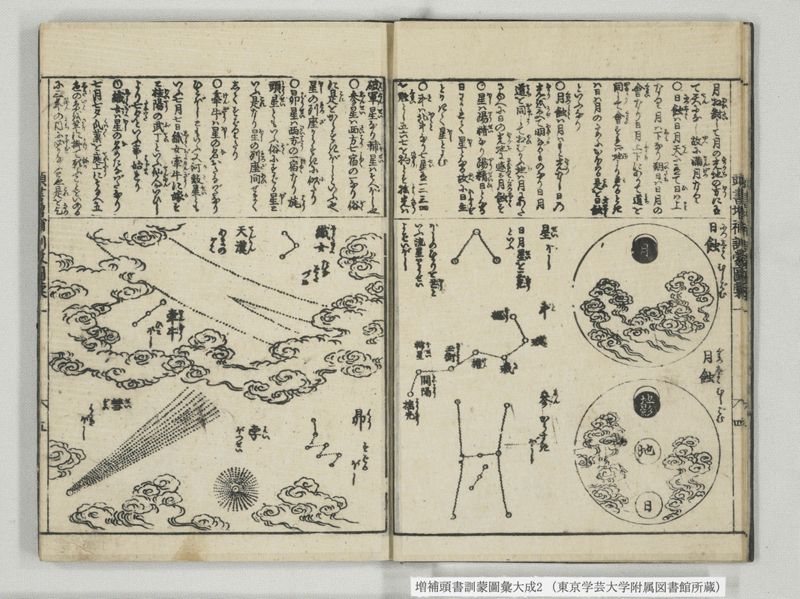
【右丁下段挿絵】
日蝕(につしよく)《割書:むしばむ|》 月蝕(ぐわつしよく)《割書:むしばむ|》
月 地影 地 日
星(せい)《割書:ほし|》
日月 星(せい)を三 光(くわう)
といふ
ほしのひかりを芒(ほう)と
いふ流星《割書:りうせい|》
よばいぼし
斗(と)【北斗七星】
枢(すう) 璇(せん) 璣(き) 権(けん) 玉衝(ぎよくかう) 開陽(かいよう) 揺光(ようくわう) 輔星(ほせい)【「輔星」は開陽ミザールの伴星アルコル】
参(しん)《割書:からすき| ぼし》【オリオン座の三ツ星】
【左丁下段挿絵】
織女(しよくぢよ)《割書:たな| ばた| づめ》
天漢(てんかん)
《割書:あまの| がは》
牽牛(けんぎう)
《割書:ひこ| ぼし》
昴(はう)《割書:すばる| ぼし》
孛(はい)
《割書:ぼつせい|》
彗(せい)【左ルビ:ずい】
《割書:はゝき| ぼし》
現代語訳
【右丁上段】
月と相対して、月の光が地球の方向にあって天にはないため、満月となる。
○日食は、太陽と月が天にあって、太陽が上、月が下にある。朔日は太陽と月の会合である。太陽と月が上下にあって同じ軌道で会合すれば、地上から見るときは太陽が月によって覆われる。これを日食という。
○月食は、月はもともと光がなく、太陽の光を受けて明るくなるものである。太陽と月が同じ軌道で向かい合うとき、地球が月に当たるため、太陽の光が地球に遮られて月食する。
○星は陽の精気である。陽の精気が太陽となり、太陽が分かれて星となる。故に「日」と「生」と書いて「星(ほし)」と読む。
○斗は北斗である。七つ星があり、一・二・三・四を魁(ます)とし、五・六・七を杓(ひしゃく)とする。揺光は
【左丁上段】
破軍星である。輔星は添え星である。
○参星は西方七宿の一つである。俗にこれを「からすき星」という。星の配列が唐鋤に似ている。
○昴星は西方の一宿である。旄頭星ともいう。俗に「すばる星」というのがこれである。星の配列が密集していて、すばっている(密集している)。
○牽牛は星の名前で、「おりひめ・ひこぼし」の「ひこぼし」である。また河鼓星ともいう。七月七日に織女が牽牛に嫁ぐと、桂陽の武丁という仙人が言ったことから七夕という行事が始まった。
○織女は星の名前で、「おりひめ・ひこぼし」の「おりひめ」である。七月七夕に瓜や果物を庭に供え、五色の糸を竿に掛けて願い事を祈ると、三年のうちに必ず叶うという。これを乞
【下段挿絵】
日食・月食の原理、星座(北斗七星、参星、昴星)、七夕の織女と牽牛、彗星などを図示している。
英語訳
【Right page, upper section】
The moon faces [the sun], and the moon's light is directed toward the earth with none toward heaven, thus creating a full moon.
○Solar eclipse occurs when the sun and moon are in heaven, with the sun above and the moon below. The new moon day is when the sun and moon meet. When the sun and moon are positioned above and below on the same path and meet, as seen from earth, the sun is covered by the moon. This is called a solar eclipse.
○Lunar eclipse occurs because the moon originally has no light and becomes bright by receiving the sun's light. When the sun and moon face each other on the same path, the earth blocks the moon, so the sun's light is obstructed by the earth, causing a lunar eclipse.
○Stars are yang essence. Yang essence becomes the sun, and the sun separates to become stars. Therefore, writing "sun" (日) and "birth" (生) together is read as "star" (星).
○The Dipper is the Big Dipper. It has seven stars: the first through fourth are called the "bowl" (魁), and the fifth through seventh are called the "handle" (杓). Yōkō is
【Left page, upper section】
the Army-Breaking Star. The Auxiliary Star is a companion star.
○Shin-sei (Orion's Belt) is one of the seven western mansions. Commonly, this is called the "plow star." The arrangement of stars resembles a Chinese plow.
○Bō-sei (Pleiades) is one of the western mansions. It is also called Bōtō-sei. This is what is commonly called the "Subaru star." The stars are closely arranged and clustered together.
○Kengyū is the name of a star, the "Hikoboshi" of the Orihime-Hikoboshi legend. It is also called the River Drum Star. The Tanabata festival began from when the immortal Butei of Keiyō said that on July 7th, Shokujo (Weaver Girl) marries Kengyū.
○Shokujo is the name of a star, the "Orihime" of the Orihime-Hikoboshi legend. On the seventh day of the seventh month (Tanabata), offerings of melons and fruits are placed in the garden, five-colored threads are hung on poles, and prayers are made; it is said that wishes will surely be granted within three years. This is called "begging for skills"
【Lower section illustrations】
Diagrams showing the principles of solar and lunar eclipses, constellations (Big Dipper, Orion's Belt, Pleiades), the Tanabata stars Shokujo and Kengyū, and comets.