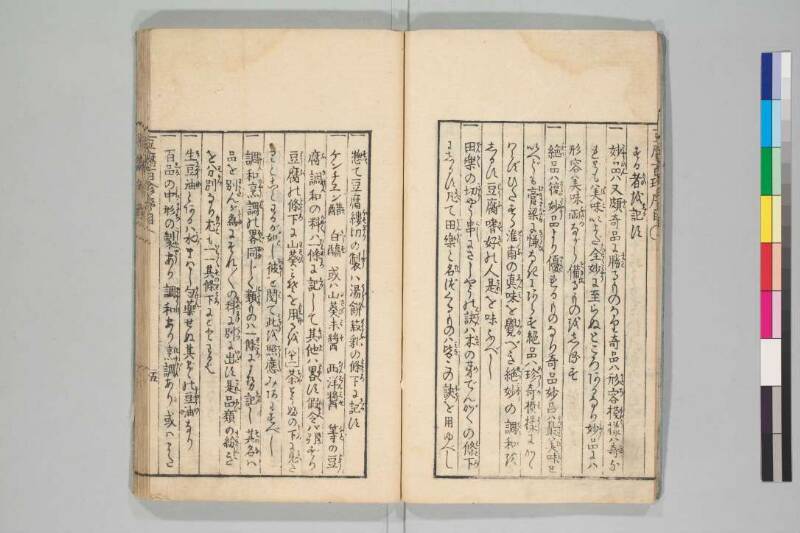
翻刻
【右丁】
する者(もの)を記(しる)す
一 妙品(みやうひん)は又 頗(やゝ)奇品に勝(まさ)るものなり奇品は形容(かたち)模様(もやう)は奇(き)な
れとも美味(びみ)いまだ全(まつたく)妙(みやう)に至らぬところあるなり妙(みやう)品には
形容美味 両(ふたつ)ながら備(そなは)るものをしるす
一 絶(ぜつ)品は復(また)妙(みやう)品より優(まさ)れるものなり奇品妙品は最(もつとも)美味(びみ)と
いへども膏梁(むますぎる)に慊(きらひ)なきにあらす絶品は珍奇(めつらか)模様(もよう)にかゝ
はらずひたすら淮南(とうふ)の真味(しんみ)を覚(しる)べき絶妙(ぜつみやう)の調和(てうみ)を
しるす豆腐(とうふ)嗜好(すき)の人 是(これ)を味ふべし
一 田楽(でんがく)の切(きり)やう串(くし)にさしやうの訣(くてん)は木(き)の芽(め)でんがくの條下(ところ)
にしるす凡(すべ)て田楽(でんがく)と名(な)づくるものは皆(みな)この訣(ほう)を用ゆべし
【左丁】
一 惣(すべ)て豆腐 縷切(ほそぎり)の製(しやう)は湯餅菽乳(うどんとうふ)の條下(ところ)に記(しる)す
一 ケンチヱン醋(す) 白醯(しらす) 或は山葵未醤(わさびみそ) 西洋醬(なんばんみそ) 等(など)の豆(とう)
腐(ふ)調和(かげん)の料(かやく)は一條(ひとところ)に記(しる)して其他(そのよ)は略(りやく)す仮令(たとへ)ば引(ひき)ずり
豆腐(とうふ)の條下(ところ)に山葵(わさび)みそを用(もちゆ)るを[八十二]茶(ちや)とうふの下(ところ)に見(みへ)た
りとことわるが如(こと)し彼(あちら)を閲(み)て此(こちら)を照応(てらし)みあわすべし
一 調和(かげん)烹調(りやうり)の略(ほゞ)同(おな)じく類(にたる)のものは一 條(ところ)によせ記(しる)し其名(そのな)は
品を別(わかた)んが為(ため)にそれ〳〵の科(しなわけ)に別(べつ)に出(いだ)す是(これ)品類(るい)の紛(まきらはし)き
を分別(わかつ)なり尤(もつと)も一一(いち〳〵)其條下(そのところ)にことわる也
一 生豆油(きしやうゆ)とあるは水(みづ)まはし勺薬(かげん)せぬ其まゝの豆油(しやうゆ)なり
一 百 品(しな)の中(うち)形(かたち)の製(こしらへやう)あり調和(りやうり)あり烹調(にかげん)あり或はまた
現代語訳
【右丁】
するものを記す。
一 妙品は奇品よりもややすぐれたものである。奇品は形や模様は奇抜であるが、美味はまだ完全に妙なる域に達していないところがある。妙品には形・美味の両方を備えたものを記す。
一 絶品はさらに妙品よりも優れたものである。奇品・妙品は最も美味とはいっても、脂っこすぎて嫌でないわけではない。絶品は珍奇な模様にこだわらず、ひたすら豆腐の真の味を知ることができる絶妙な調理法を記す。豆腐を愛好する人はこれを味わうべきである。
一 田楽の切り方、串への刺し方の秘訣は木の芽田楽の条のところに記す。すべて田楽と名づけるものは皆この方法を用いるべきである。
【左丁】
一 すべての豆腐の細切りの製法は湯餅豆腐の条のところに記す。
一 ケンチエン酢、白酢、あるいは山葵味噌、南蛮味噌などの豆腐調理の調味料は一箇所に記してその他は省略する。例えば引きずり豆腐の条で山葵味噌を用いることを「八十二茶豆腐のところを見よ」と断るようなものである。あちらを見てこちらと照らし合わせて見るべきである。
一 調理法・料理法がほぼ同じで類似のものは一箇所にまとめて記し、その名前は品を区別するためにそれぞれの分類に別々に載せる。これは品種の紛らわしさを区別するためである。もっとも一つ一つその条のところで断っている。
一 「生醤油」とあるのは水で薄めず調整していないそのままの醤油のことである。
一 百品の中には形の作り方があり、調理法があり、煮加減があり、あるいはまた
英語訳
【Right page】
are recorded.
1. Exquisite dishes are somewhat superior to rare dishes. While rare dishes may be unusual in form and appearance, their flavor has not yet reached the realm of complete excellence. For exquisite dishes, those that possess both beautiful form and flavor are recorded.
1. Supreme dishes are even more excellent than exquisite dishes. Although rare and exquisite dishes are considered most delicious, they are not without the fault of being too rich. Supreme dishes do not concern themselves with unusual appearances, but record absolutely exquisite cooking methods through which one can know the true flavor of tofu. Those who love tofu should taste these.
1. The secrets of how to cut dengaku and how to skewer it are recorded in the section on kinome dengaku (wood bud dengaku). All dishes named dengaku should use this method.
【Left page】
1. All methods for finely cutting tofu are recorded in the section on yumochi-dofu (noodle tofu).
1. Seasonings for tofu dishes such as kenchien vinegar, white vinegar, or wasabi miso, nanban miso, etc., are recorded in one place and others are omitted. For example, just as we note that wasabi miso used in hikizuri-dofu can be "seen in item eighty-two, cha-dofu." One should look at that section and compare it with this one.
1. Those with similar seasoning and cooking methods are grouped together and recorded in one place, but their names are listed separately in their respective categories to distinguish the varieties. This is to differentiate confusing similarities between types. Of course, each is explained in its respective section.
1. "Raw soy sauce" refers to soy sauce that has not been diluted with water or adjusted in any way.
1. Among the hundred varieties, there are methods for shaping, seasoning, cooking temperatures, and also