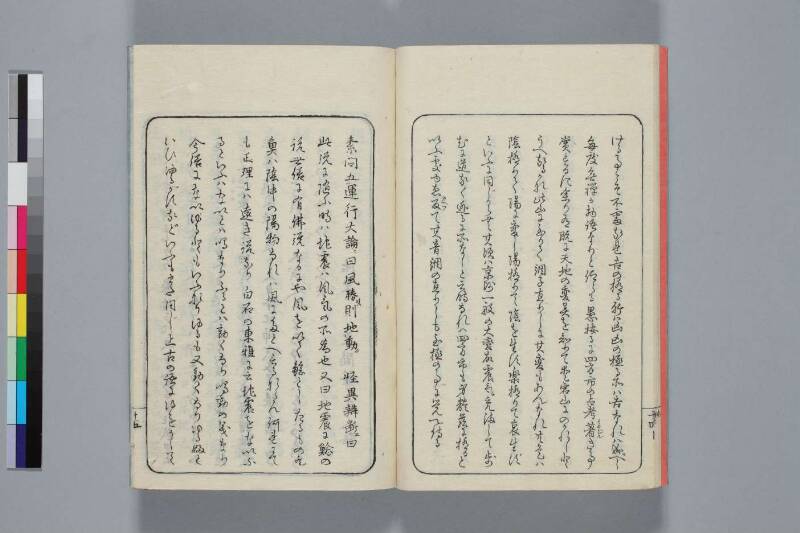
翻刻
ける事こそ不審なれ吉の極る所は凶凶の極る所は吉なれは成べし
毎度無禅か物語なりと仰らる愚按るに四方市の占考 著(いちじる)き事
賞するに余り有既に天地の変異を知りて愛宕山にのかれしと
うへなるかな此山に至りて調子直りしに其変もあんなれ共是は
陰極りて陽に変し陽極りて陰を生す楽極りて哀生ず
といふに同じからむ其頃京師一般の大変故震気充満して歩
むに道なく逃るに所なしと云時なれは四方市も身体茲に極ると
いふ処ゆゑ反(かへつ)て其音調の直りしも至極の事に覚へ侍る
素問五運行大論 ̄ニ曰風勝 ̄オハ則地ー動 ̄ク怪異弁断 ̄ニ曰
此説に随ふ時は地震は風気の所為也又曰地震に鯰の
説世俗に有仏説なるにや風を以て鯰としたるもの歟
魚は陰中の陽物なれは風にたとへ言るならん何れにて
も正理には遠き説なり白石の東雅に云地震をな い(ママ)ふ
るといふはないとは鳴なりふるとは動くなり鳴動の義なり
今俗にないゆるともいふなりゆるも又動くなりゆるふと
いひゆるがすなどいふもまた同じ上古の語にゆをにて
現代語訳
たことこそ不審である。吉の極まる所は凶であり、凶の極まる所は吉であるからそうなるのだろう。毎度無禅(むぜん)の物語である、と仰られる。愚考するに、四方市の占い考察は著しいものがあり、賞賛するに余りある。既に天地の変異を知って愛宕山に逃れたとは、なんと優れたことか。この山に至って調子が直ったのに、その変事もあったのは残念だが、これは陰が極まって陽に変じ、陽が極まって陰を生じ、楽が極まって哀しみが生ずるということと同じであろう。その頃は京都一帯の大変事故、震気が充満して歩むに道なく、逃げるに場所なしという時であったから、四方市も身体がここに極まるという処ゆえ、かえってその音調が直ったのも至極当然のことと思われる。
『素問』五運行大論に曰く「風勝れば則ち地動く」と。『怪異弁断』に曰く、この説に従う時は地震は風気の所為である、また曰く、地震に鯰の説が世俗にある。仏説なのか。風を以て鯰としたものか。魚は陰中の陽物であるから風に例えて言うのであろう。いずれにしても正理には遠い説である。白石の『東雅』に言う、地震を「ないふる」というのは、「ない」とは鳴ることであり、「ふる」とは動くことであり、鳴動の義である。今俗に「ないゆる」とも言う。「ゆる」もまた動くことである。「ゆるふ」と言い「ゆるがす」などと言うのもまた同じである。上古の語に「ゆ」を「に」て
英語訳
This is indeed suspicious. Where good reaches its extreme is misfortune, and where misfortune reaches its extreme is good fortune, so it must be thus. "This is always a tale of meaninglessness," he says. In my humble consideration, Shikata-ichi's divinatory observations were remarkable, worthy of excessive praise. That he already knew of the heaven and earth's anomalies and escaped to Mount Atago was truly excellent! When he reached this mountain and his condition improved, it was regrettable that the disaster still occurred, but this would be the same as the principle that when yin reaches its extreme it transforms into yang, when yang reaches its extreme it gives birth to yin, and when joy reaches its extreme, sorrow is born. At that time, there was a great calamity throughout the capital, so the earthquake energy was overflowing, there was no road to walk on, and no place to escape to. Since Shikata-ichi's body had reached its extreme at this place, conversely, it seems quite natural that his acoustic condition improved.
The "Suwen" Five Phases Theory states: "When wind prevails, the earth moves." The "Strange Phenomena Discrimination" states that according to this theory, earthquakes are the work of wind energy. It also states that there is a folk belief about catfish causing earthquakes. Is this a Buddhist teaching? Did they use wind to represent the catfish? Since fish are yang creatures within yin, they are probably spoken of as analogous to wind. In any case, these are explanations far from true principle. Hakuseki's "Tōga" states that calling earthquakes "naifuru" means that "nai" refers to sound and "furu" refers to movement, meaning rumbling motion. Now common people also say "naiyuru." "Yuru" also means to move. Saying "yurufu" and "yurugasu" are also the same. In ancient language, "yu" was written as "ni"...